Name/Title
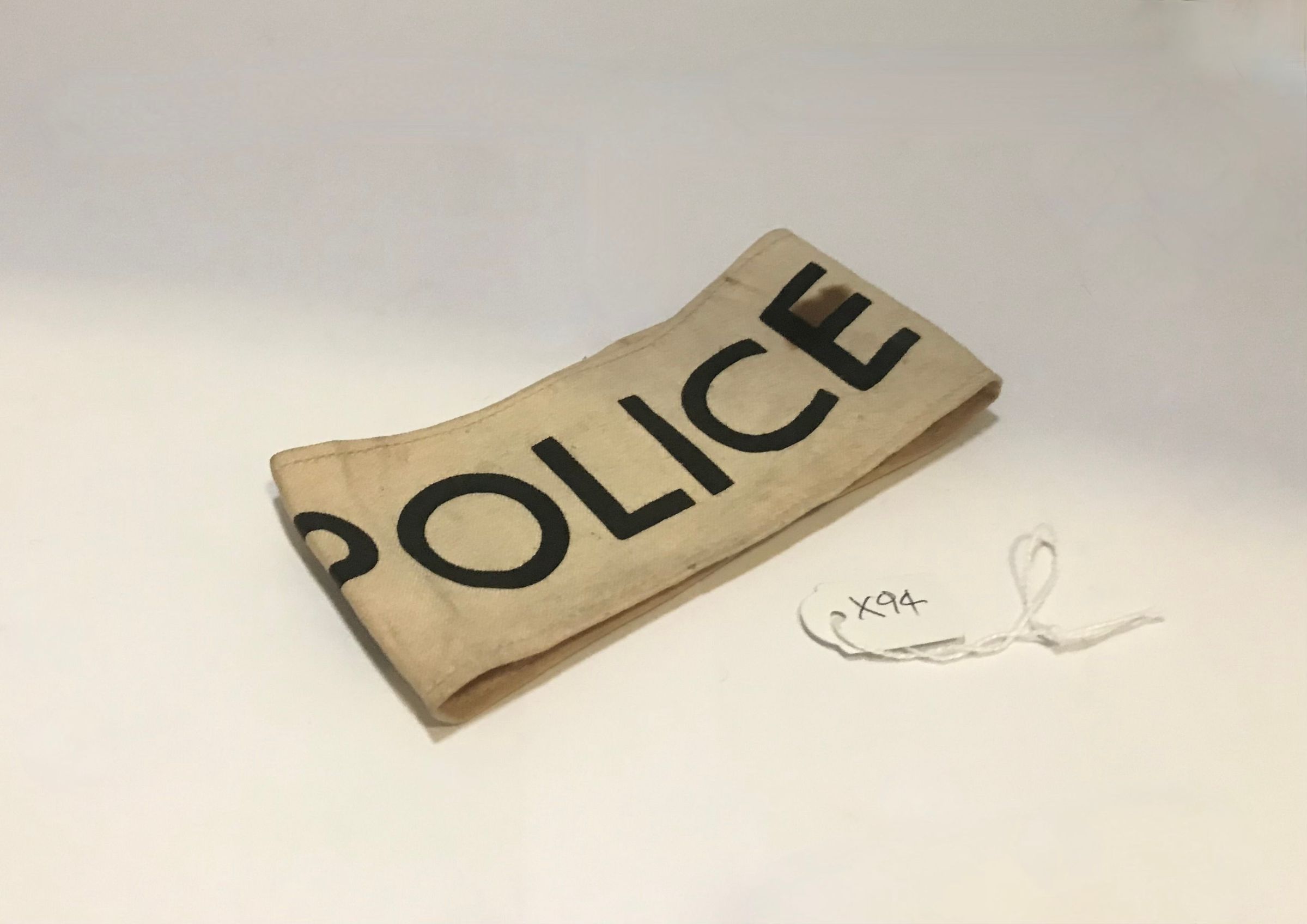
East Sussex Constabulary "POLICE" armband 1940Entry/Object ID
94Description
White/beige coloured cotton armband with stencilled "Police" marking, and on reverse rubber date stamped mark, "East Sussex Constabulary, Bexhill Division, Superintendent's Office, 30 Aug 1940"Use
For use by a Special Constable or War Reserve Constable, when no uniform was available.Context
As early as 1937 East Sussex Constabulary began recruiting additional Special Constables as part of nationwide preparations in case of a war with Germany. A First Police Reserve was formed in June 1939, as had been in during the First World War, with 37 Reserve Constables appointed on the outbreak of war in September. A further 78 were later recruited. More Special Constables and War Reservists were recruited throughout the war and this included The Women's Auxilary Police Corps and The Police Auxiliary Messenger Service (made up of girls between the ages of 17-18)(Kyrke 1969)
All of these volunteers helped to maintain police numbers as more regular officers were called up to serve in the armed services, many of whom had previously been servicemen and were therefore on the military reserve lists.
In April1943 under The Defence Regulations, all of the Sussex Police forces were amalgamated to form the wartime Sussex Police Force. This was to make the best use of the available resources and equipment, against a backdrop of fewer regular officers and no recruitment. This combined Sussex Police Force continued to Police Sussex until 1947, when all of the pre war forces become independent, again with the exception of Hove Borough, which was absorbed into East Sussex Constabulary. The wartime Sussex Police Force, did not have any of its own insignia and all of the officers used the uniforms and insignia of their parent forces.
This armband dated 1940 would have been for the use of a war reservist or special constable, before a uniform was available for them. They would have initially been equipped with this, a steel helmet, a truncheon, and a service gas mask, with handcuffs being given only to the reservists (Kyrke 1969). It is interesting that this item has been marked with an office date stamp, perhaps all that was available at the time, showing an urgent need to identity mark scare equipment as soon as it arrived on a Division.