Name/Title
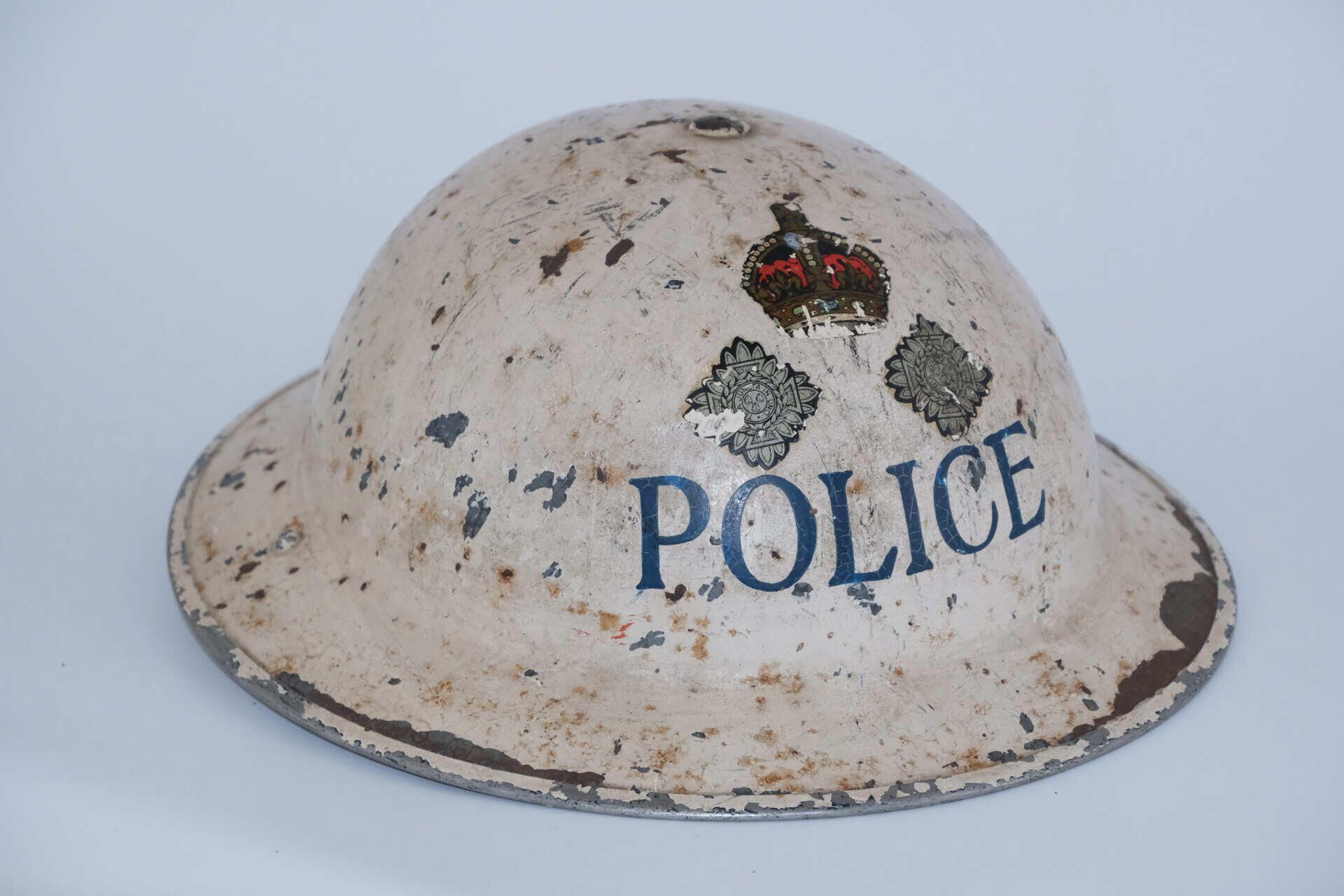
East Sussex Constabulary senior officer's steel helmet c1938Entry/Object ID
1219Description
White painted Mark II "Brodie" Style steel helmet, with stencil painted "Police" in blue and transfer printed rank insignia of a King's Crown and two pips or Bath Stars. The webbing chinstrap has stencil marked "East Sussex Police' and "CC". The helmet is stamped under the rim, "GC8" then indistinct lettering possibly "MB" or "MR" followed by "19. The liner is clearly marked "VERO I 1938". The helmet may originally have been blue and later painted white as there appear to be traces of darker paint but it is not known for certain.Use
To be worn on the Home Front by police in World War Two as protection, especially during air raids.Context
By the late 1930s civil defence preparations were quite advanced because of the threat of war with Germany and in 1938 and 1939 police officers were issued with gas masks and steel helmets for protection in the event of German air raids and gas attacks. These helmets were of identical construction to those issued to the armed services. Most officers were issued with blue painted helmets with white stencilled lettering and then after September 1940, some more senior ranks were issued with white helmets with dark lettering and transfer printed rank insignia. The white helmets are scarcer. Most police steel helmets have the type of font shown here, though there are some, possibly later examples, that have a transfer printed square font.
The chinstrap marking on this helmet indicates that it was issued to East Sussex Constabulary. The "C.C" could be for 'County Constabulary", however the museum has at least one ordinary other ranks blue steel helmet, which only has the "East Sussex Police" mark on the strap.The liner markings appear to date the helmet to 1938, and show the liner was made by "Everett W. Vero & Co". of London, who made liners between 1937 and 1944. The indistinct markings under the rim relate to the helmet maker and date of manufacture. Of the known makers, the most likely manufacturer's stamps on this helmet are "BMB" for "Briggs Motor Bodies Ltd" or "HBH" for "Harrison Brothers and Howson'"
The rank insignia on this helmet of a crown and two pips is unusual, as it designates a chief superintendent, a rank that technically did not exist until after the war. In 1949 the Metropolitan Police regraded a number of its middle ranking officers and created the new rank of chief superintendent. Other police forces subsequently adopted the rank but they only used one pip (in the Met the crown rank insignia was used to designate a chief inspector until 1953, elsewhere it designated a superintendent). In 1953 two grades of superintendent were introduced, and two pips were used outside of London, to designate a chief superintendent for the first time. However in 1939 East Sussex Constabulary only had six superintendents, with only the Chief Constable more senior, and they would have used a crown rank insignia.
This means that either this pre war produced helmet, had additional insignia added to it after 1953 or it reflects an earlier usage of the crown and two pips insignia, before it was adopted for chief superintendents. If it was reused in the 1950s, it would have been for Cold War civil defence preparations, possibly on "Mobile Columns", large mobile units of police expected to work independently in the aftermath of a nuclear attack. However research suggests that by then the government had stockpiles of the newer Mk4 "turtle shell" helmets, suitably marked, in storage for police use.
The solution to the puzzle is that prior to the Second World War there was no nationally recognised system of chief officer rank insignia, for either chief constables, or in the forces that had them, the ranks of assistant chief constable or deputy chief constable. Despite the fact that recommendations were made by the Home Office in 1934 to standardise other police ranks, the question of ranks for chief officers was left. This meant that effectively the 179 county and borough police forces at the time, could chose whatever insignia they wanted and at least one county chief constable was using insignia that appeared to make him more senior than the commissioner of the Metropolitan Police.
The outbreak of war highlighted the need for uniformity at a time when police forces were working more closely with each other and other agencies, especially the military. So in April 1941 it was decided that the national rank insignia for a chief constable would be a laurel wreath with tip staves surmounted by a crown. The insignia for an assistant chief constable was to be two Bath stars surmounted by a crown (as on our helmet) and that for a deputy chief constable (at the time a rank less senior than an assistant chief constable) was to be one Bath star surmounted by a crown.
So the museum white helmet was intended for an officer of the rank of assistant chief constable sometime after April 1941. East Sussex Constabulary appointed its first ACC, in October 1943, Mr James Edward Bailey and it is likely that this helmet was intended for him.
On 1st April 1943 under the Defence Regulations, all of the Sussex Police forces were amalgamated to become part of the wartime "Sussex Police Force". This was to make best use of the available officers and resources. Many regular officers were serving with the armed forces and there were no replacements, their numbers being supplemented by special constables and war reservists. Mr Bailey retained the rank of assistant chief constable in command of the East Sussex Division of the combined Sussex Police. A new chief constable Mr Ferguson was appointed to lead the Sussex Force and the chief constables of the other Sussex Forces were all appointed assistant chief constables. So for the duration of he war a number of other officers in Sussex were entitled to wear this rank insignia. The amalgamation lasted until 1947.
After the war in the late 1940s the issue of national chief officer insignia was re-visited and the rank of deputy chief constable made senior to deputy. At the same time the insignia for these ranks was changed to include wreaths with tip staves, bringing it closer to the current model, the crown with two or one pip combination no longer being used for these ranks.