Name/Title
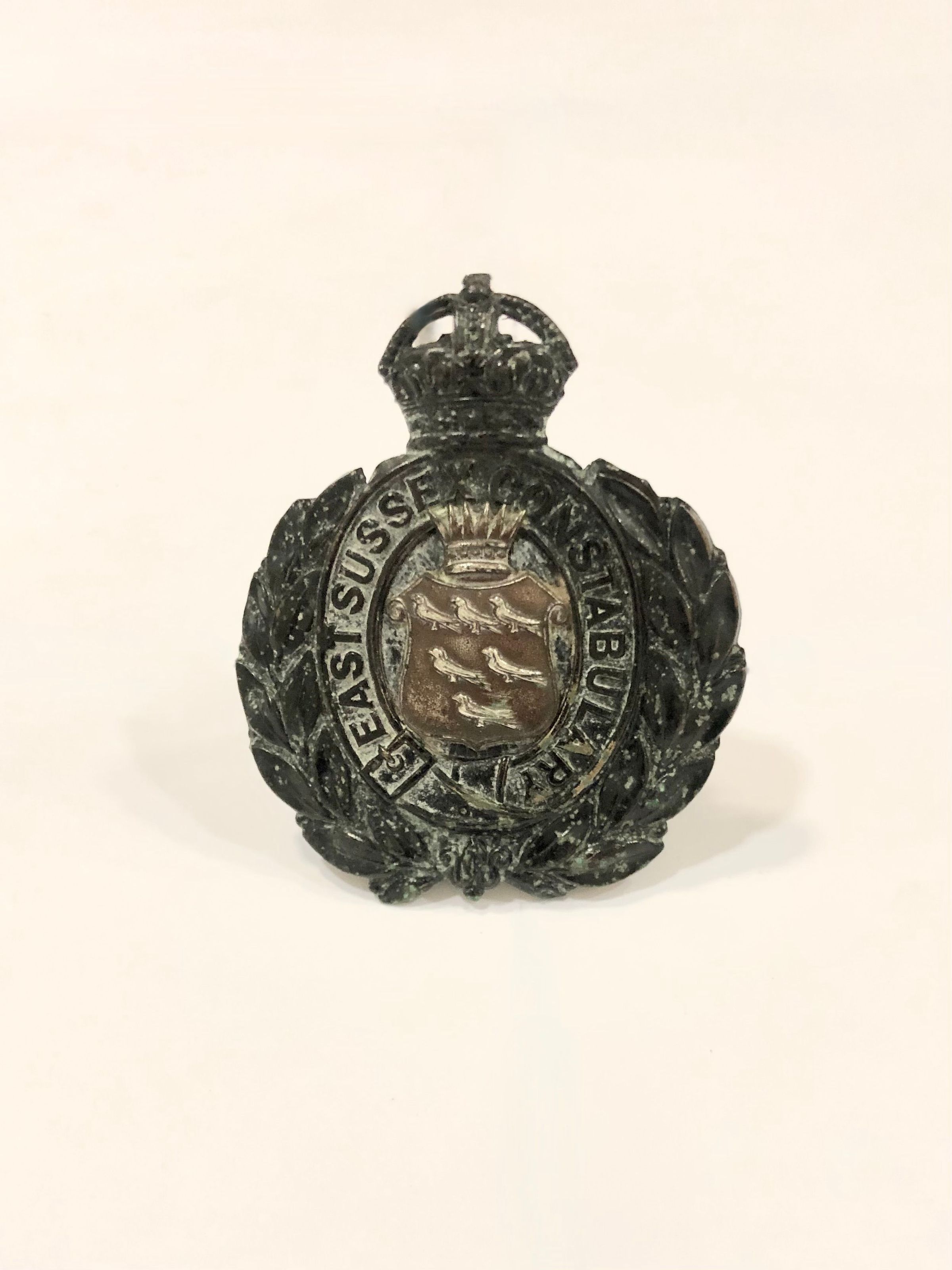
East Sussex Constabulary superintendent's black helmet plate c1902-1921Entry/Object ID
2251Description
Black painted or blackened King's Crown helmet plate, of laurel leaf and garter design, marked inside garter "East Sussex Constabulary" with separate East Sussex shield coat of arms insert, mounted on leather and metal plates. The shield insert appears to have been coated in a bronze coloured metal. Both badge and the insert are heavily worn.Use
For use on an East Sussex Constabulary superintendent's police helmet.Context
The use of the King's or Imperial Crown on this helmet plate dates it from 1902 until 1922, and it is of a wreath style. During this period constables wore black badges similar to this but with white metal inserts and sergeants all white metal versions. However the use of what appears to be a bronze coloured insert on this particular example suggests that it may have been for use by a superintendent. From 1889, East Sussex Constabulary superintendents (there were no other supervisory ranks above a sergeant until 1919), were required to wear helmets for certain ceremonial occasions, and it appears that they were issued with both black and white metal wreath helmet badges with a Victorian crown and a bronze coloured shield centre. This was most likely to be able to distinguish them from sergeants, who wore all white metal badges. It is not know why both black and white metal badges with these bronze inserts were produced, but both types exist from the 1889-1901 period.
This badge suggests that the use of bronze centred helmet plates for superintendents continued after 1902 and the introduction of badges with King's Crowns following the death of Queen Victoria. It is difficult to be certain, as the few occasions when superintendents in the county wore helmets means there are few photographs.
East Sussex Constabulary stopped using helmets in 1921 following the appointment in 1920 of a new Chief Constable, Lt. Col. George Ormerod, and adopted uniform caps for all ranks ( Kyrke 1968). It was only in October 1954 that helmets were re-introduced in the East Sussex force and again black helmet plates were used for both day and night use, this time for all ranks. These badges were no longer of a wreath style but instead that of a Brunswick Star.