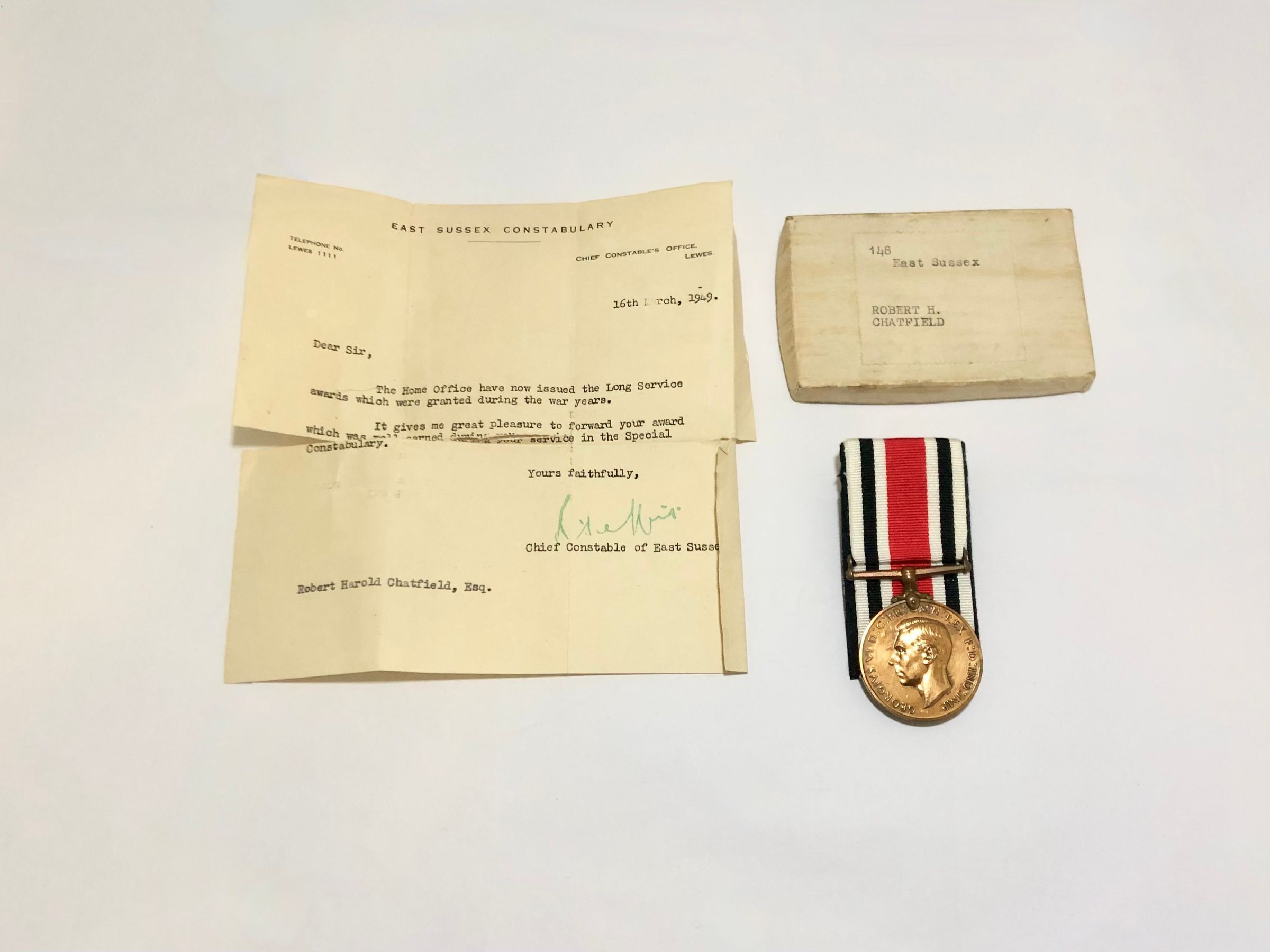
East Sussex Special Constabulary Long Service Medal presented in 1949 to Robert Chatfield for wartime service
East Sussex Special Constabulary Long Service Medal presented in 1949 to Robert Chatfield for wartime service

East Sussex Special Constabulary Long Service Medal presented in 1949 to Robert Chatfield for wartime service

Name/Title

East Sussex Special Constabulary Long Service Medal presented in 1949 to Robert Chatfield for wartime service

Entry/Object ID

382

Description

Small white card box, with mounted King George VI Special Constabulary Long Service medal and ribbon, together with presentation letter. The box is marked "148 East Sussex Robert H. Chatfield" and the rim of the medal is inscribed "Robert H. Chatfield".

Use

For awarding to a special constable with 9 years service or three year's war service

Context

The Special Constabulary Long Service medal was first instituted in 1919, as the Special Constabulary Medal, to acknowledge the contribution made by members of the special constabulary during the First World War. It was later change to the Special Constabulary Long Service Medal and awarded to recognise 9 year's service. In addition claps are awarded to the medal ribbon for additional periods of service. Initially this was for every ten years but in 2022 it was reduced to 5 years. Service during World War Two was tripled. This particular medal was awarded in 1949 to Robert Harold Chatfield who served as a special constable in East Sussex Constabulary. The accompanying letter from Reginald Breffit, the chief constable of East Sussex Constabulary explains that the medal was for service within the special constabulary during the war. Large numbers of additional special constables, together with war reserve officers were recruited before and during the war, to replace regular police officers who were called up to serve in the military. As wartime service years counted as normal triple service Mr Chatfield would have served at least three years as a special to qualify for the medal. Because of the war many medals were not actually presented until sometime after they were actually awarded, which appears to be the case here. Research shows that a Robert Harold Chatfield was a taxi driver in Lewes and died in 1954. He may have been the same person that was awarded the medal.