Name/Title
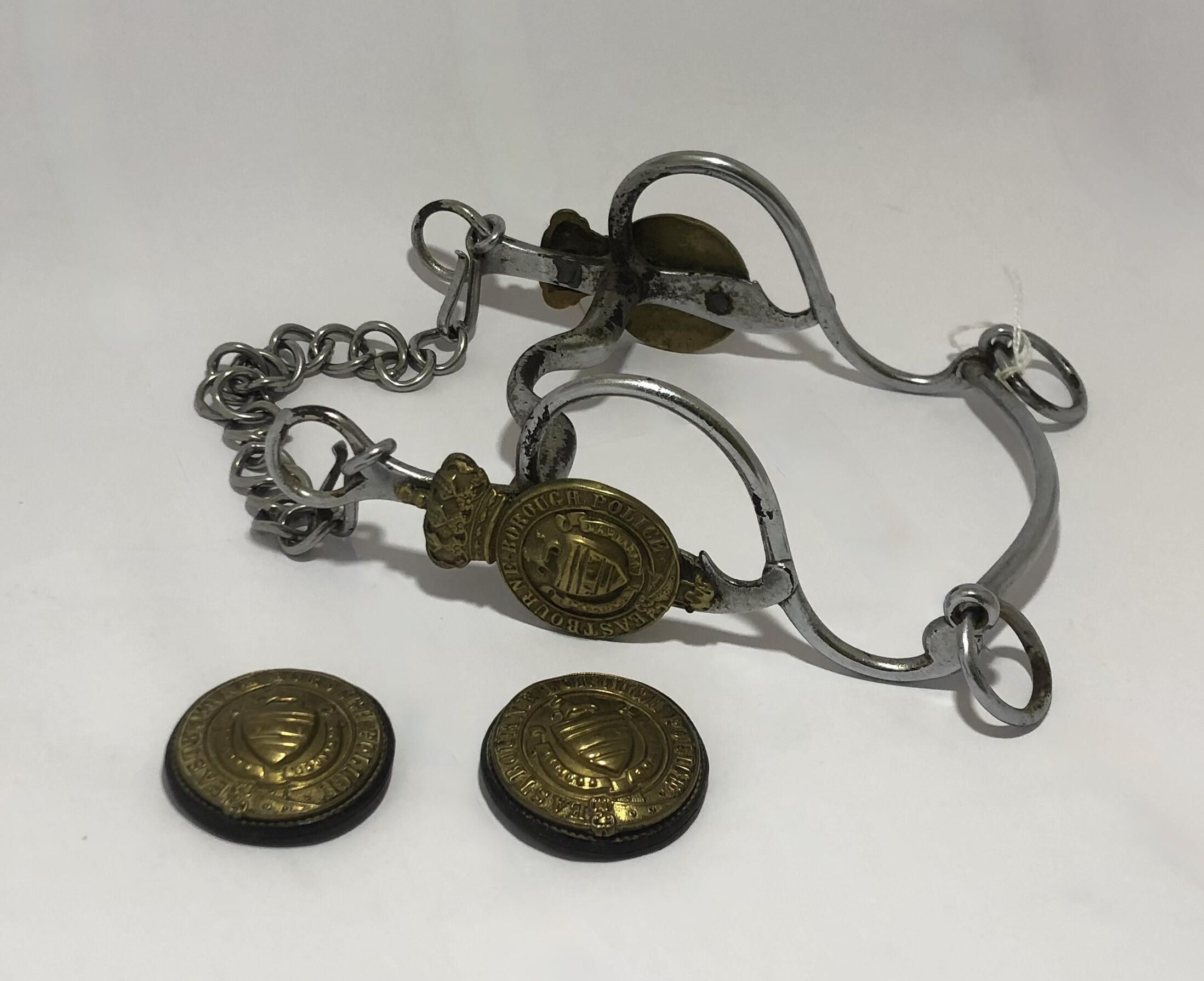
Eastbourne Borough Police horse bit and bridle fittings c1891-1928Entry/Object ID
2316Description
Chrome plated steel horse bit with two cast brass badges attached each side, with coat of arms centres and topped with Victorian style crowns, marked "Eastbourne Borough Police". Also included are two brass die stamped roundels with coat of arms centres, also marked "Eastbourne Borough Police", attached to brown leather backs with strap loops for attaching to a leather bridle. The coat of arms used on all of the badges is the same and was in use until 1928 when the Borough of Eastbourne adopted a different version. No marker's marks.Use
For attaching to a horse bridle, to both control the animal and give additional decoration.Context
From its formation in 1891 Eastbourne Borough Police regularly used mounted officers and the earliest group photograph of the force from April/May 1891 unusually shows a number of officers wearing riding boots and armed with swords. This probably reflects the use of mounted officers to help deal with the disorder that occurred in the town as a result of the Salvation Army marching with a band on Sundays. These marches and the demonstrations against them led to large scale disorder both prior to the formation of the Force and during its early years.
As was common practice at the time the Borough Police did not actually own their own horses but hired them, as and when required. This would not only have been for the Salvation Army demonstrations but for official visits, including those by the Royal family, Edward VII being a frequent visitor to the town before and after he came to the throne. However the Police Force did possess its own horse tack and as many as 6 sets are believed to have been purchased in the 1890s.
Mounted officers continued to be used regularly in Eastbourne until at least the late 1920s. In 1929 the Borough Council took ownership of a large area of Downland around Beachy Head, in order to prevent development. To police this area the unique post of Downs Ranger was created, a full time mounted officer of Eastbourne Borough Police based at a stable at Beachy Head, using a horse owned by the force (see item 2205). By this time the use of horses by the Borough Force had declined and the Downs Ranger became the only mounted officer in Eastbourne. The role survived the 1968 amalgamation into Sussex Constabulary but was ended in 1974, with the establishment of the Sussex Constabulary/Sussex Police mounted unit based at Brighton.
The bit and bridle fittings pictured date to pre 1928, when the Eastbourne Borough coat of arms was changed, and after which the Borough Police badges used the name "Eastbourne County Borough Police". The crowns used on the bit are of a Victorian style and these fittings may well date to the 1890s and even be some of the original tack purchased by the Force. The full set would have included a leather breast plate with a cast badge and crown, of at least one is known to have survived. These particular fittings are known to have been moved to the stables at Brighton Police station in John Street, when the last Downs Ranger, Jack Williams was transferred to the mounted unit based there in 1974. They together with a pair of stirrups (item 2317) also from Eastbourne, were rescued by mounted officer Bob Bird when the unit was disbanded in 1989.
Most photographs of the horses used by the Downs Rangers show plain tack and bridles being used. However there is one of PC Harry Ward on his horse Jumbo, with a bit and roundels like those pictured, as well as a leather badged breast plate. Given that we know these fittings came from the Beachy Head stables, we can be reasonably confident that they are the same ones used in that photograph. Harry Ward was the Ranger from 1953 until 1966 and was actually awarded the MBE at a special ceremony at Beachy Head in 1964. It is possible that the photo of him on Jumbo was taken at the same time as he is dressed with his medals and it would have been a ceremonial occasion for him to use the old badged horse tack rather than his day to day tack.