Name/Title
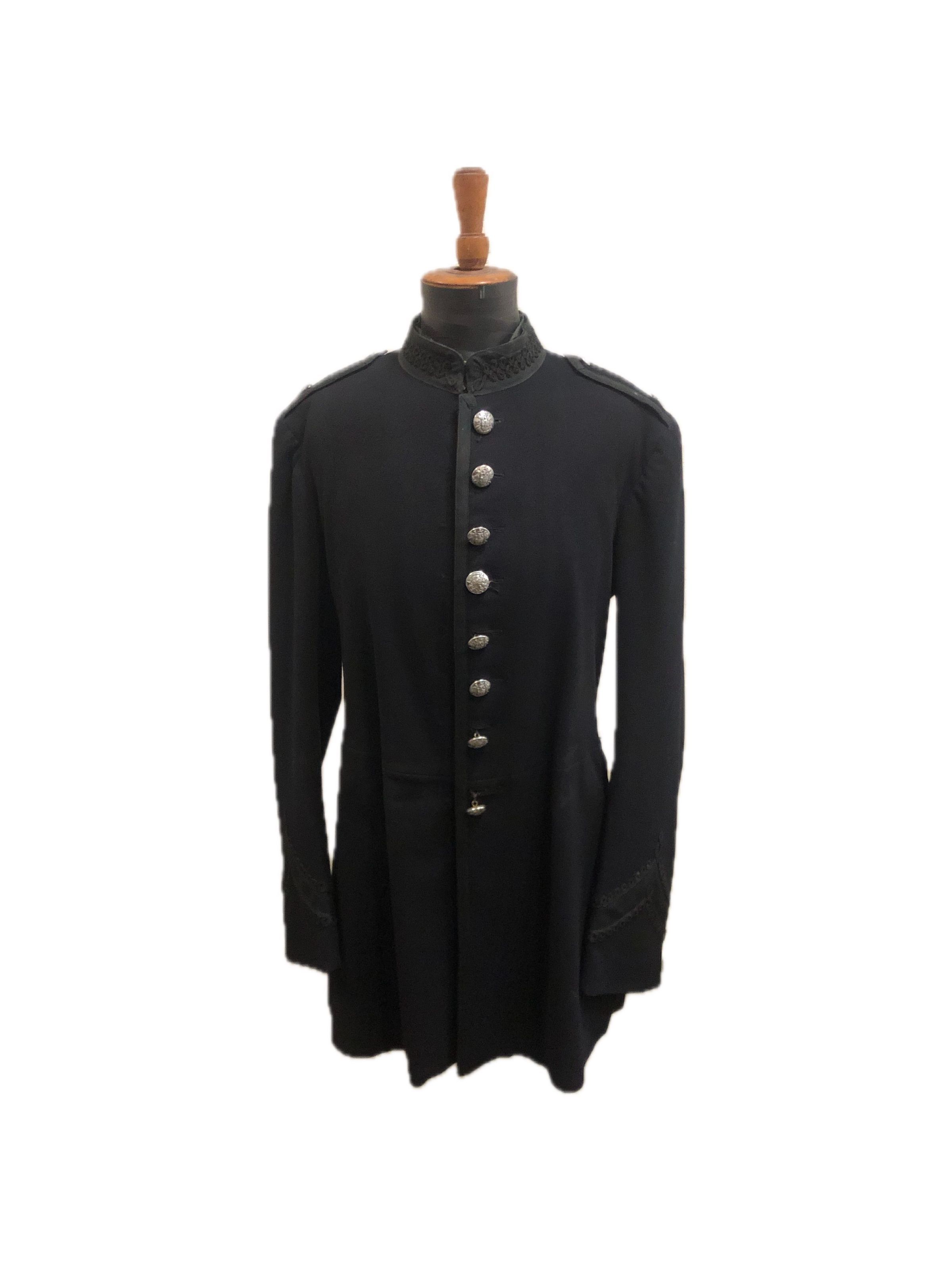
Eastbourne Borough Police superintendent's ceremonial dress uniform tunic c1930sEntry/Object ID
13Description
Blue coloured wool single breasted three quarter length frock coat style police tunic, with black braided decoration around the collar and braided chevrons at the end of each sleeve. There is also braided edging around the epaulettes and the front edge. There are eight large white metal buttons to the front and two smaller buttons fastening the epaulettes. There are four additional buttons, two each side of the rear vent, which is also edged in braid. All buttons are marked with the Eastbourne Borough coat of arms, with the latin motto, "Meliora Sequitur". On each epaulette is a white metal King's Crown badge with a red enamel insert. On each side of the tunic are metal clips for securing a belt. There are no pockets other than in the rear vent. Inside written on the cotton lining are the numbers "5-10, 40, 37". This tunic has long been displayed with a Sam Browne leather belt without its shoulder strap but photograph item 551, clearly shows that it would have been worn with a leather belt with a round buckle.Use
For an Eastbourne superintendent to wear as a ceremonial tunic in the 1930sContext
Long three quarter length tunics of this general style were worn by UK police from the 1860s, when they replaced swallow tail coats, until the late 19th century. By the mid 1890s and early 1900s they were replaced in many areas with shorter tunics with two breast pockets, although in some places they were retained for ceremonial and night wear Constables and sergeants would have plainer versions, whilst more senior officers would have elaborate braiding, often to signify their rank. This would extend to decoration across the front in horizontal rows. By the 1920s most police forces had abandoned long pocketless tunics for normal wear.
This particular tunic however, is a later example, as the buttons are marked with a version of the Eastbourne Borough coat of arms that was only used after 1928. This is interesting, as photographs show that tunics like this had not been worn in Eastbourne since the early 1900s, most ranks wearing far more modern shorter tunics with breast pockets, even as a dress uniform. More senior officers did wear pocketless tunics as late as the 1920s but the front decoration was far more elaborate than shown here and they were not worn with belts.
The use of the Crown insignia on the epaulette's of this tunic indicate that it was intended for a superintendent, and the decoration on it confirms it was for a more senior officer.
A group photograph of Eastbourne Police dated April 1938 (item 551)shows all of the officers, other than the chief constable, wearing the style of tunic pictured. The senior officers have the simpler style of decoration as shown here and not that used previously, and like the constables and sergeants, are wearing leather belts with a round buckle. In fact, it is quite possible that the superintendent in that photograph is wearing this actual tunic.
The tunic and the photograph suggests that at some time between 1928 and 1938, Eastbourne Borough Police adopted an old fashioned style uniform tunic for ceremonial duties only, and at the same time a new style leather belt to go with it. Previously officers had used a belt with a square buckle. The same style of tunic was worn by all ranks, and would not have been worn for day to day duties. That would have been shorter, with breast pockets and was not worn with a belt.
The adoption of this uniform is typical of the Eastbourne force, which had numerous and frequent changes of uniform, helmets and insignia over its relatively short 76 year history.