Name/Title
Eastbourne Borough Police truncheon c1900Entry/Object ID
86Description
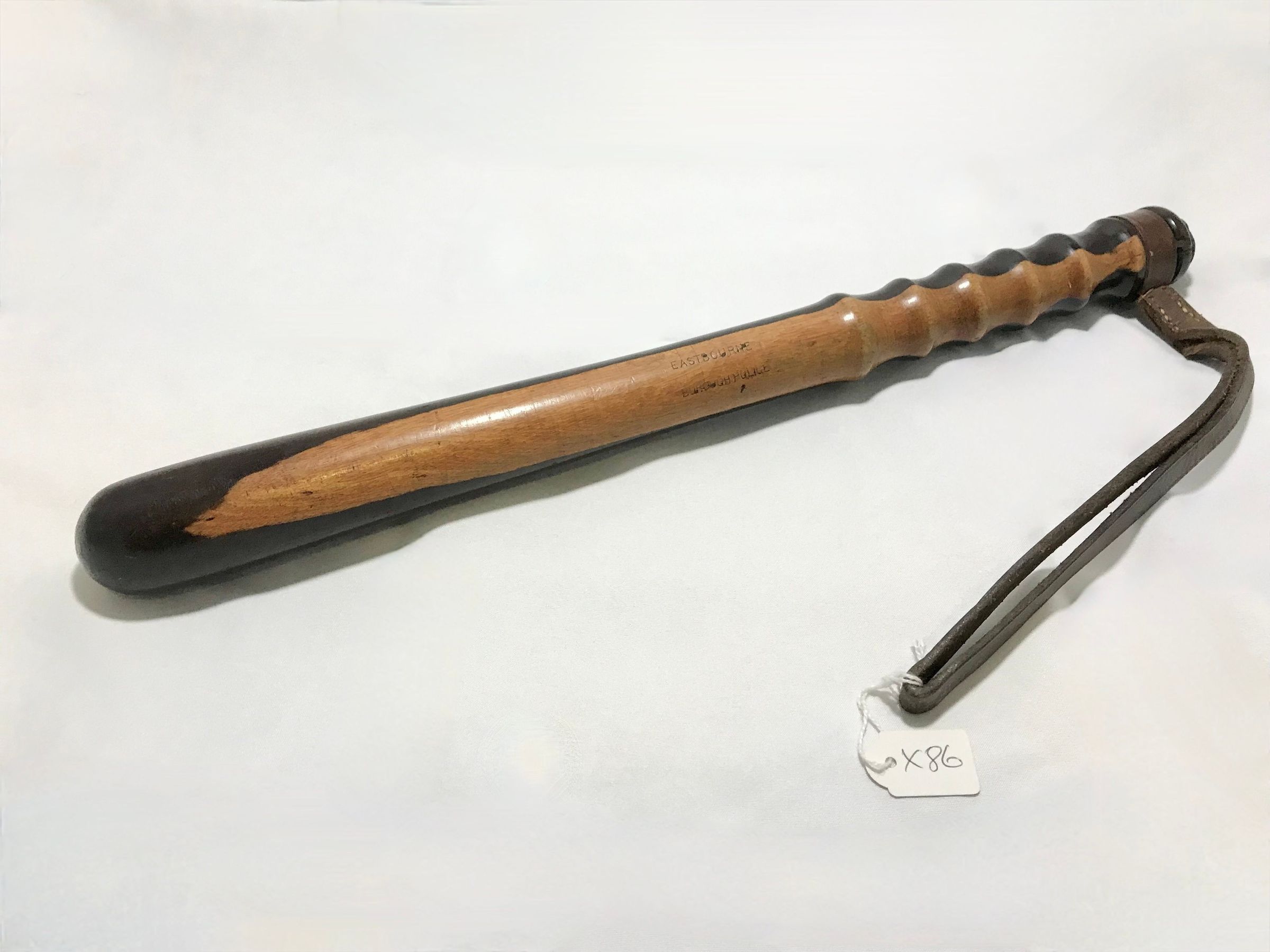
Hardwood 15 inch (38 cm) truncheon with five finger grip notches, stamped "Eastbourne Borough Police", with a stitched on brown leather strap.Use
For use by a police officer for protectionContext
During most of the 19th century police officers were issued with truncheons of approximately 17 inches (43 cm) in length. These were usually decorated in some way, mostly with a crown. This was because police warrant (ID) cards had not been introduced and the truncheon with its painted symbols was a badge of office, representing the officer's warrant or authority for carrying out his duties on behalf of the Crown (the monarchy).
By the mid 1880s warrant cards were in common use and the public were by now well aware of the authority of unformed police so decorated truncheons became less common. At the same time there was a need for shorter truncheons 14-15 inches in length as police forces began to use a pocket in uniform trousers to carry them, usually replacing belt carried leather truncheon holders. Many of these shorter truncheons had a new style of handle, which was changed from a multi ribbed type to one with notches for each finger.
This particular Eastbourne Borough Police truncheon probably dates to at least the early 20th century. However it has an unusual handle with 5 notches instead of the normal 4. This may indicate that it is earlier and may date from the 1890's, the Borough Force being formed in April 1891. This would explain the presence of five notches, having been made at a time before four became more or less universal in the 20th century. It is made of a tropical hardwood, probably cocus wood or lignum vitae, the lighter streaking being common to these and other similar hardwoods.
There is a series of other stamped Eastbourne Borough Police truncheons , broadly similar, but with only the normal 4 notches and of slightly more slender construction. These have maker's marks and numbers stamped into them. These are thought to date from around 1914, which again suggests the pictured truncheon is earlier.