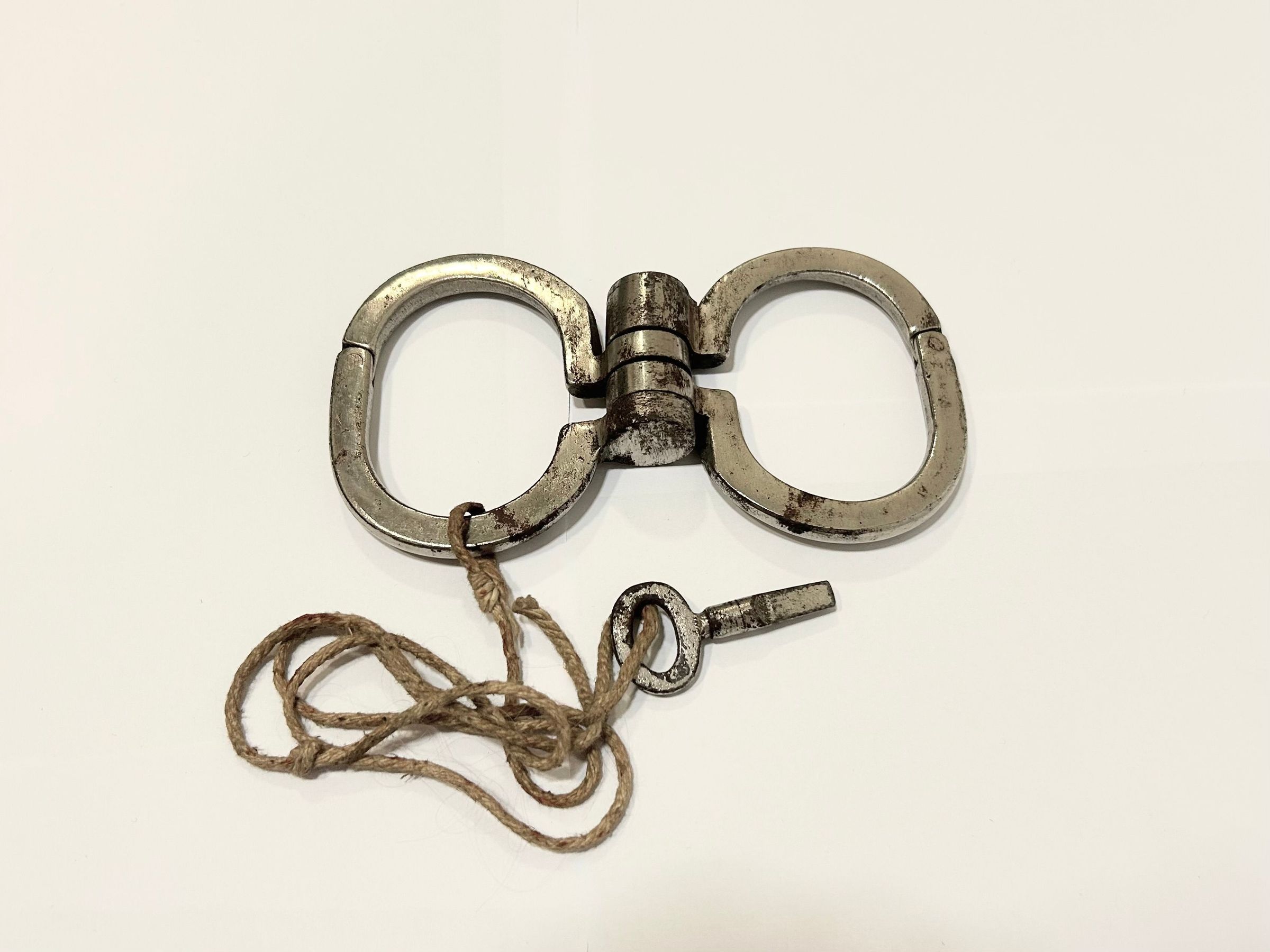
A pair of nickel plated "Hamburg Eight" style hinged handcuffs, with key attached on a piece of cord.
Use
For restraining persons in custody
Context
This style of handcuffs are called "Hamburg Eights" and were initially made by the German company of Kayser in the 1930s referred to as their model no. 5 (Nicholls 2002 page 107). They are designed to fold flat together so that they can be carried easily in a pocket and when folded will not lock. When used, they can be unfolded the arms opened and secured on a person's wrist. There is no actual lock in the strictest sense, and they are secured by a spring loaded bolt. Consequently the key is flat and simply pushes the bolt open when inserted, it does not turn.
The way that these handcuffs operated made then popular with escape artists who often modified then to make it easier to open then without the key.
This particular pair do not have a maker's mark but are thought to be an early Kayser version. This is because the key is flat and later versions were fluted to make them more difficult to open. They had been in the possession of Angus Cargill who was the chief constable of Hastings Police from 1942 until 1954. Prior to that he had been an officer in Liverpool Police. "Hamburg Eight" handcuffs as the name suggests were mainly used in Germany and it is unlikely that Cargill obtained them during his UK Police service, as British police at this time normally used Darby style handcuffs. However in 1944 he was seconded to the army to help prepare for policing in liberated Europe and occupied Germany. After the German surrender he was tasked with organising the policing arrangements in the British sector of occupied West Berlin. It is highly likely that he acquired these handcuffs whilst there. They may therefore have originally been Berlin Police issue.