Name/Title
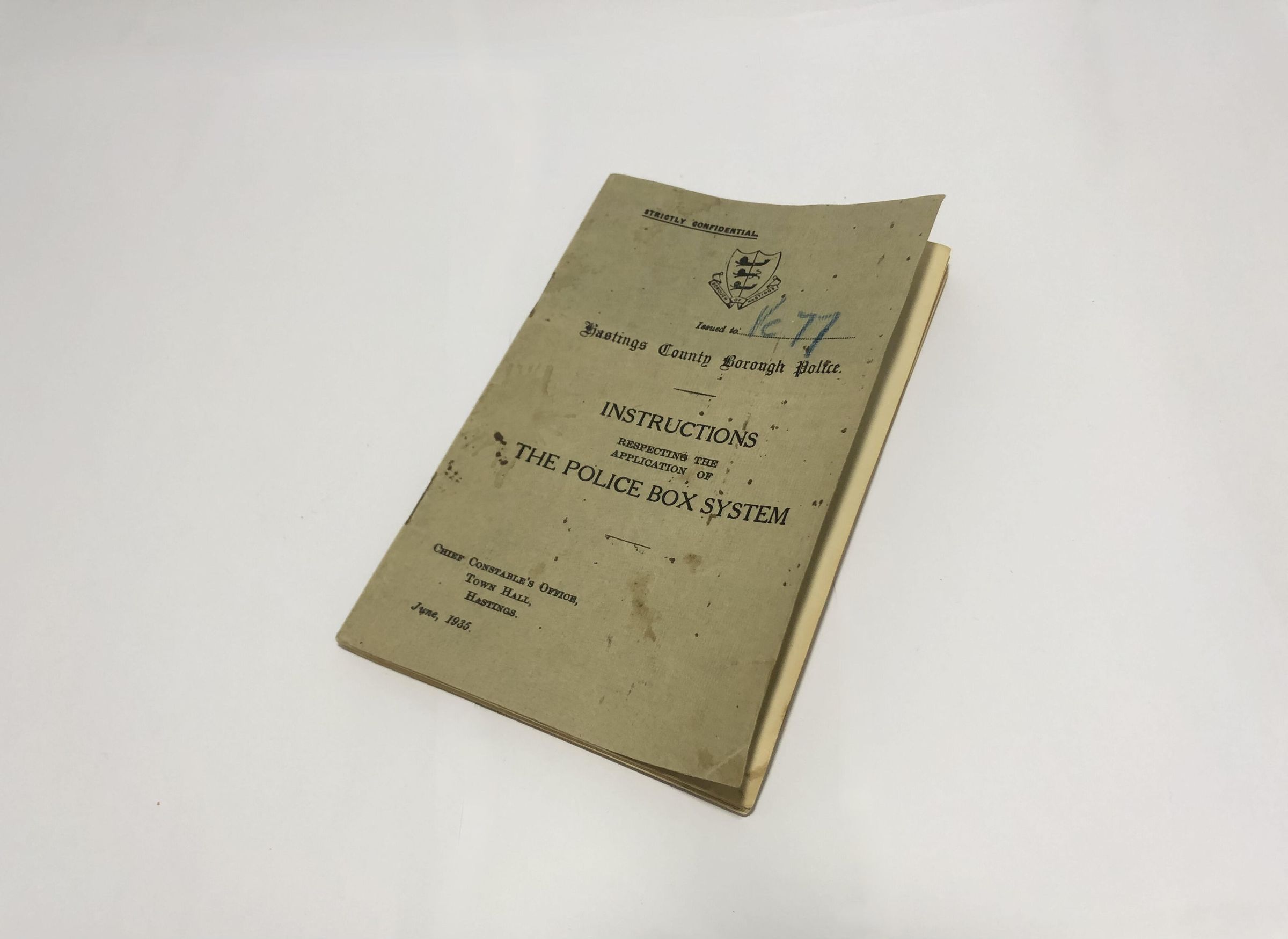
Hastings Borough Police Box System booklet 1935Entry/Object ID
559Description
Small green/grey card covered booklet titled, "Hastings County Borough Police - Instructions Respecting the Application of The Police Box System", consisting of 38 pages published June 1935. Marked on front cover issued to 'PC 77" in blue pencil'.Use
Booklet for officers detailing the use of the Hastings Police box system and other aspects of work, in the town including, cycle and motor patrol and the responsibilities when taking the report of a crime.Context
Throughout the early 20th century the British police began to rely more and more on telephone communication. In the late 1920s police forces began to introduce "Police Box systems", where officers in towns would not book onto duty at a police station but at a "Police Box" actually on their "Beat", the area they were designated to patrol. These 'boxes" would be small structures equipped with a telephone for the officer to contact a police station at the beginning and end of his duty, and at regular intervals throughout that duty. This was to check on his welfare and to relay to that officer any messages. The attraction for police forces of these systems was that they could reduce the number of police stations that they needed and that officers would spend more time on their beat, instead of having to walk to it from a police station at the beginning of their duty and back again at the end of it.
The type of police box used varied from police force to police force, but to begin with most were wooden structures similar to small sheds, usually furnished with a desk/table and a chair, as well as the all important telephone.
Hastings Police introduced its box system in 1930 after the construction of a number of boxes since 1929. As initially organised the system involved very rigid working with officers following set patterns of patrolling without variation. By 1935 it was recognised that such a system allowed persons to know exactly where and when a beat officer would be at any given time and that the lack of flexibility also stifled an officer's ability to use their initiative. As a result the system was revised in June 1935 with the publication of this booklet (Banks 1967). Additional Police boxes had been provided and a number of police telephone pillars added to system. In all the revised system consisted of 21 boxes and 6 telephone pillars, servicing 18 beats. The boxes had special telephones for the general public to use attached to the outside. These would consist of a special small door that when opened would automatically activate a speaker telephone that would connect the central police station. The pillars had a similar telephone.
This booklet was personal issue to all officers and contains detailed information for each beat in Hastings, such as where it was, which box was specifically assigned to it, and any other boxes that were also available. It also details "conference points", specific locations where officers would meet their supervisors. The book does not contain the specific timetables of what times officers should call in or of their booking off locations but states that these are detailed within each beat box. These timetables and the system of patrolling were designed to make it appear to the public that this whole system was random and therefore unpredictable.
A scan of this booklet is available in the museum CD files section of the museum main folder.