Name/Title
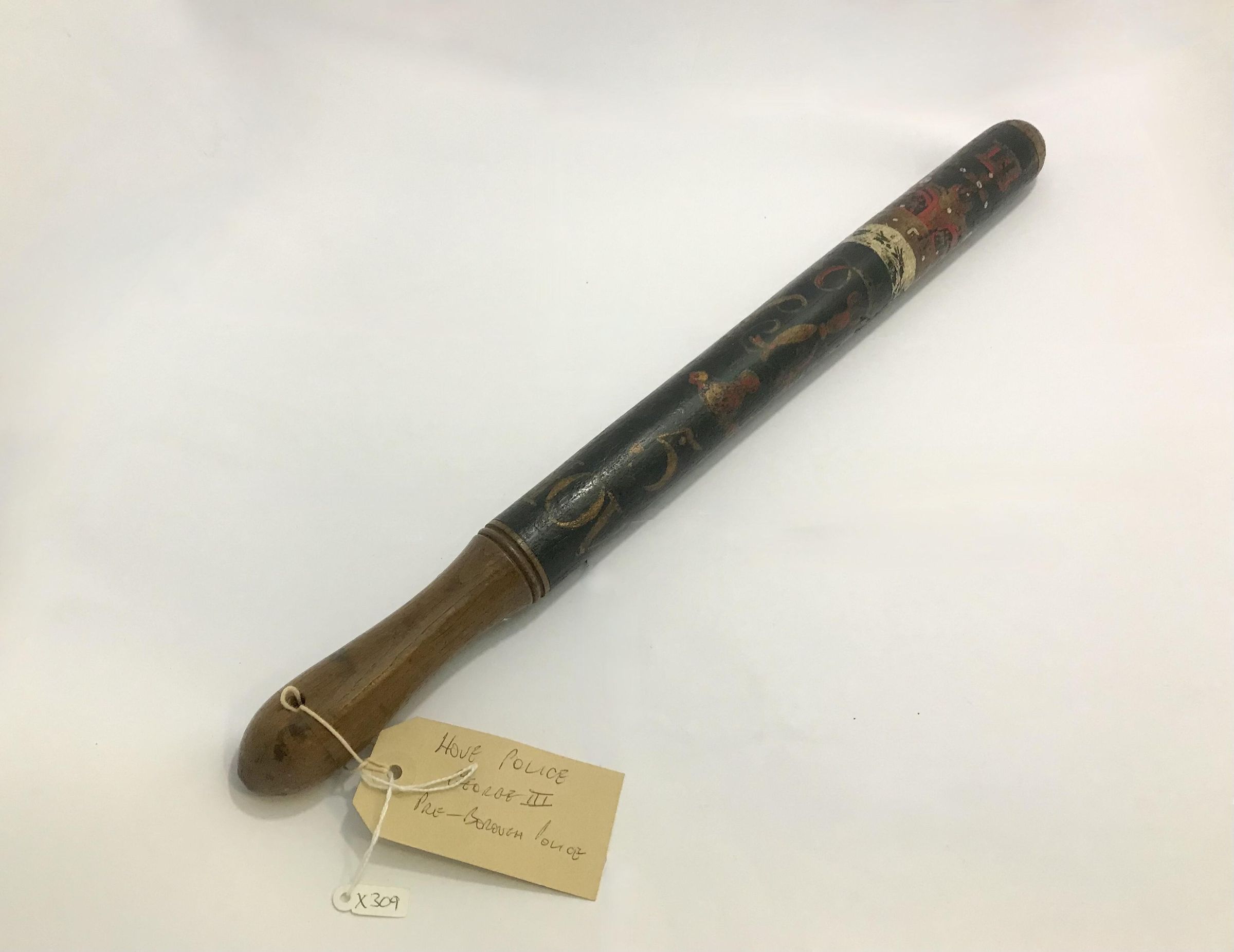
Hove George III decorated Parish constable's truncheon c1800-1820Entry/Object ID
309Description
Wooden decorated truncheon with plain smooth handle which has a hole for a strap cord, 17 1/4 inches (44cm) in length, painted black with white gold & red markings. Marked "III" over a crown Royal Crown, over a gold "GR" cypher over "5" and "Hove". No maker's name.Use
To be used by a Hove Parish Constable for both protection and as a symbol of their authorityContext
Before the establishment of regular full time uniformed police forces, responsibility for law and order and keeping the peace, mostly fell upon unpaid parish constables who were usually appointed on an annual basis. Like the later full time uniformed police constables, these parish officers carried decorated truncheons which acted as their authority for carrying out their duties. At the same time these truncheons were also designed to be used for protection and were not ceremonial items.
This truncheon has markings representing George III, who reigned from 1760 until his death in 1820. It probably dates from the 1800-1820. At this time the only officers in Hove were Parish Constables appointed by the Court Leet of Preston. The administrative area or "Hundred" of Preston had jurisdiction over both Hove and Preston Parishes, although each was a separate entity (Oakensen 1994). Parish Constables did not have uniforms or numbers, so the number "5" is the actual number of this truncheon. Unpaid parish constables continued to be responsible for policing in Hove until the 1840s, although in 1830 the Brunswick Town area established its own police force. However the parish constables policed the rest of Hove. In the 1840s the Parish itself and its parishioners or Vestry, took over the role of appointing constables from the Court Leet. From this period onwards they supplemented the constables with some paid officials and watchmen as they attempted to avoid government legislation which was designed to force local authorities to establish full time police forces. In particular they were trying to prevent East Sussex Constabulary from taking over responsibility for policing the area, wishing to retain their independence. Eventually the Parish petitioned for the Hove Improvement Act of 1858, which when passed allowed for the establishment of the Hove Police Commissioners to take over policing for the whole of Hove, including Brunswick Town. This led to to end of the Hove parish constables and the formation of Hove Police.