Name/Title
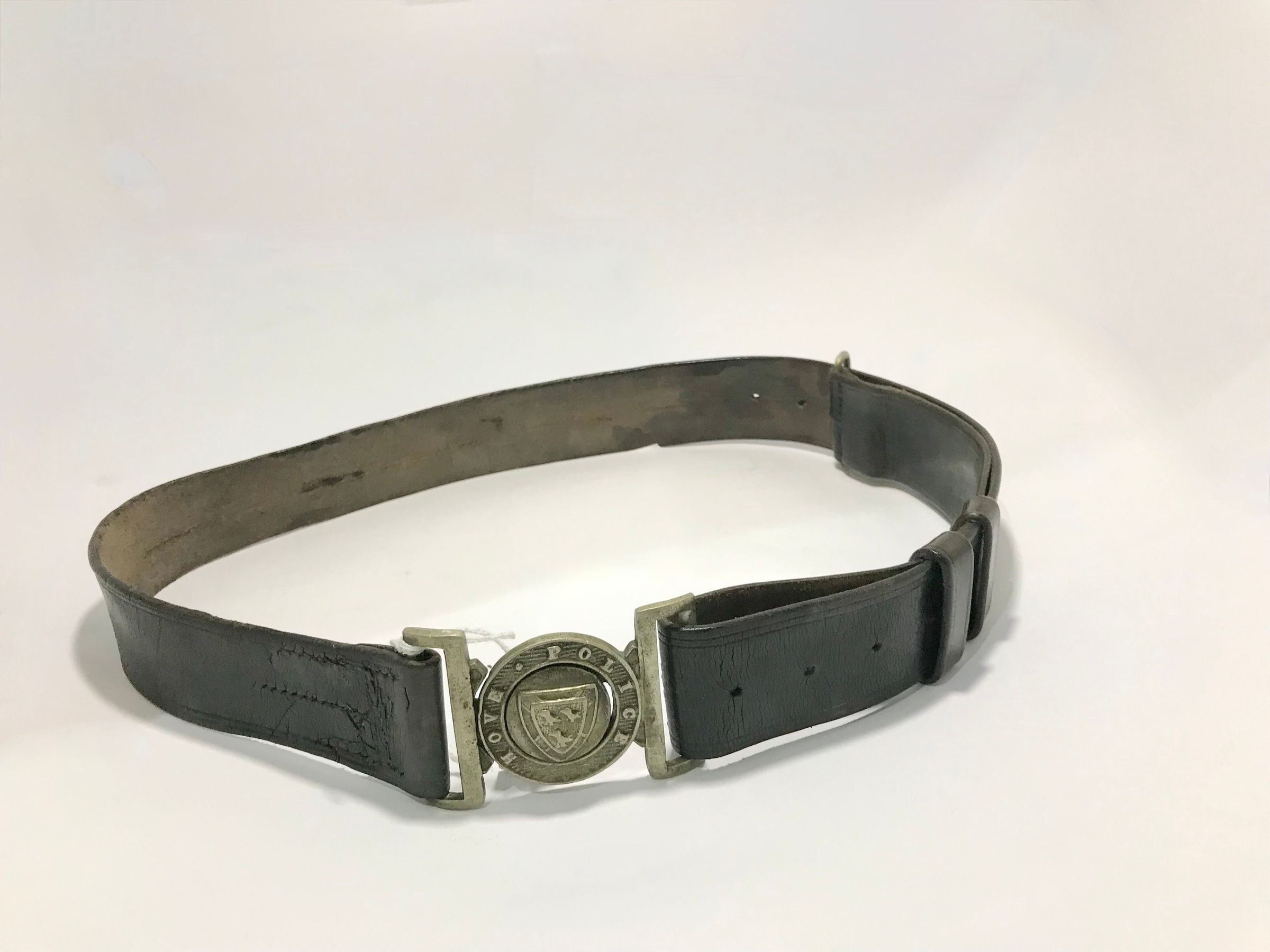
Hove Police leather belt and clasp c1878-1901Entry/Object ID
125Description
Broad black leather belt with nickel silver clasp and adjustment buckle, marked "Hove Police" with coat of arms centre.Use
Used as a uniform belt over a tunic or overcoat.Context
Belts were first introduced when police forces abandoned the tail coat in favour of a tunic in the 1850's. They smartened the appearance of the long tunics then worn and were used to hang leather truncheon holders, occasionally small swords and at night oil lanterns. When used at night they would often have leather guards attached to prevent the oil lamps from burning or staining the uniform.
This particular belt has a clasp marked "Hove Police" and has the coat of arms for the Town of Hove, a shield with three martlets, over a St.Andrew's Cross. This same coat of arms was also used on what are thought to be the first helmet plates used in the Force in 1878, when the Town of Hove Commissioners took control of policing in the Town ( Poulson et al 1987 ). This type of belt was probably first introduced then and the design of clasp used is certainly seen in pattern books from the 1880s. After the death of Queen Victoria in 1901, the newly named, Hove Borough Police adopted a new helmet plate with a different coat of arms, to reflect Hove's new Borough status, so this belt with the old coat of arms is unlikely to have been made after that date.
Photographs of Hove Police officers show them wearing belts for ceremonial occasions with tunics without pockets in the 1920s. It is not known if these belts, had the same coat of arms as the one pictured, though they appear to be of a similar general design. It is possible that new belts were purchased after 1901 to match the coat of arms on the new helmet badge. It is not known how the long belts continued to be worn for normal winter use in Hove and if this practice continued after the First World War. Whilst many photographs show officers not wearing them, these appear to be taken in the summer months when officers wore summer tunics with pockets and no belts.
The use of belts nationally, declined in the 1920's as police forces began to abandon the use of long tunics without pockets for normal wear, and they were often only used for ceremonial occasions. It is known though that some police forces retained them for night use until the 1960's, presumably to hang battery powered lamps that replaced oil lanterns in the 1920's.
Photographs show that many of the Sussex police forces issued elaborate belts like this one in the 19th and early 20th centuries, sometimes supplementing their use with plain examples with generic "snake's head" clasps (see item 1269).