Name/Title
Lion Alcolmeter S-L2A electronic breath testing deviceEntry/Object ID
2334Description
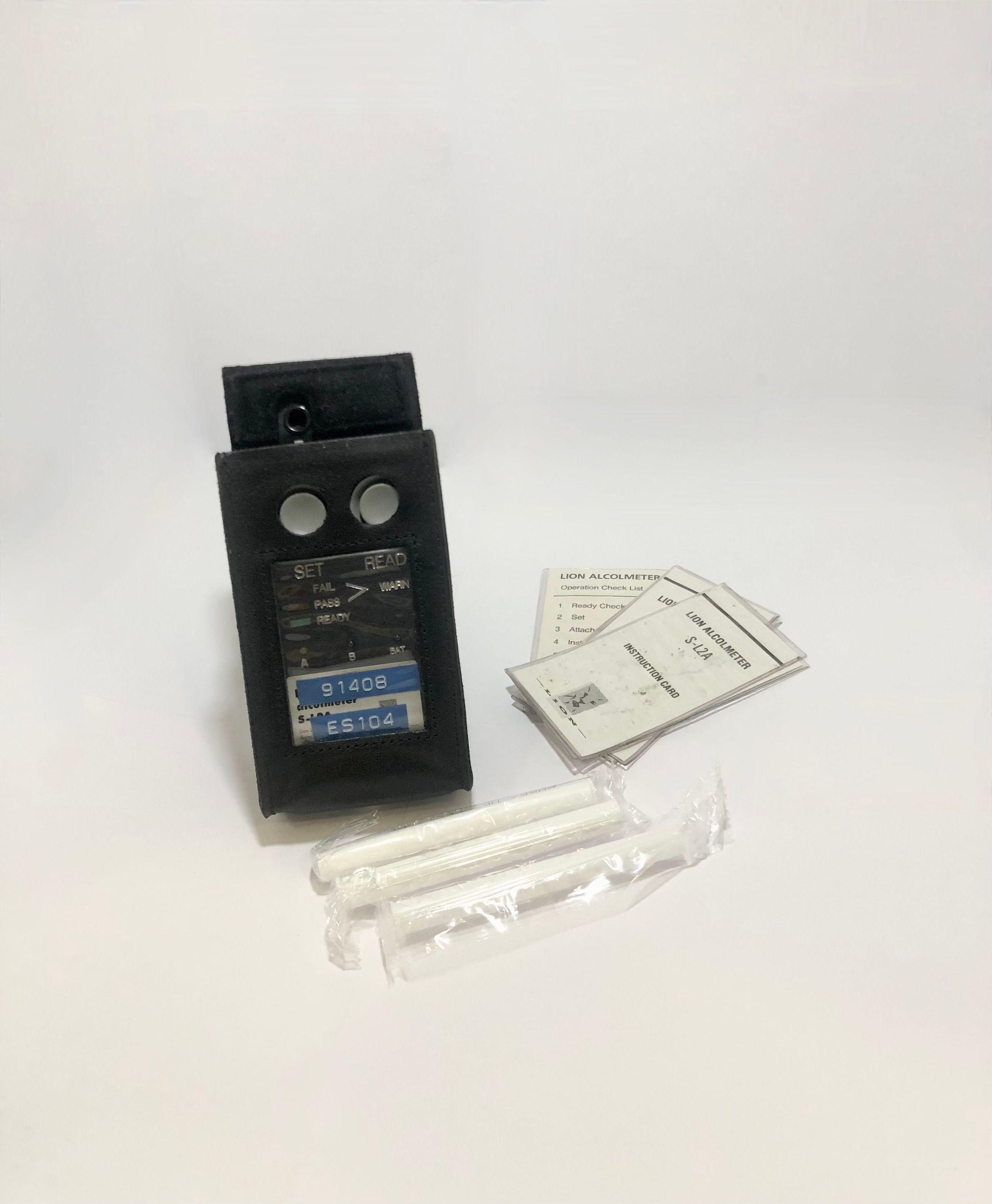
Lion Alocolmeter S-L2A roadside breath screening device in leather case, with two grey coloured buttons to the front and "traffic light" pass/fail coloured lights. Has a nozzel on the top for attaching a mouth tube. Marked on front "Lion Alcolmeter S-L2A Lion Laboratories" and "Serial No. 91408". On the clear plastic window on front of the case are Dyno taped strips marked "91408" and "ES104". In pocket in case are three sets of basic instruction cards, and in the rear pocket three disposable mouth tubes, one of these cards has written on it "Calibrated PC AT599".Use
For police officers to use to conduct a roadside Algol screening test.Context
In 1979 Sussex Police was one of two police forces selected to trial the Lion Alcolmeter S-L2 ("Patrol December 1979). This was a hand held electronic breath testing machine designed to replace the cumbersome "blow in bag" devices that had been used for road side breath testing since the late 1960s. The trials were a success and the new machines began to replace the bag equipment nationally in 1980.
This particular Alcolmeter is the S-L2A which was introduced in 1987 and was used on the Lewes District of Sussex Police. Similar devices such as this were used throughout Sussex Police until the later 2000s when they were replaced with more modern versions that actually gave a digital readout of the level of alcohol in the breath. However all of these instruments were only used for screening drivers for alcohol. On failure a driver still has to undergo a further test at a police station on a larger more sophisticated device that is more accurate and can give results that can be used as evidence in court proceedings.
The Dyno tape on the front of this example gives the serial number of the instrument, which is needed for an officer's statement of arrest and the letters and numbers "ES104". Alcolmeters were not issued to individual officers but usually specific vehicles, in this case patrol car "ES104", which would have been a marked vehicle based at Seaford". The reference to calibration relates to the fact that on a regular basis these devices were checked locally using a set procedure involving a cylinder of special gas. These checks were recorded and any devices that failed were sent off for re calibrating, to ensure accuracy, this particular device was calibrated at least once by the officer with the warrant number AT599.