Name/Title
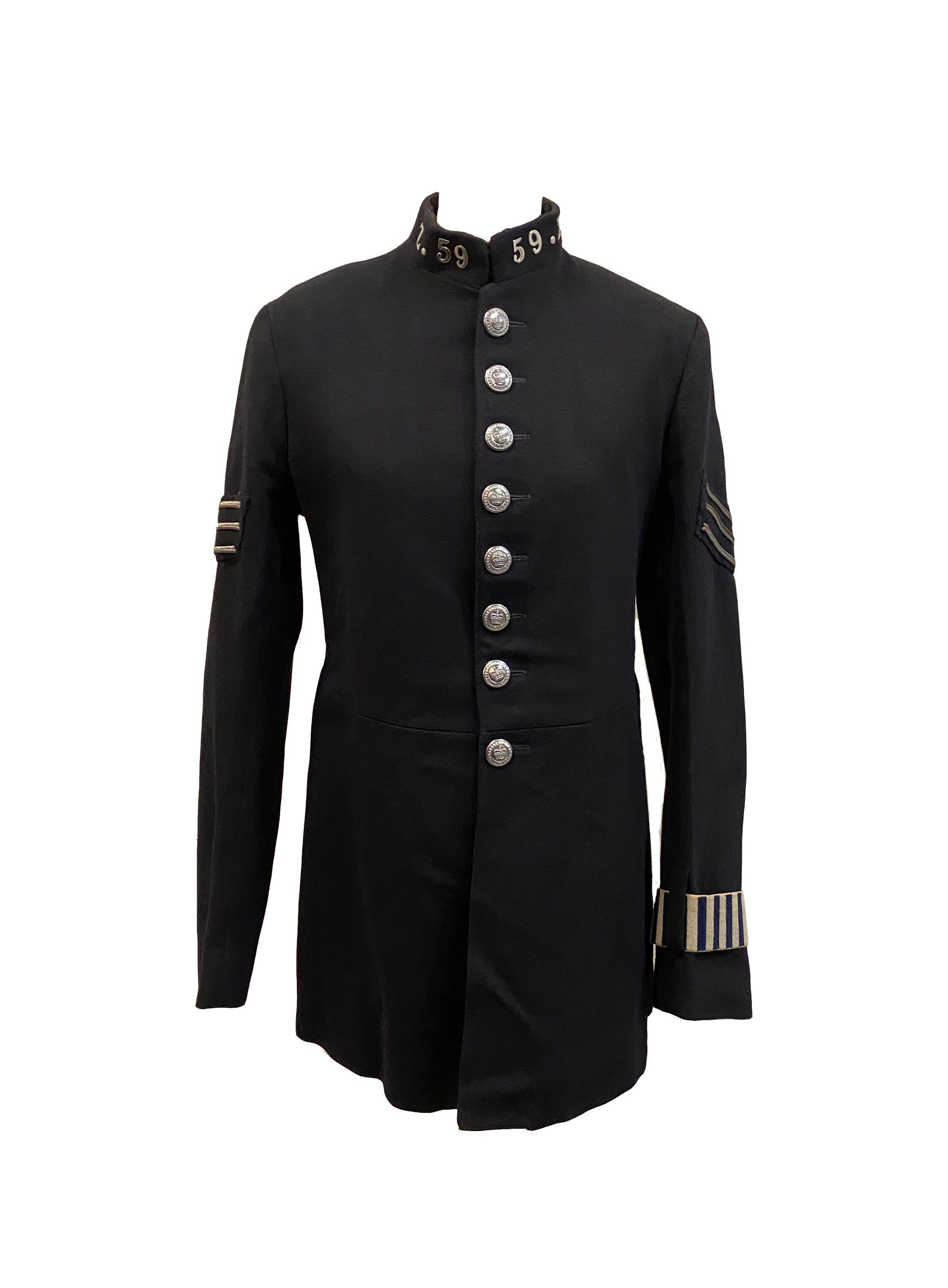
Metropolitan Police ceremonial "No.1" sergeant's uniform tunic c1955Entry/Object ID
1156Description
Black/blue coloured wool closed high collar long police tunic, with eight large buttons to the front, no pockets and four large buttons around the rear vent. All buttons are chrome plated and marked "Metropolitan Police" with a Queen's crown. On each arm are badges with three thin white/silver cotton sergeant's chevrons. There are metal clips either side to hold a belt and the chromed metal letter "Z" and the numbers "59" separated by a dot on either side of the collar. On the left cuff are fabric loops holding a blue and white plush cotton duty band with a chrome plated buckle. Inside on the rear vents are indistinctive marks. There are also pockets in the inside of each side of the rear vent, and a very small inside pocket adjacent to the fourth front button hole from the bottom.Use
For a Metropolitan Police sergeant to use when on ceremonial dutyContext
Tunics very similar to the one pictured were used in most UK police forces from the late 1850s and 1860s, when they replaced the earlier swallow tail styles. They were normally worn with a leather belt. The Metropolitan Police replaced this style of tunic in for day use in 1897 when they adopted a shorter 5 button closed neck tunic with two breast pockets and no belt. The older pocketless tunics were retained for ceremonial duty, and continued to be used at night until the late 1930s.
Even after they were replaced for night duty the older style longer tunics without pockets were retained in the Metropolitan Police for ceremonial duties and special occasions and were called "Number ones" or "No.1s". They continued to be issued to officers and worn for certain duties until the late 1960s/early 1970s, including state occasions such as the "Trooping of the Colour" ceremonies. They were worn together with a "snake's head" leather belt (item 1269) which was held in place by the metal clips on the tunic, any medals the officer had been awarded, and a whistle chain hooked onto the second button and hung down the front, with the whistle often shown in photographs tucked into the belt, although these tunics did have small internal pockets on the left hand side especially to hold a whistle. The lack of external pockets in these tunics is compensated for by having special pockets in the tails of the rear vent.
This particular tunic still has a duty band attached to the left sleeve. Originally such bands were used to identify whether an officer was on duty, at a time when officers were expected to wear their uniforms at all times. The first duty bands had horizontal strips but by the 20th century many police forces had adopted ones with horizontal stripes. By the 1920s the use of duty bands had become less common in the UK but they were retained in the Metropolitan Police until 1968. Unlike in Sussex Police, alpha numeric collar numbers used in the Met. are not officer's warrant numbers, they signify a divisional number, which will change upon a transfer to another division or promotion. The numbers and arm stripes on this tunic identify it as having been used by a sergeant of "Z" Division which covered the area of Croydon. This division was created in 1921, the area previously having been part of "W" Division.
This tunic though not actually used in Sussex, is certainly of a style that would have been worn in all of the region's police forces from the 1850s/1860s until the beginning of the 20th century and in some forces until the 1920s. It was probably made in the 1950s and eventually found its way into a stock of old police uniform that was used by Sussex Police school's officer's in Bexhill.