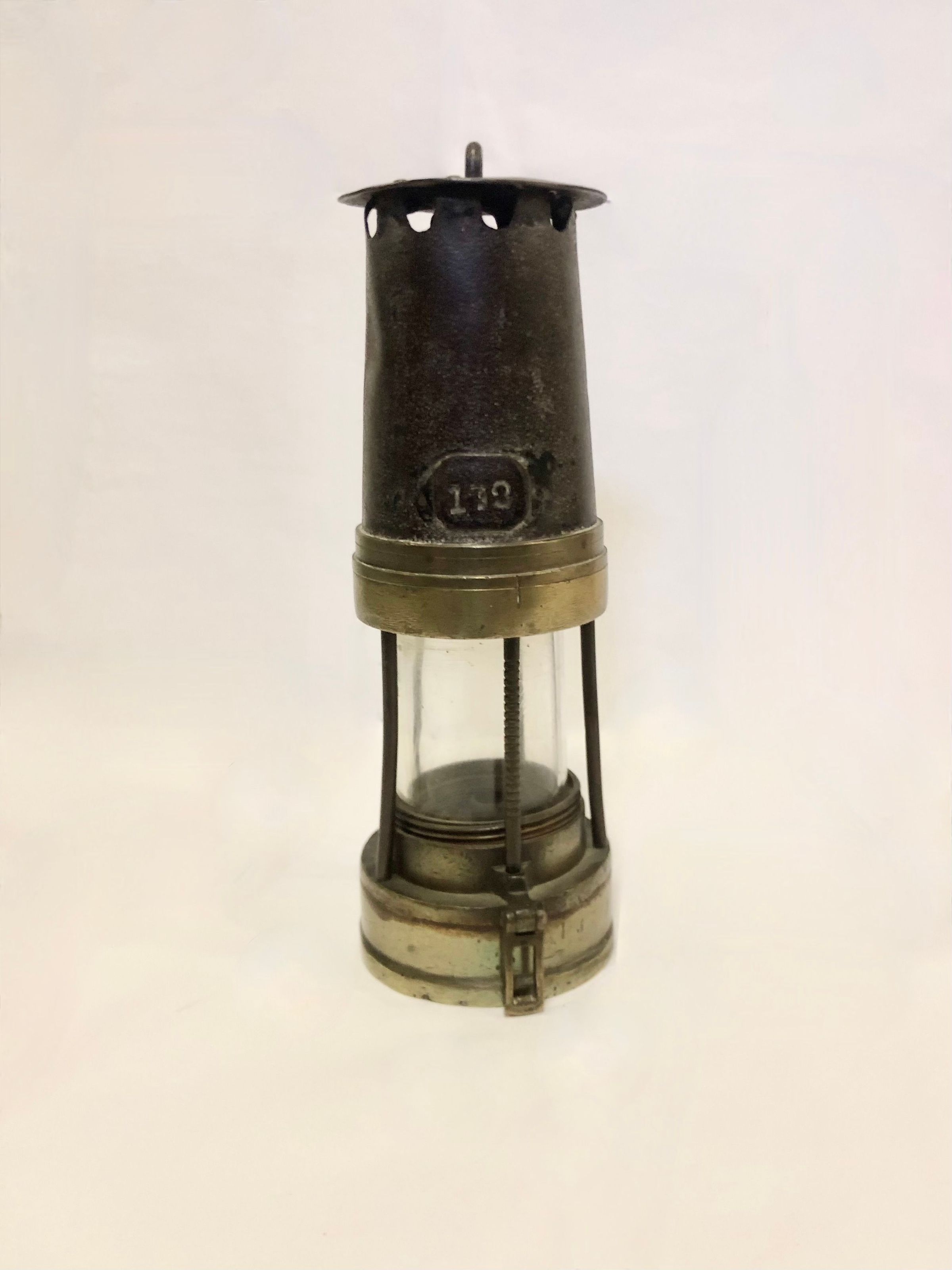
Name/Title
Miner's safety lamp c1920Entry/Object ID
2525Description
Brass miner's safety lamp with perforated top, loop and glass lantern. The outside has a numbered tag attached which is marked "172" or similar. The base section when unscrewed reveals stamped numbers "172345" or similar. The glass is etched "SW" either side of what appears to be a Welsh feathers symbol. Underneath this is etched "E.T.W. 2".Use
To provide safe illumination underground.Context
Various types of safety lamp such as this were used in the 19th century and 20th centuries in Uk mines until they were replaced by battery powered examples. The basic design of this type of lamp allowed electric ignition from below, to prevent the use of a naked flame to light it.
This particular lamp was owned by Harold Harmes who joined Brighton Borough Police in 1919 and retired as a superintendent in the early 1950s. He was one of 52 Brighton officers that were sent to Glamorgan in South Wales, between 21st October and 1st December 1926, to assist the Glamorgan County Police during the miner's strikes of that year. The Brighton officers were joined by others from across the country and at least some were based at Ferndale and Tylorstown. PC Harmes was definitely at Pontypridd in November of 1926, when he was involved in an incident where officers were attacked by strikers and he subsequently gave evidence at court (Western Mail 5/11/1926 page 11).
Harold is believed to have obtained this lamp during his time in Wales and it is known that the chief constable of Brighton at the time, Charles Griffin, was presented with an engraved miner's lamp by Glamorgan Police in recognition of his assistance in sending officers to Wales. The maker of Harold's lamp has yet to be identified although it is not believed to be "E.T.W." (Edward Thomas and Williams), despite the glass in it. The company were from Aberdare and made many of the lamps used in the Glamorgan coalfield, though this is not thought to be one of theirs. This lamp certainly had some age prior to Harold obtaining it and it is hard to think when else he would have obtained it other than during his time in Wales.
When thinking of police from Sussex assisting in mining disputes most people think of the 1984 strikes that led to hundreds of local officers travelling to the northern coalfields. It is often forgotten that there is a much longer history of officers from across the region assisting colleagues elsewhere during such unrest. Officers from West Sussex Constabulary assisted in the Welsh coalfield in both 1921 and during 1926 and is thought officers from at least East Sussex county force would have done so as well.