Name/Title
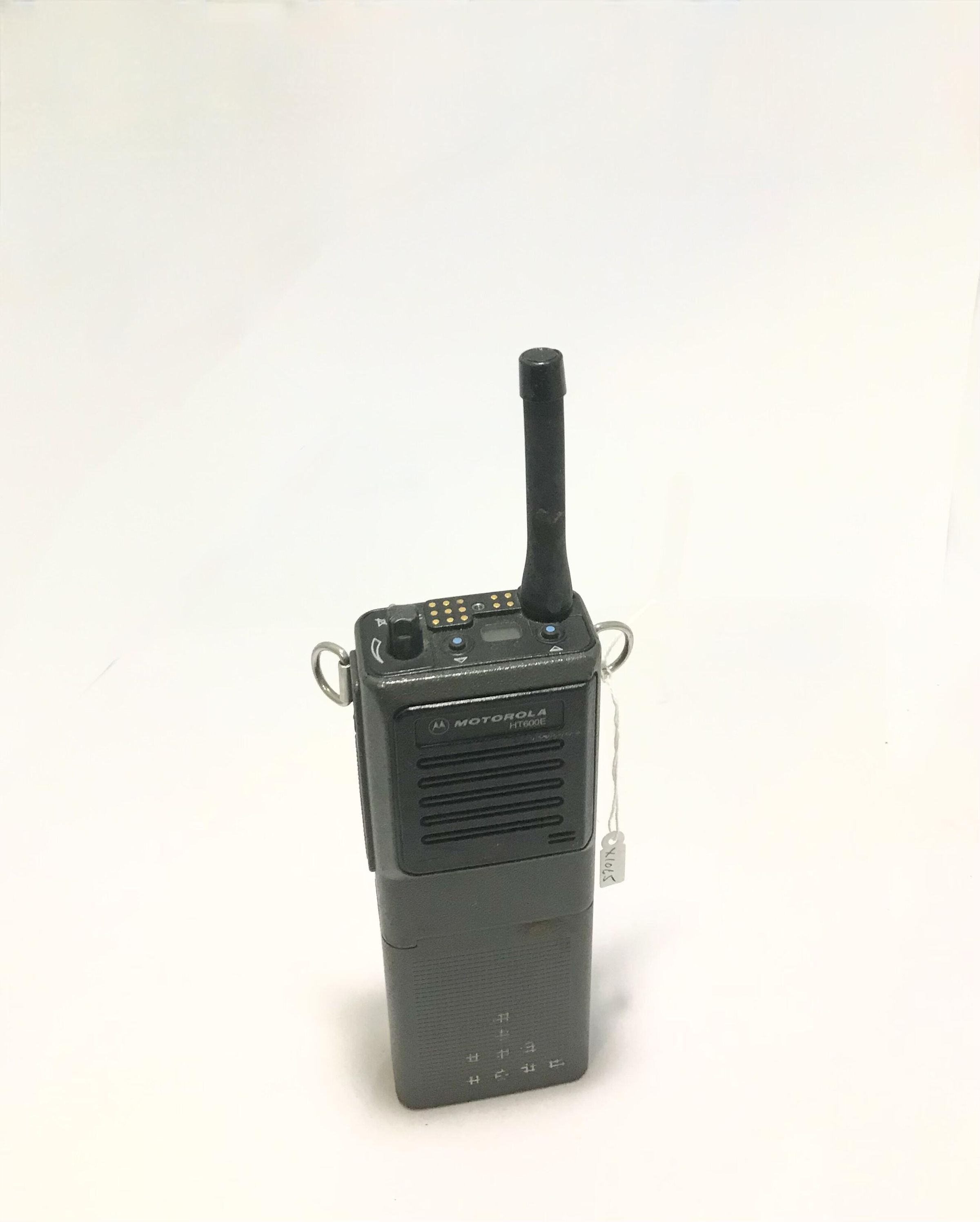
Motorola HT600E police personal radio c1985Entry/Object ID
1065Description
Motorola HT600E personal radio and battery, with metal fitting for two belt clipsUse
For a police officer to transmit and receive radio messagesContext
This model of radio was developed for the Home Office from Motorola's existing MT1000 model and came into service with UK police forces, including Sussex in the mid to late 1980s. It is a very robust design and the bottom half is the battery which slides out.It could then be placed in a charging unit. These radios had 99 channels and could be fitted with a microphone attachment, that could be clipped onto the lapels of a tunic. This particular radio has two metal rings attached so it could be hung from two belt clips, which was the commonest way they were carried in Sussex. Another type of fitting allowed the radio to be attached to a belt via a "D" shaped spigot, similar to those on modern Airwave radios. The radio could also be placed in a harness or leather holder.
At the time these radios were used in Sussex there were two radio networks. There was a force wide system referred to as "KB" which was managed from the control room at Police HQ and was confined to radio sets in vehicles. Amongst other things it managed the 999 emergency call system and car pursuits. The other system, for personal radios was controlled locally. Every police station that managed a sub division would have its own radio channel, with its own personnel to answer telephone calls, control the switchboard and manage the local radio. In small stations this may amount to one person. These local control rooms were referred to as "Front Offices", because they were usually at the front of the police station behind the public counter. At this time police stations were open for 24 hours a day and whoever was managing the telephone and radio would have to staff the counter as well. In larger stations a mixture of police officers and civilian staff would carry out these roles.
There was a facility in some police vehicles for officers to use their personal radios to contact the Force Control Room radio via the radio set in the vehicle, by means of additional equipment called a "repeater". These were used in more remote locations where the local radio signal may be poor, and by officers who may find themselves in such areas, including traffic officers and dog handlers. Vehicles with these additional radio sets could be identified by having additional radio antennas.
In the mid to late 1990s Sussex Police began to shut down the local radio network and replace it with Area Control Rooms or "ACRs". Things were further developed in the 2000s and now all communications systems are centralised.
The HT600E radios were used in Sussex until the 2000s when more up to date models became available. However nationally it had been recognised that a fully secure encrypted network was required and from 2000 to 2007 the Airwave system was developed for use by all of the UK emergency services. The use of this TETRA based system has made traditional personal radios obsolete.