Name/Title
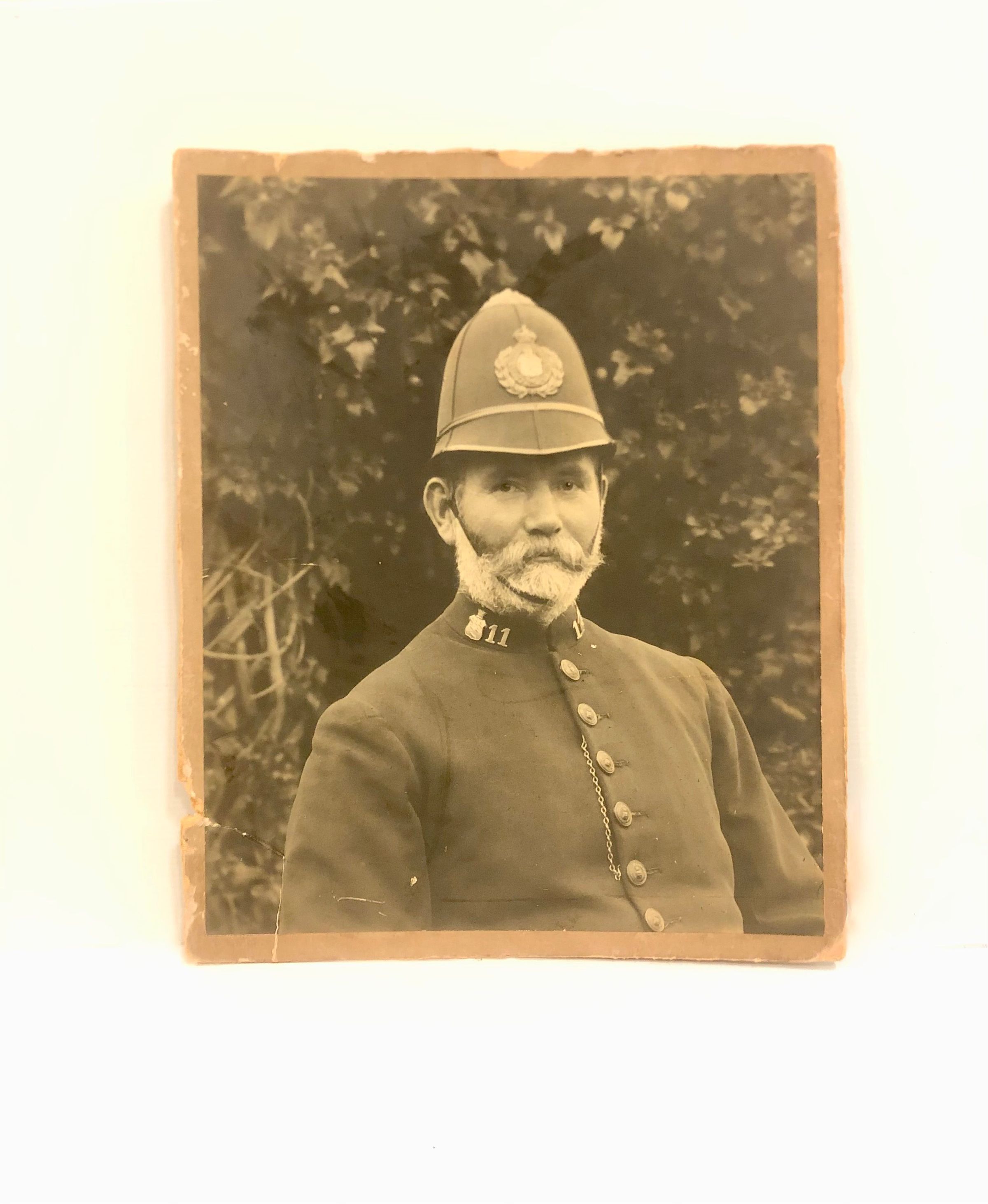
Photograph of East Sussex Constabulary constable believed to be Charles Turner c1914 - 1920Entry/Object ID
2467Description
Large black and white original photographic print, 15 x 12 inches, with card backing of the head and shoulders of an East Sussex Constabulary constable wearing a police helmet displaying an East Sussex Constabulary wreath style helmet plate. The officer is also wearing a closed neck pocketless tunic displaying an East Sussex Constabulary collar badge and the number "11". On the rear written in biro is marked "East Sussex Constabulary PC M. Turner Auxillary Horsted Keynes 1913 - 1918".Context
This officer is clearly from East Sussex Constabulary, though the helmet centre is not too clear, the collar badge is. Interestingly until 1905 West Sussex Officers had a very similar helmet badge to those in East Sussex, but they did not wear the Martlets collar badge as shown here, instead displaying the letters "WS".
This photograph is of a large size and in particular gives a very clear image of the uniform buttons being used, which appear to be of a dark composite material and do not display a crown in the centre but instead the East Sussex county coat of arms in a shield. The use of an helmet and an eight buttoned tunic dates the photograph to before late 1921, after which helmets in the county were replaced by caps and a shorter tunic was introduced for year round use (Kyrke 1969).
The use of the word "Auxiliary" on the rear of the photograph and the dates "1913 - 1918", suggest that the officer was possibly a First Reserve officer serving during the First World War. As early as 1911 the Home Office required police forces to recruit a police reserve, of retired officers that would carry out full time police duties in the event of war. They were needed because many serving police officers were ex military personnel and were therefore army and navy reservists, meaning that in the event of a war they could be "called up" and re-enlisted. This would mean that police forces would be short of officers, hence the need for ex officers to be available to replace those rejoining the armed services. In 1914, when war was actually declared it was recognised that there were not enough First Police Reserve officers and they were augmented by large numbers of special constables.
The officer in this photo is not a special constable but a full time officer, as he has a proper uniform, a collar number and a helmet.
Research indicates that both the initial "M" and the dates on the reverse are incorrect. However a PC Charles Turner was an East Sussex Constabulary officer who initially retired in 1911, having served since 1885. He re joined the force on the outbreak of the war and served at Horsted Keynes and Ardingly, eventually retiring for the second time as late as 1920.
Given that the service of Charles Turner matches much of the information on the rear of this photograph, there is every reason to believe that it does indeed depict that officer, although some of that information is incorrect.
At the time this photograph was taken Horsted Keynes and much of that locality, including Bruges Hill and Haywards Heath were in East Sussex. It was only after 1972 that administrative changes moved them to West Sussex jurisdiction.