Name/Title
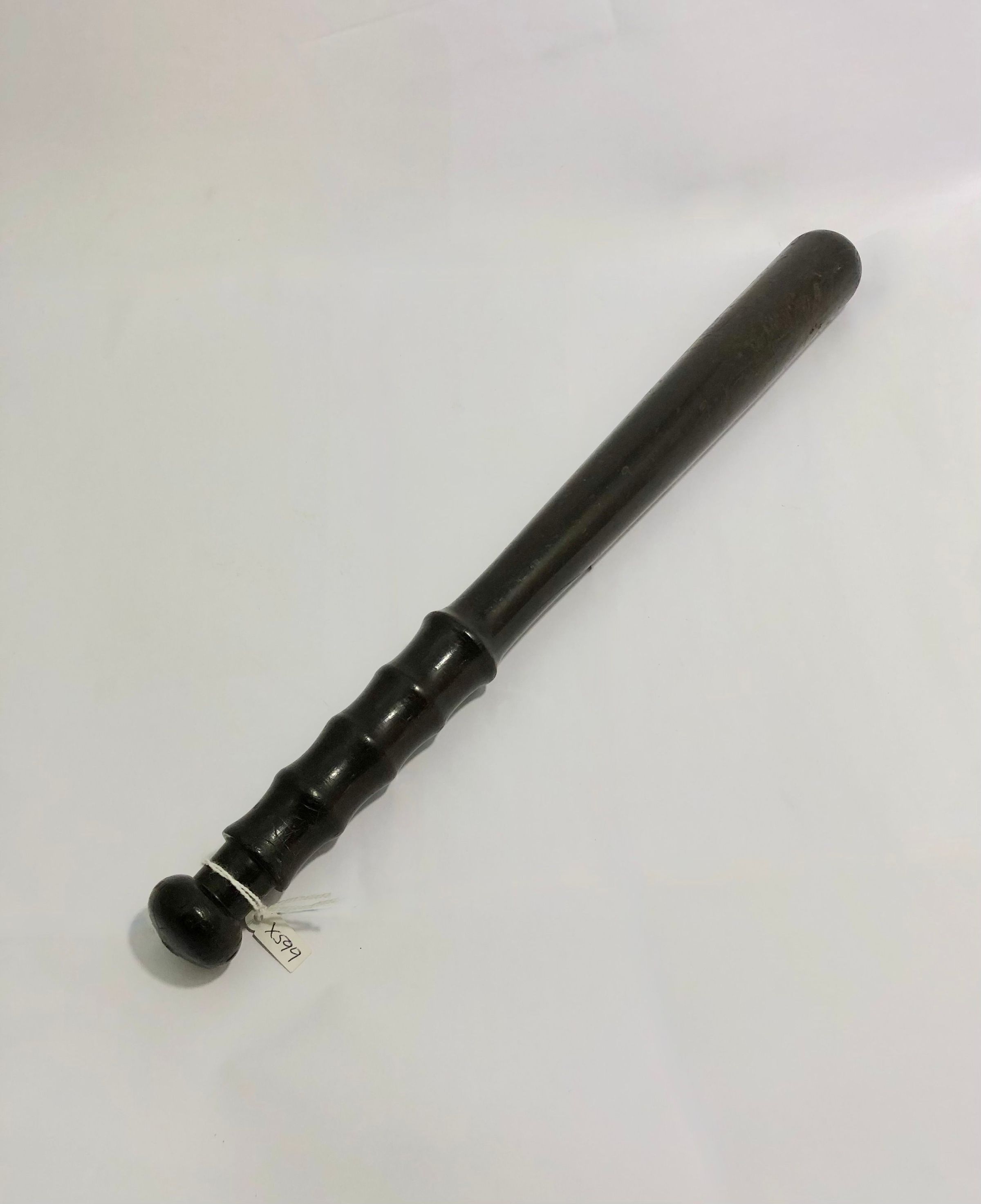
Plain hardwood truncheon c1900-1930Entry/Object ID
599Description
Undecorated dark brown hardwood truncheon, with domed top, 4 groove grip, 15 1/2 inches (39cm) in length. No wrist strap or maker's stamp or mark.Use
For a police officer to use as protectionContext
Decorated police truncheons became less common in the 1870s, and in 1887 the Metropolitan Police reduced the length of its truncheons from approximately 17 inches in length to 15 and a half inches long. This was as a result of the Met. abandoning the use of truncheon cases hanging from a belt. Instead they were to be carried in a special pocket sewn into the trousers, which necessitated a smaller truncheon, something that the City of London Police had already adopted (Wilkinson 2002). After some experimentation with different woods, the Met. began to issue plain cocus wood truncheons in 1887/88 and it is thought that these had handles consisting of 4 grooves, moving away from a multi turned grip. Other police forces followed suit and by 1900 a 15 to 16 inch truncheon with such a handle became standard issue. There were some variations in size and shape but these truncheons were much more utilitarian than the earlier Victorian examples, having no decoration and were often made of exotic hardwoods for strength and durability. This style of truncheon remained in use with British police until the 1990s when an increase in knife crime led to the adoption of longer polycarbonate and extendable batons.
The truncheon pictured is typical of what police officers across the UK would have carried throughout the first half of the 20th century. Such truncheons are difficult to date accurately but during and after the Second World War exotic hardwoods tend not to have been used to make truncheons, and as time went on they got lighter and lighter. Indeed many hardwood truncheons only date up to the 1920s and like all police equipment they were often re-issued many times. This particular one has a domed or mushroom top and whilst there was some variation in the exact shape and design of 20th century truncheons, they are all broadly similar.
There is a stong possibility that this truncheon was used in one of the Sussex police forces and if not then very similar ones would have been in common use throughout the region. It probably dates to no later than the 1930s.