Name/Title
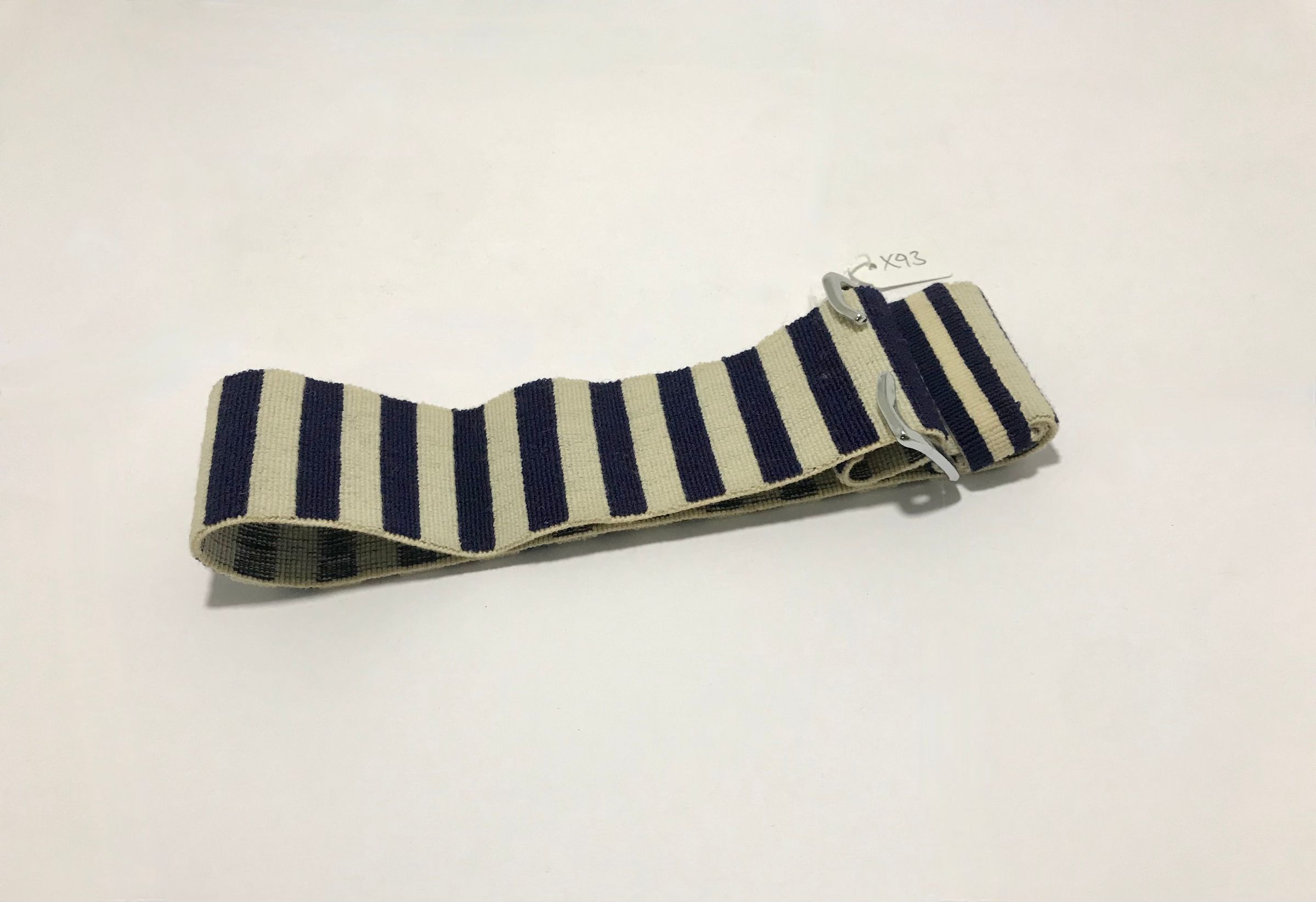
Police "Duty" armband c1950 - 1960Entry/Object ID
93Description
Plush cloth material blue and white vertically stripped armband with chrome plated buckle clasp.Use
To be worn on the left sleeve of a tunic at the cuff end in order to signify that an officer was on duty.Context
The first Metropolitan Police officers in 1829 were instructed to wear their uniform at all times, even when off duty. In order to signify whether an officer was on duty or not the "Duty Armband " was introduced by the Metropolitan Police in 1830, to be worn on the left sleeve cuff. To begin with these bands had horizontal stripes but over time they were changed to vertical, and before the use of arm chevrons or "stripes", between 1835 and 1864, were used to identify sergeants, who wore bands with thinner stripes on their right arms, constables wearing their's on the left.
Arm bands were adopted by other police forces who used either vertical or horizontal stripes. In Sussex there was some variation, with officers in Brighton originally wearing horizontal stripes, later changing to vertical ones. Hove Borough Police officers continued to wear bands with horizontal stripes until armbands were withdrawn, and in East Sussex Constabulary, constables wore armbands with horizontal stripes and sergeants ones with vertical stripes until the 1890s, after which all officers wore bands with vertical stripes. In Hastings Borough Police, unusually, they were worn on the right sleeve, whereas in Eastbourne Borough Police they were worn as usual on the left. In West Sussex Constabulary there is no evidence of them being worn at all, with a distinct absence in photographs. In Chichester, the small city force wore bands with horizontal stripes until it was disbanded in 1889.
Nationally the bands were usually blue and white, although the City of London Police had red and white striped duty bands, which officers still wear with tunics to the present day. In Sussex blue and white bands were used in most police forces except in Hove which used red and white ones. It is believed that the reason red was used in Hove was to distinguish officers from those of Brighton Borough Police.
When armbands were in use, tunics normally had loops attached to the left cuff in order to hold them in place.
It was only at the end of the 19th century that some police forces allowed their officers to wear civilian clothes off duty. However the practice of wearing duty bands continued, often because officers travelled to and from work in their uniforms. Slowly the practice was abandoned in many forces but the Metropolitan Police only withdrew duty bands in July 1968. In Sussex, police forces stopped using duty bands by the 1930s.
This example is probably from the Metropolitan Police and if so being cloth, would be an earlier version, as nylon ones were introduced in the 1960s.