Name/Title
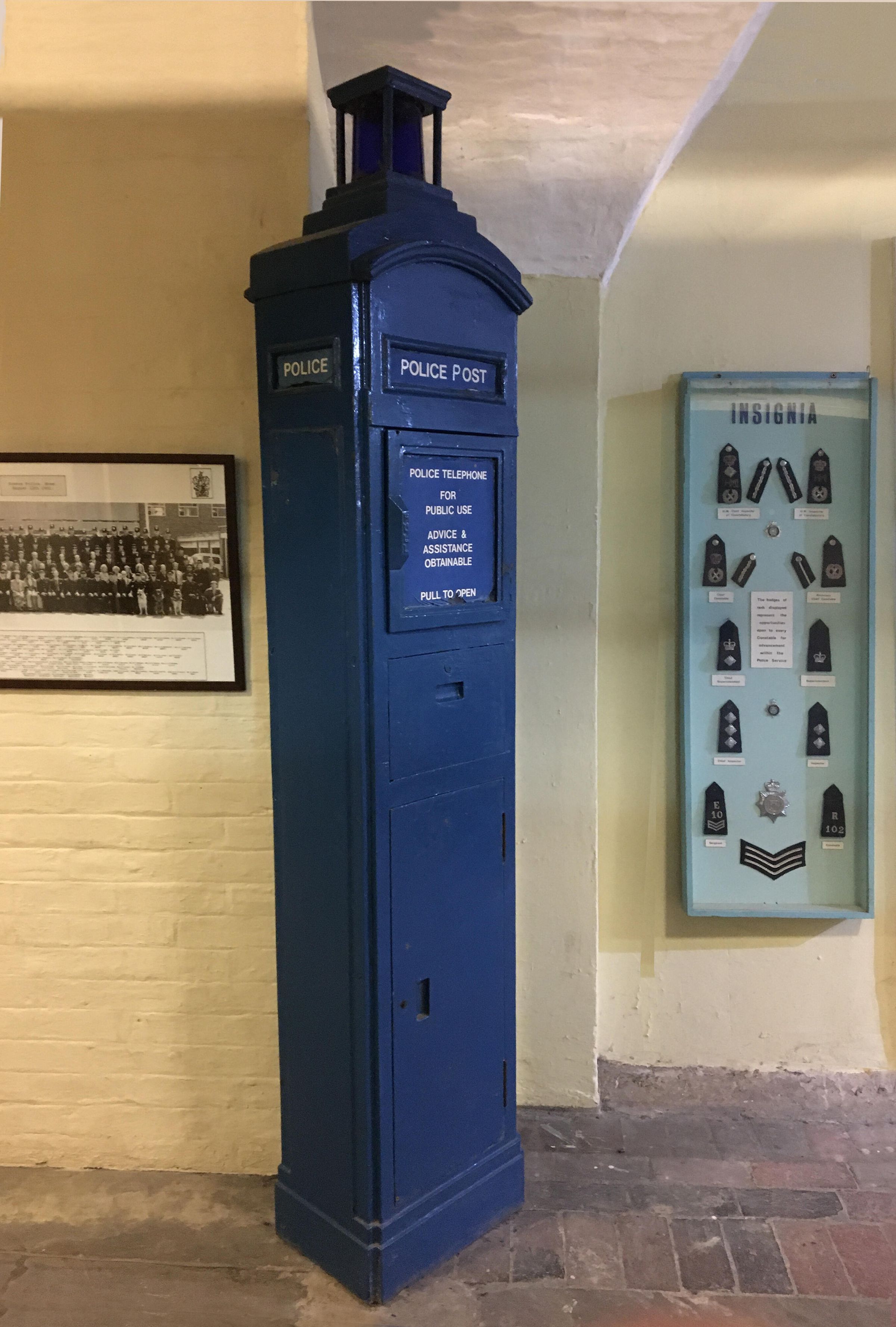
Police PA3 telephone post from Gatwick Airport c1958Entry/Object ID
2200Description
Cast iron police PA3 telephone post with three compartments, later self adhesive signage and blue coloured lamp. No phone or internal workings.Use
To house a telephone for the use of police officers and the public to contact a police station or control roomContext
Throughout the 1920s the police in the UK began to rely more on telephone communications. Police forces extended the use of police telephone kiosks or "boxes", many of which were wooden huts, and developed "Police Box systems". These not only allowed officers the ability to telephone a station, but a place to work in and actually commence work, or 'book on" from. This type of remote working meant officers could start duty on their beats without having to go to a police station first.
These systems were taken a stage further in London where the Metropolitan Police between 1929 and 1937 built nearly 700 Police boxes of a design that sci-fi fans would now recognise as Dr Who's TARDIS. However as the system moved into central London it was found that the "Tardis" style box was too big for narrow streets and the Chief Architect of the Met., Gilbert Mackenzie Trench, who had designed the larger "Tardis" Police boxes, designed a telephone post, very similar to the one pictured. This had three compartments, one for the telephone, one for the officer to use as a writing platform and one to store items such as a first aid kit and fire extinguisher. The last two locked and used the same key that opened the larger police boxes. Eventually 73 of these posts were used by the Met.
The phone compartment did not lock so that the phone could be used by the public and directly connected them to the police. If the control room wanted to contact an officer or officers, a light on the top of the post or other posts and boxes would flash. In London these lights were originally red but later changed to white. There was an internal light which a night illuminated glass or perspex signs at front, sides and in the top door.
In 1954 the Post Office used the same design and designated it the PA2 which they began to offer to police forces outside of London, to update earlier outdated police telephone posts. These older posts were the PA1, a totally different design of a triangular shaped box on a pillar. When used outside of London the new PA2 posts had an amber signal light instead of a white one. By the late 1960s with the increased use of personal radios, telephone communications became less important and police posts and boxes began to be removed from our streets.
The telephone post in the museum is a PA3 design which was first made in 1958. It was lighter than the PA2 and can be identified because it does not have a bottom part that was sunk into the ground like the PA2. It is also lighter and was designed to be bolted down on the inside, making it easier to install.
This particular post pictured has actually travelled more across Sussex than some officers did in their entire service. It is thought to have begun its service life at Gatwick Airport and the 1958 date or sometime thereafter ties in with a period of continuous expansion at the site. At the time the airport was policed by the Ministry of Civil Aviation Constabulary, and after 1960, the British Airports Authority Constabulary. In 1975 Sussex Police took over responsibility for policing the airport. Under Sussex Police this post is known to have been located at the north of the airport and at one time was used to house telephone connections that extra cables could be plugged into, thus enabling fixed telephone lines to be used across the airport in an emergency. After it became redundant the post was moved to stand outside Gatwick Airport police station. It was then later moved to stand outside the reception area at Police HQ in Lewes, before finally ending up in the museum at Brighton. At over 2 metres in height, it is the largest object in the collection, not to mention the heaviest.
It is not known if this type of police post was used elsewhere in Sussex, but is is known that many of the Sussex Forces made extensive use of the earlier PA1 pillar as they were the Post Office's standard design for the police from 1932 until 1954. Photographic evidence clearly shows their use in Brighton and Eastbourne, the latter using them until amalgamation in 1968. So if any of the police forces in Sussex needed to replace one or have a new post installed after 1954, it would have been similar to the one in the collection.
The PA1 pillar had a locked compartment for a police use telephone and an unlocked door which activated a speaker phone for the public, connecting them direct to the police.