Name/Title
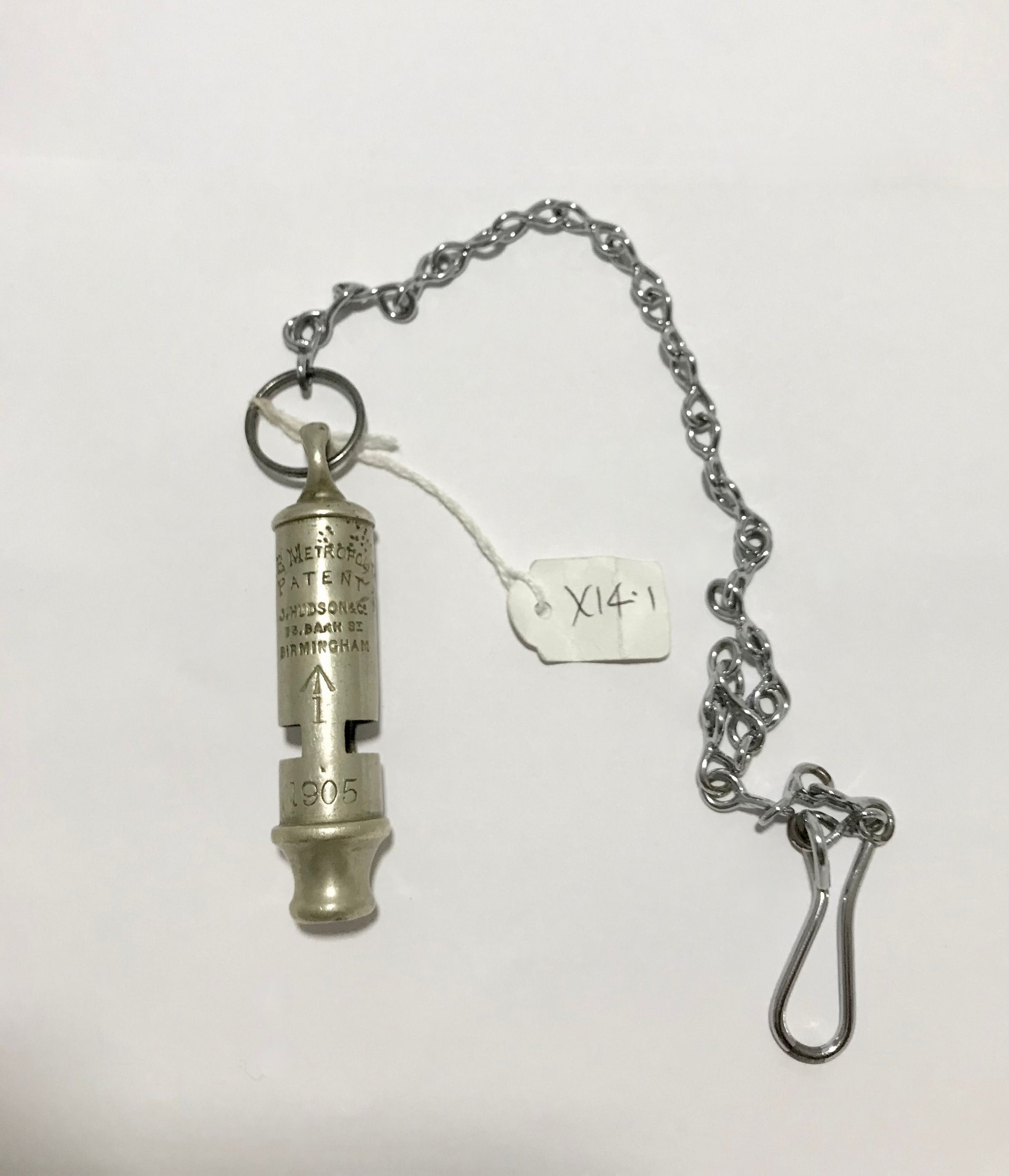
Police type General Service whistle with Government/military markings 1905Entry/Object ID
14.1Description
Nickel silver police type whistle with chrome plated chain and button hook attached with a key loop. Marked "The Metropolitan, Patent, J. Hudson and Co., 13 Barr St. Birmingham" Government mark, "1905"Use
For police officers and others to raise the alarm and summon assistance.Context
The use of the whistle by police to replace the rattle as a means of raising the alarm, only became widespread after 1884, when whistles were adopted by the Metropolitan Police in London. Joesph Hudson and Co. supplied these whistles to the Met. and the "Metropolitan" trademark was registered to reflect this, the connection being used heavily in the company's marketing.
To begin with a number of Birmingham based companies produced whistles for the police but Hudsons soon became the largest manufacturer. The company was formed in 1870 and is still in existence as The Acme Whistle Company. Whilst most famous for producing whistles, Hudson and Co. also manufactured other items of police equipment until the 1950's.
The correct name for a police type whistle is a General Service Whistle or GWS, as they were not only used by the police, and after 1884 they became popular not just with police but with all manner of other institutions as well as with the general public.
This particular whistle has the "Broad Arrow" mark identifying it as Government Property. This mark is usually found on military items and when applied to whistles it also includes the year of manufacture, in this case 1905. What is more interesting is the use of the "I", which signifies Indian Government property, probably for use by the British Indian Army.
While many police forces had whistles made with their names stamped on them, some did not. Even those that did are thought to have purchased plainer unnamed whistles as replacements or to supplement their supplies. This was because personalised whistles were more expensive and had to be bought in larger numbers. Hudson and Co. had a minimum order policy for such marked whistles of 144 or a gross.
The source of this whistle suggests it was used by police in Sussex. It may have originally been obtained as surplus Government stock or from an ex military officer and found its way into police stores at the end of their service. The addition of a much later chrome plated chain certainly infers police use, most military whistles were originally issued with leather button straps.