Name/Title
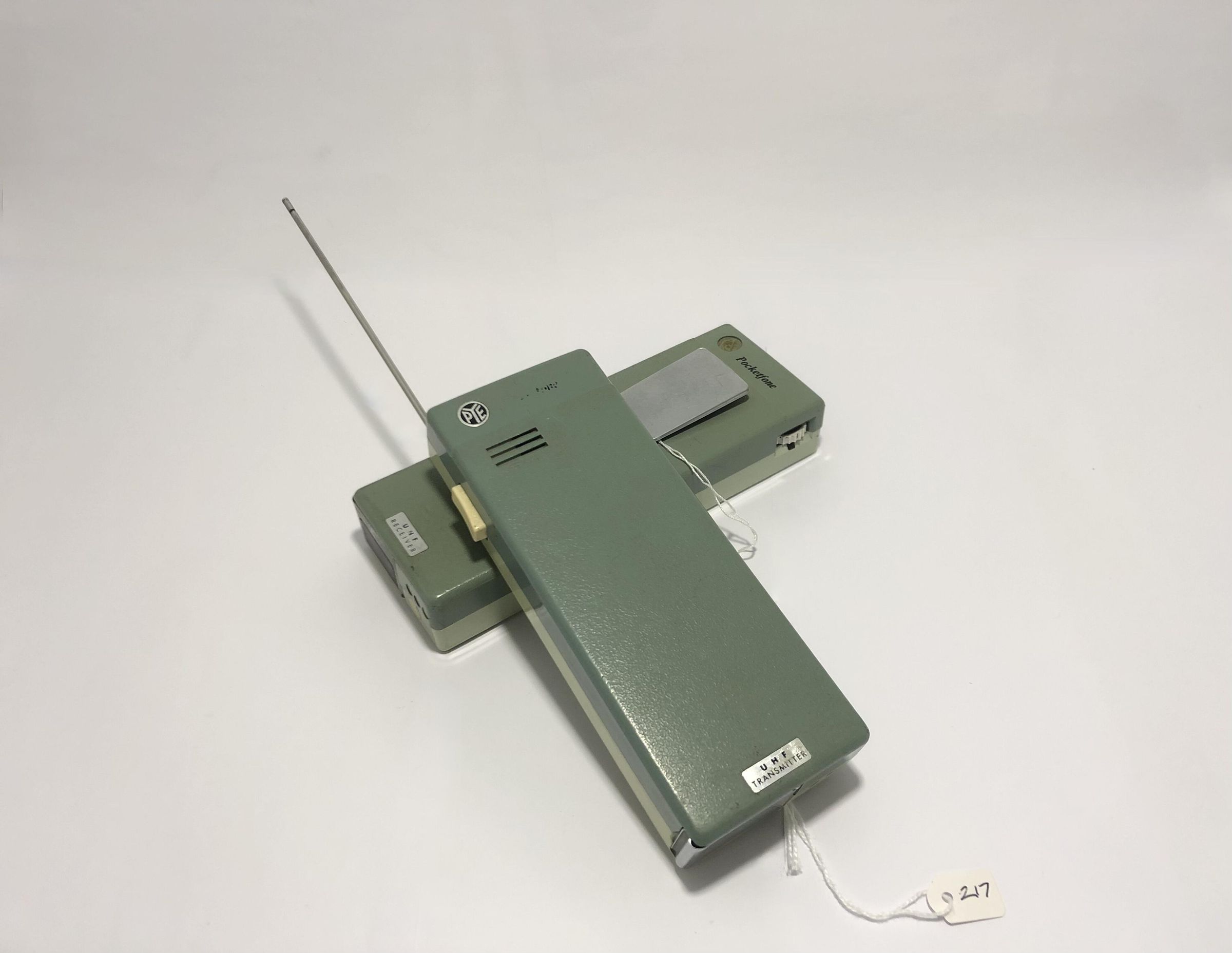
Pye PF1 Pocketfone two part personal radio set 1964 -1972Entry/Object ID
217Description
Two part Pye Pocketfone personal radio set, consisting of seperate transmitter and receiver. The transmitter, with the aerial, is marked "PYE" "UHF Transmitter" with serial number "5007" and the receiver "PYE" "UHF Receiver" with serial number "2-22567". Both have marks for channel "35". The aerial is missing a plastic cap. The "Pocketfone" logo has worn off of the transmitter unit.Use
For police officers to receive and transmit messages from and to their local stationsContext
From the late 1920's police forces had been using various forms of radio communications. However due to the size of the equipment required most police radio use was confined to vehicles. A few forces, Brighton being the first in 1933, developed workable pocket radios but these were only capable of receiving messages. Brighton stopped using their system in 1939 when its frequency was re-allocated due to preparations for war. Experiments continued nationally after the Second World War but the challenge was to develop a transmitter unit that was small enough for an officer on foot to carry. So until the 1960s officers on the "beat" had to rely on telephone communications, at police boxes or police pillars.
By the 1960's a number of more portable radios were available and in August 1964 the British electronics company, Pye launched the Pocketfone, a two-piece set of separate receiver and transmitter. These units were lightweight and worked well in buildings and built up areas. The receiver had a clip and was designed to go into a breast pocket or be attached to the rear of a tunic lapel, while the transmitter could be put in another pocket, there being no wire connection between them. The aerial was spring loaded and automatically extended when the transmit button was pressed.
These radio sets were instantly popular with companies and institutions, though the British Home Office (the Government department responsible for policing) only began to trial them in 1965. The Pocketfone was subsequently adopted by the Home Office as its standard police personal radio design (radiohistory.uk). Parliamentary records show that the rollout was slow and that by January 1966 only 23 out of 123 police forces had access to personal radios (Hansard 18/1/166). At the start of 1967, 600 radios were said to be in use, with a target of 10,000 by the end of that year and a target of between 16,000 to 20,000 in use by the end of 1968 (Hansard 29/11/67).
Not all police forces adopted the Pocketfone, the Metropolitan Police in particular believed it too fragile and in 1966 began to use the Storno CQP500 radio and only completed the installation of the system in 1969.
Pocketfones were used in Sussex prior to the 1968 amalgamation. It is known that they were adopted in West Sussex in 1966/1967 and in Brighton in 1966. They are likely to have been used elsewhere and this particular set would definitely have been used by Sussex Constabulary as they came from Sussex Police stores. Hastings Borough Police began to use personal radios in April 1967, which were almost certainly Pocketfones and it is likely that East Sussex Constabulary and Eastbourne Borough Police were using them by then as well.
The Pocketfone was replaced as the standard Home Office police personal radio by the 3 channel Bunrdept BE470 in the 1970s, but Pocketfones remained in use in Sussex Police until the 1980s.