Name/Title
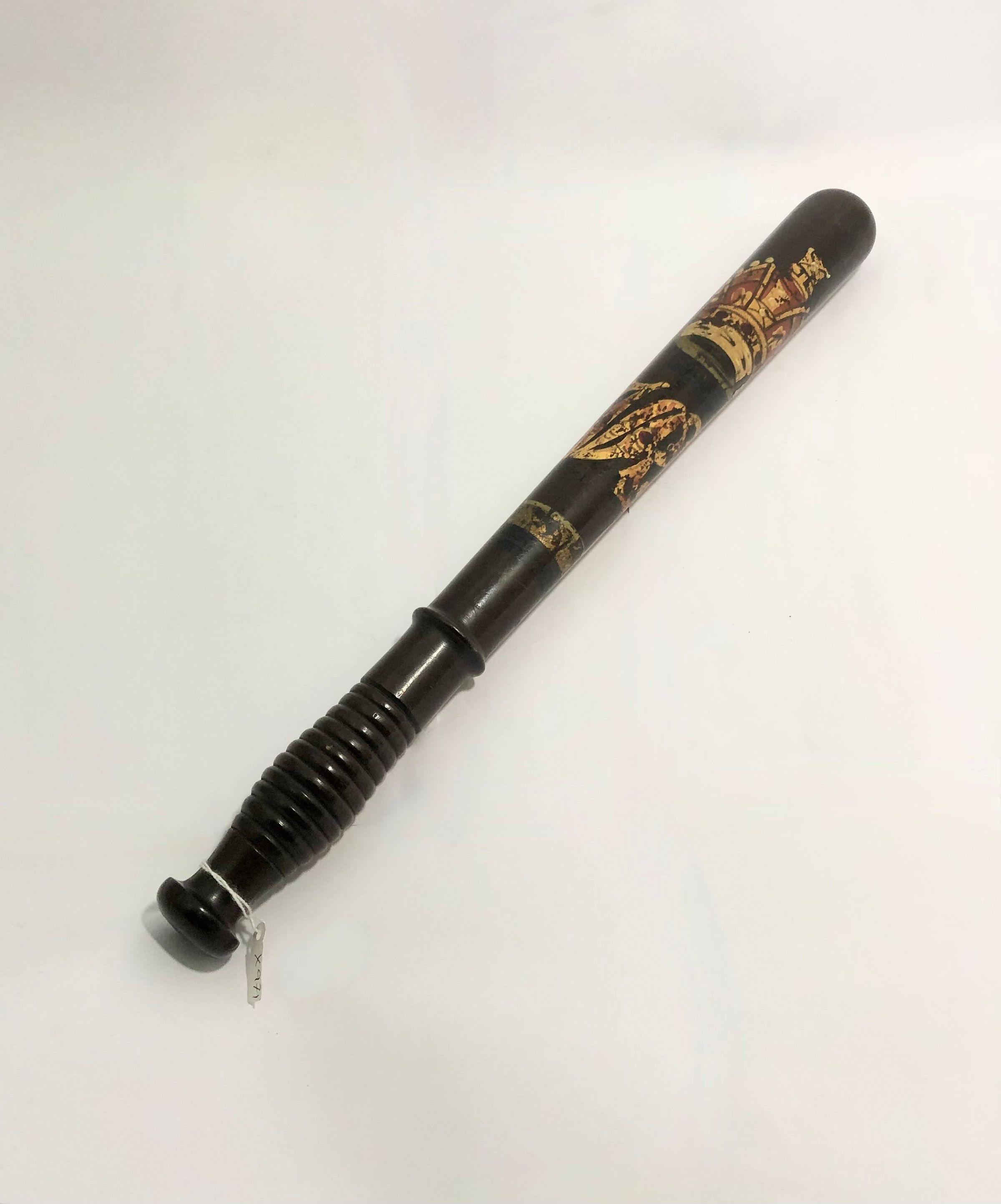
Scottish police painted truncheon c1880sEntry/Object ID
971Description
Hardwood truncheon, 16 inches (41cm) long, decorated in gold red and white paint with a crown over a VR cypher, with a single gold band and a single black band between the cypher and the handle. The end of the handle is stamped "McNAUGHTAN GLASGOW". No wrist strap.Use
For use by a Scottish officer as protection and as a symbol of their authorityContext
As with England, there is no such thing as a standard Scottish 19th century truncheon and various designs were used. However this example is of probably the most generic style that was used in the country and is worthy of comparing to, generic English truncheons made by Parker Field. It is typical of truncheons made by Daniel McNaughton of Glasgow. Unlike many other makers, McNaughton did not paint his truncheons black but applied the painted decoration straight onto the wood, whatever colour it happened to be. The rest of the decoration is not that different from generic styles used in England.
The use of the VR cypher only indicates that this truncheon was made anytime between 1837 and 1901. McNaughton was a prolific manufacturer throughout the 19th Century and was known to be advertising his services to the new county police forces in Scotland that were created following the 1857 Police (Scotland) Act. He had previously been supplying truncheons to the Glasgow City Police. The fact that this truncheon is of a shorter length may indicate that it is later example c1880s, the time when shorter truncheons were adopted in England. The gold band on this truncheon, something unique to Scotland would have contained the name of the police force to which it was made for. Unfortunately whatever was originally written has worn off.
Interestingly Daniel McNaughton is thought to be the father of another Daniel McNaughton whose trial in London for murder in 1843 led to the establishment of The McNaughton rules for dealing with suspects claiming a defence of insanity. Both were woodturners, and the son was confined to an asylum following his acquittal until his death in 1865.