Name/Title
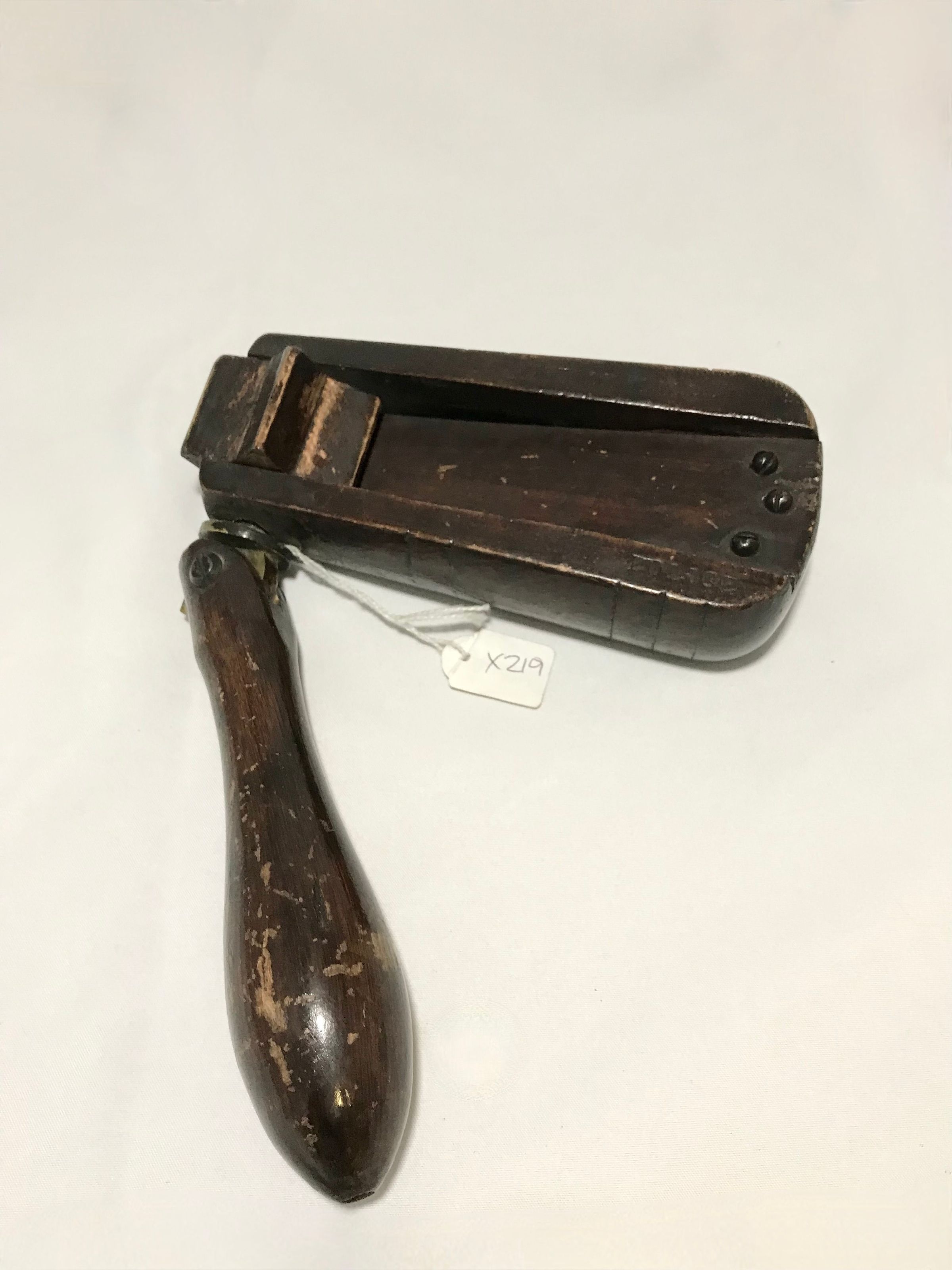
Small wooden police rattle with folding handle from Hastings Borough Police 1883-1886Entry/Object ID
219Description
Small wooden police rattle with folding handle and lead weights built into paddle. Stamped, "FIELD TAVISTOCK ST. WC", "POLICE"Use
To raise the alarm and summon the assistance of other officers.Context
Rattles were used since at least the 17th century as a means of raising an alarm. They were used by the first Metropolitan Police officers in 1829, as they had been by the watchmen they replaced. The type of small rattle pictured is of a generic type used by police in the UK throughout the 19th century, only being phased out with the widespread introduction of the police whistle in the 1880s. This particular one is of a folding handle type, originally designed to make it easier for the first officers to carry them in the tailcoat pockets of their jackets. There is a similar type with a fixed handle (see item 1182 ).
This rattle was made by the company of "Parker Field and Sons", who manufactured and supplied police equipment throughout the 19th century. They only used the "Tavistock Street" address between 1883 and 1886. It is thought that this rattle along with a truncheon (item 218) was issued to a PC John Dudeney who joined Hastings Borough Police on 25th July 1885, it having come to the museum via relatives. From local newspaper reports we know that in 1895 Dudeney's collar number was 12 and that by 1902 he had been promoted to a sergeant. We also know that in November 1923 he was 65 and had already retired, as another article shows that he had made an application to have his pension increased and that he was awarded another 4d (pence) a week.
This rattle and its associated truncheon, demonstrate what equipment was issued to Hastings Borough Police officers in the 1880s. The timing is interesting as at the same time PC Dudeney was allocated these objects, they were beginning to be phased out in the UK. In 1884 the whistle began to replace the rattle in the Metropolitan Police and in 1887 the Met. also began to replace its 17 inch truncheons with shorter plain ones.
Whistles replaced rattles because not only were they easier to carry than bulky rattles but experiments in London showed they could be heard over a much longer distance than a rattle.