Name/Title
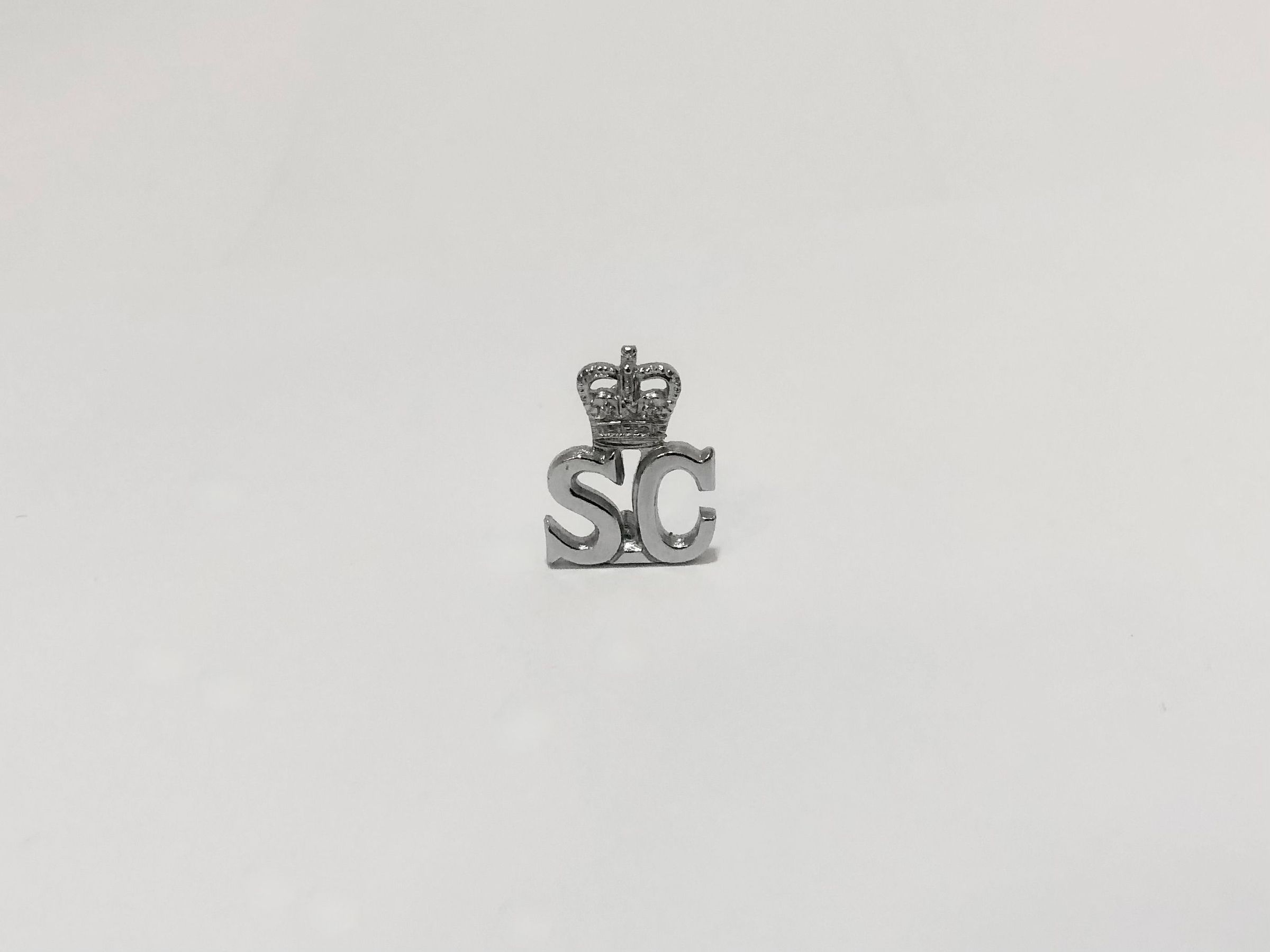
Special Constabulary Queen's Crown collar/lapel badge 1952 - 2022Entry/Object ID
109Description
Small metal chrome plated badge consisting of the letters"SC" surmounted by a Queen's Crown, with a uniform fixing to rear.Use
For use on the collars or lapels of special constable's tunics.Context
The Special Constabulary is made up of volunteers who carry out uniform police duties in their own time, and in its current form it dates from The Special Constable's Acts of 1914 and 1923. Until 1914 special constables could only be sworn in for very limited amounts of time if there was the threat of a riot or a serious disturbance and were not uniformed. The threat of war in 1914, and the likelihood that many police officers, being ex soldiers and therefore army reservists, would be "called up" to fight led to concerns that there would be a shortage of officers. To counter this the 1914 Act allowed special constables to be sworn in for the duration of the conflict. The 1923 Act made the temporary arrangement permanent.
With the 1914 Act and longer periods of service special constables were given uniforms for the first time, though in may areas shortages meant that most specials only had proper uniforms towards the end of the war. However by the end of the war and in particular following the 1923 Act, similar uniforms to regular officers were in use, though helmets were not issued to specials, who wore caps. They also worn different rank insignia as the rank structure in the special constabulary is different to that for regular officers.
The type of insignia used by special constables varied from police force to police force. Most forces used the same insignia as full time officers, though some used generic special constabulary insignia and others used special constabulary insignia unique to the particular force in question.
Special constables often had additional insignia to identify them as specials. This usually included an "SC" prefix before their warrant number. In some areas pairs of badges such as this were used. On closed collar tunic, they were attached to either side of the collar along with the officers' number and on open necked tunics on each lapel. They were also used on the epaulettes of shirts and rain coats and the collars of capes.
This particular example could date anytime between 1952 and 2022, by virtue of the crown used, though if it was from Sussex Police (which is probable) it probably dates from the 1970s or 1980s, though it would depend on whether it was originally on a tunic or epaulettes. These badges were definitely used by Sussex Constabulary from 1968 on epaulettes but not necessarily on tunics. In the 1970s they were used on tunic lapels and elsewhere on removable epaulettes. With the introduction of new male tunics in the mid 1980s over time special constables tended to wear the same lapel shield coat of arms badges as regular officers, but retained the 'SC" badges for epaulettes until metal numbers were placed with embroidered ones in the 1990s.
In the modern Sussex Police the only difference in the uniforms of regular and special constables are the format of epaulette letters and numbers, special constables having the "SC" prefix followed by a 4 digit number.