Name/Title
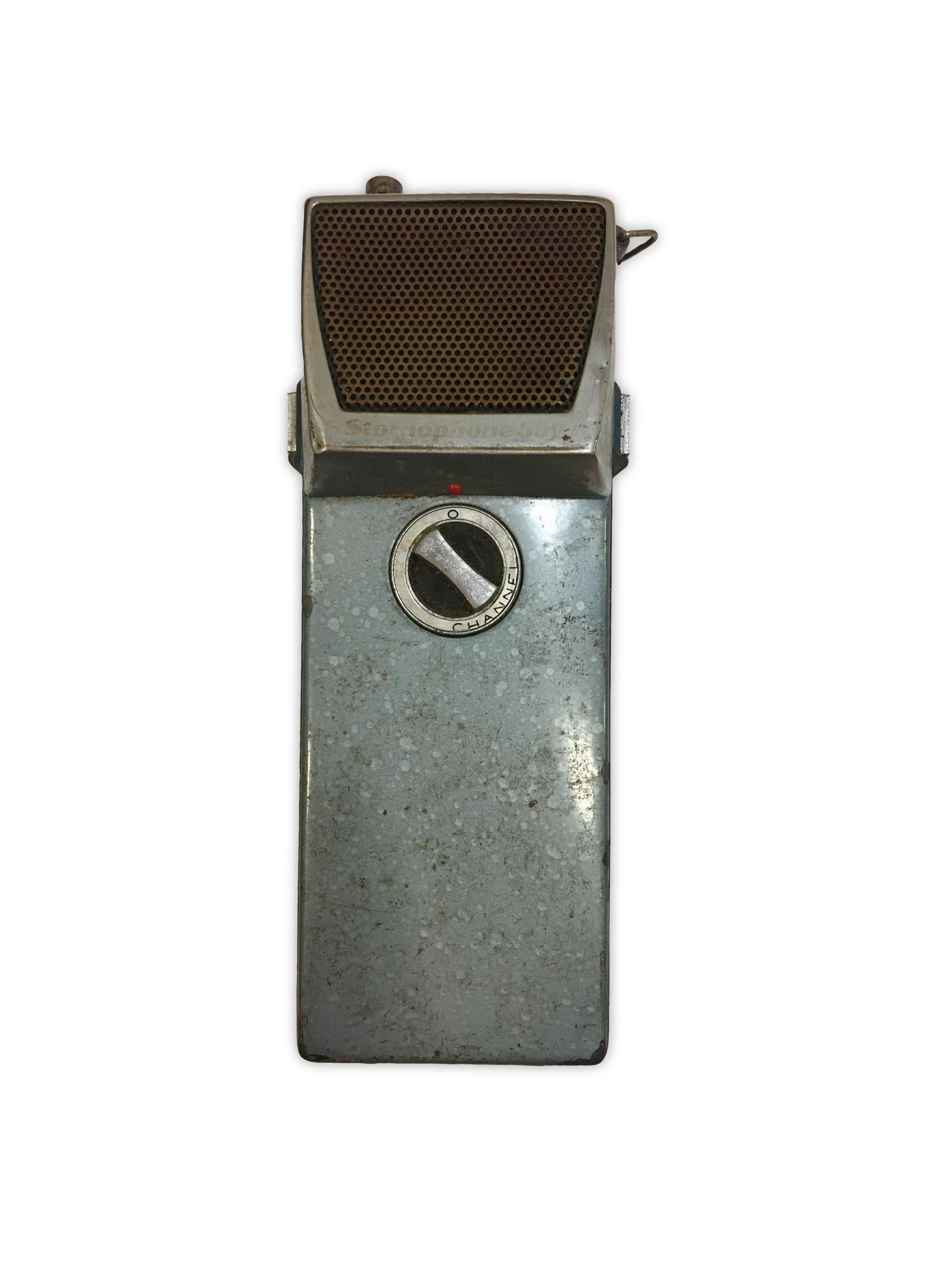
Stornophone 500 VHF personal radio c1963Entry/Object ID
1225Description
Stornophone 500 VHF personal radio, all metal construction, with buttons to side, front metal speaker/microphone grill and channel switch to front. It is missing an aerial and rear battery pack. Markings to front have worn off but rear maker's plate is marked "Storno Copenhagen Denmark", "Type CQP 542" and "Serial" with indistinct stamped number including "9". Also marked for 3 channel frequencies with only "1" stamped for "TX 97.100Mc" and "RX 81.800Mc".Use
For a police officers to receive and transmit messages from and to their local stationsContext
From the late 1920s police forces had been using various forms of radio communications. However due to the size of the equipment required most police radios were confined to vehicles.
A few forces, Brighton being the first in 1933, developed workable pocket radios but these were only capable of receiving messages. Brighton stopped using their system in 1939 when its frequency was re-allocated due to preparations for war.
Experiments continued nationally after the Second World War but the challenge was to develop a transmitter unit that was small enough for an officer on foot to carry. So until the 1960s officers on the "beat" had to rely on telephone communications , at police boxes or police pillars.
The "Stornophone 500" was introduced in 1963 by the Danish company Storno which was established in 1947 and operated until 1986, when it was taken over by Motorola. From 1960 the company had a UK factory in Camberly under the name Storno Ltd. At the time of its introduction this unit was the world's smallest portable transceiver and is very recognisable as what became to be called a "walkie talkie".
This particular radio can be identified as a VHF version as it has the capability for 3 channels, UHF versions only having 2 channels. It came from Sussex Police and is thought to have been used in Sussex prior to the 1968 amalgamation by which time the Pye Pocketfone was being used across Sussex.
It is part of a small collection of contemporary radios that appear to have been part of a display at some time, within Sussex Constabulary/Sussex Police as they came complete with display cards. The card with this radio suggested it was in use in Brighton between 1962 and 1964.
Given that the Storno 500 was only introduced in 1963, this is probably an error. If they were used in Brighton it would have only been in a limited capacity as the 1967 history of the force states that personal radios were only introduced for all officers in 1966 and indicates that these were Pye Pocketphones.
Research shows that the frequency combination on this radio was one of those used in Home Office trials for a VHF police personal radio late 1964/65. It is likely that it may have been used in Sussex, possibly in Brighton, as part of those trials.
Interestingly in the late 1960s when most police forces nationally were adopting the Home Office standard approved personal radio, the Pye Pocketfone, for use by all officers, the Metropolitan Police decided to use a version of the Storo 500 instead. This was specially customised for them and was designated the CQP512 R-1549 and differed from the unit pictured by having no speaker/microphone on the body of the unit but instead on an extended brooch.
The rollout of these personal radios in the Met. was only completed in 1969. One of the reasons that the Met. preferred the Storno over the Pye Pocketfone was because of its robustness, the Storno having a strong metal case, compared to the somewhat flimsy plastic of the Pocketfone.