Name/Title
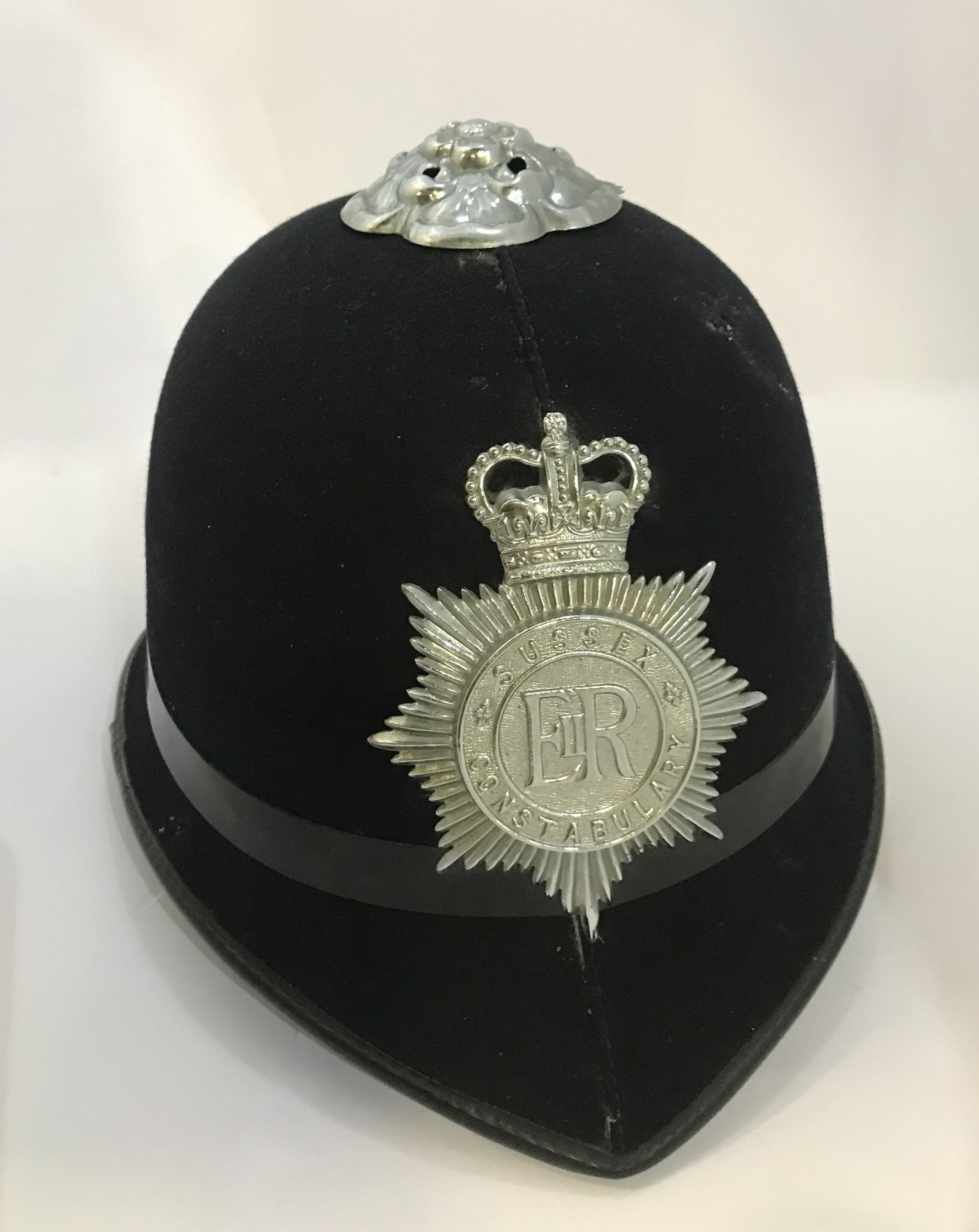
Sussex Constabulary Lightweight motorcycle/mounted officer's helmet 1968-1974Entry/Object ID
655Description
Two panelled felt covered Sussex Constabulary re-enforced mounted officer's helmet with chrome rose top and chrome one piece Sussex Constabulary Queen's Crown "EIIR" single piece helmet plate. The inside has cork padding a webbing harness, leather lining and headband and a harness chinstrap. Marked "Protective Police Helmet, J. Compton Sons and Webb, London", ""7 1/4" "AJ210"Use
For use by a Sussex Constabulary mounted male constable or sergeant.Context
Most of the pre amalgamation Sussex police forces made use of mounted officers, especially in the late 19th and early 20th centuries. However they usually rented horses when they were required and did not have full time mounted units.
Photographs indicate that they did use horse breastplates with individual force crests on them, suggesting that they retained at least some tack.
The only two forces that are known to have had their own horses and to have retained them until amalgamation in 1968, are those of Eastbourne and Brighton Boroughs.
In 1929 Eastbourne Borough Council took ownership of a large area of downland around Beachy Head, in order to prevent development. To police this area the unique police post of Downs Ranger was created, a full time mounted officer of Eastbourne Borough Police, based at a stable at Beachy Head. The officers in this role and their horses became famous with tourists. PC Henry Poole served in the role from 1929 to 1953 and PC Harry Ward from 1953 until 1966. The last Downs Ranger was PC Jack Williams who took over in 1966.
Brighton Borough Police also had full time horses and in the 1960s retained two for its mounted unit. When the new police station at John Street was finished in 1965 it came complete with stables at the rear.
After the 1968 creation of Sussex Constabulary a full time mounted branch was retained at the John Street stables. This unit was part of the Traffic Department and officers were issued with white traffic officer's caps. In 1974 it was felt that the horses were not being used efficiently and Sussex Constabulary recruited two experienced mounted officers from other forces, PC Bob Bird from the Metropolitan Police and PC Tom Grey from Glasgow. At the same time PC Jack Williams, who was still the Downs Ranger, joined the unit at Brighton and the role of Down's Ranger came to an end. Sussex Constabulary became Sussex Police and the mounted unit eventually grew to four police constables, a sergeant and four horses, under an inspector who also managed the Dog unit. The mounted unit was eventually disbanded in 1989.
This helmet is not a "Custodian" public order helmet and pre dates that design and is actually designed for lightweight motor cycle use and is slightly smaller than a standard police helmet, which is why the badge or helmet plate looks a little large. These helmets were designed for attaching a badge with a slider fitting and in London special smaller versions of the Metropolitan Police's helmet badge were made for them. Sussex Constabulary adapted their existing helmet badges to fit these helmets see item 2522. However the badge used here has traditional fittings that have been forced through this helmet. This style of helmet plate was used by Sussex Constabulary from its formation in 1968 until the force name was changed to Sussex Police in 1974.
This helmet was supplied to the re-vamped mounted unit in 1974 after PC Bob Bird and PC Tom Grey, requested proper police riding helmets to supplement the caps they were issued with. Initially they were not supplied with riding hats but previously issued lightweight motorcycle helmets such as this. The "AJ210" mark is a Sussex Constabulary warrant number for a male officer whose surname begins with the letter "J", and was originally issued with this helmet for riding a motor cycle.