Name/Title
Sussex Constabulary sergeant's Gannex raincoat c1968 - 1974Entry/Object ID
2027Description
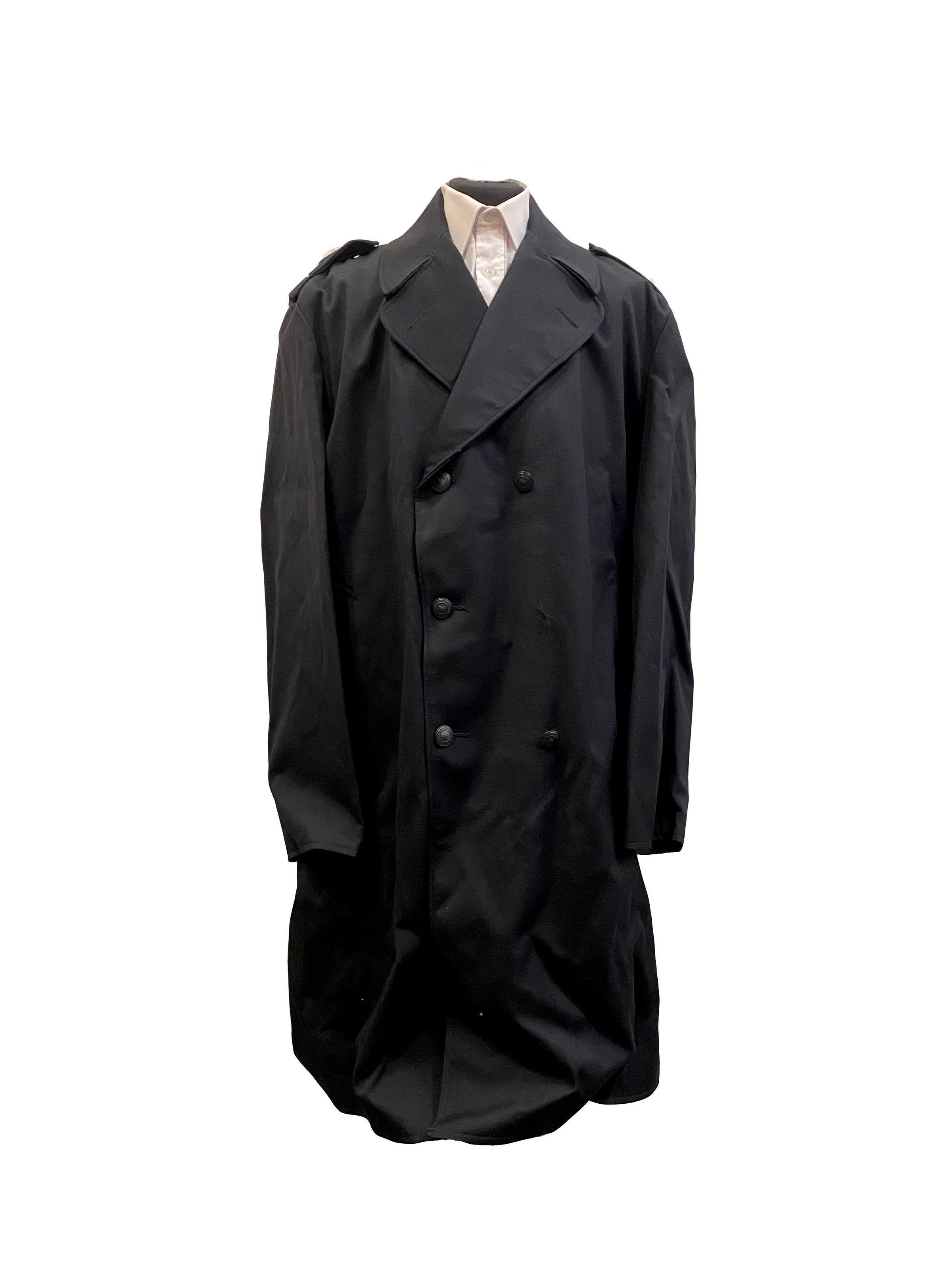
Black coloured Gannex cloth double breasted knee length raincoat, with two rows of four large black plastic buttons (one button is missing) two of which are under the lapels, and large epaulettes on the shoulders, each fastened with a small black plastic button and made of the same material as the raincoat. There are two slanted hip pockets and a button hole on the left lapel. All buttons are marked "Sussex Constabulary" with a Queen's crown. Attached to each epaulette is a chrome plated metal letter "H" over the chrome plated numbers "810" and a chrome plated three curved chevron sergeant's stripe badge, with additional detailing. Inside is a label with Royal appointment warrants and marked "Manufacturers and Suppliers of Gannex Cloth Kagan Textiles Ltd GANNEX CLOTH The Best All Weather Fabric In The World Regd. Trade Mark. Made in England World Pat". There is another partly obscured label marked " H. ?otley & Company Ltd Sussex Police" with handwritten "H.T.F Hother H810" together with some sizes.Use
For a Sussex Constabulary sergeant to wear as an outer garmentContext
From the late Victorian period police officers were issued with both capes and thick woollen overcoats for use at night and during the winter. These coats are often referred to by the military term "greatcoat", and both single and double breasted styles were used by the police. By the 1960s though, police forces were replacing overcoats with varying styles of raincoats such as the one pictured. These were usually made of Gannex cloth, and consequently all similar police raincoats were referred to as "Gannexes". They were water repellant and much lighter than woollen overcoats, which became even heavier when wet.
Gannex cloth was invented in 1951 by Joseph Kagan, and consists of an outer layer of nylon and an inner layer of wool, with air acting as an insulator, between them. Gannex raincoats were famously worn by the labour politician and prime minister Harold Wilson, who promoted them on behalf of the manufacturer.
The buttons and label on this particular raincoat identify it as having been made for Sussex Constabulary. The Amalgamation Memorandum document from 1967 on the formation of the force, states that officers were not to be issued with overcoats, but instead: two Gannex heavyweight coats, one Gannex lightweight coat, a cape and a Gaberdine raincoat.
The epaulette letter and numbers "H 810" identify this coat as having been issued to PS Herbert Hother, who had been a sergeant in Brighton Borough Police and went onto serve in Sussex Constabulary/Police until his retirement in 1980. The chevron stripe epaulette badges are interesting as they show that Sussex Constabulary initially used this design of metal sergeant's stripes for epaulettes. Later in the 1970s they adopted a simpler less fancy style, which was used until metal epaulette insignia was discontinued and replaced with embroidered epaulettes in the mid 1990s. The buttons date it to between 1968 and 1974.
This raincoat would have been worn with a blue shirt and tie.