Name/Title
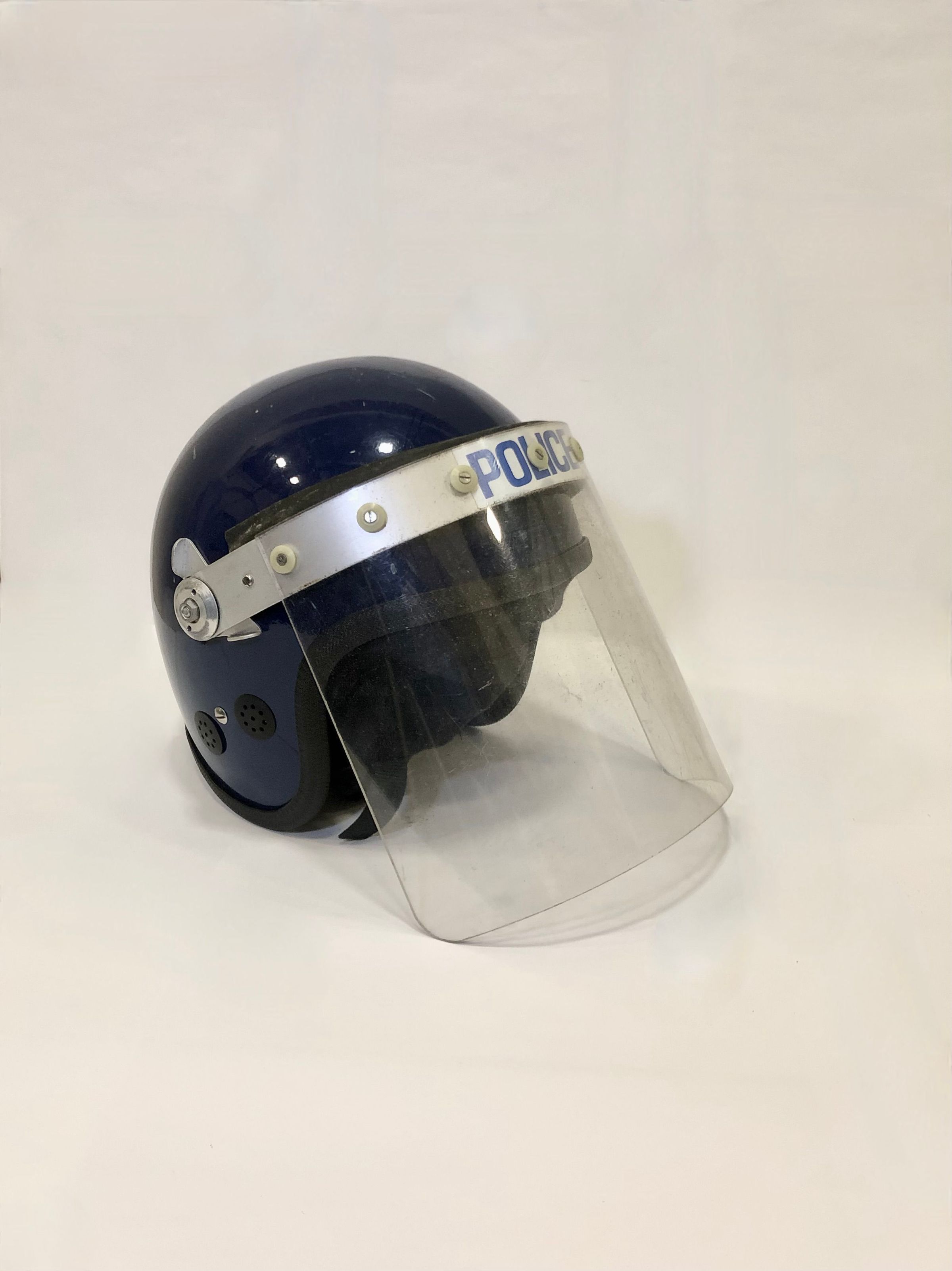
Sussex Police constable's "NATO" public order helmet c1984Entry/Object ID
2441Description
Police blue re-enforced public order helmet, with lifting clear perspex visor, and cupped rubber chinstrap. Marked at front under visor on a blue on white sticker "Police". Marked to rear on blue sticker the white letter "C" and on a separate sticker the numbers "37". There is also a red coloured diamond mark. On the outside on left is a small size label marked "2 - 6 7/8-7 56-57"Use
For a PSU constable to wear during a public order situationContext
Following a number of riots and violent public order situations in 1981, police in the UK began to be equipped with specially designed protective equipment. This included so called "riot" helmets, shields, arm and leg pads and fireproof clothing. Until this time all that was generally available were re-enforced "custodian" versions of the traditional police helmet. Along with the equipment came better training and tactics that have evolved over the intervening years. Officers that receive additional training are organised into Public Support Units (PSU's) which normally consist one inspector , three sergeants and 21 constables, including three drivers. Each PSU is subdivided into three "serials" consisting of one sergeant and six constables, with their own customised mini bus and a driver. Several PSU's are usually commanded by a suitably trained officer, usually a chief inspector, who themselves have specially trained "Tactical Advisors".
This particular helmet was issued to PC Ian Borthwick who served in Sussex Police between 1976 and 2007. It was worn by him during the policing of the 1984 to 1985 miner's strike. The scale of this industrial action led to large numbers of officers from around the country to be drafted to various mining areas, especially in Nottinghamshire and Yorkshire, in order to assist local police forces. Over the length of the dispute, Sussex Police sent a total of 416 Police Support Units to assist, representing a total of 56,901 officer hours (Poulsom, Rumble and Smith 1987).
The helmet has a more refined visor attachment than the very earliest police public order helmets but does not have a neck guard seen on later versions. The letter "C" on the rear identifies the wearer as a member of a Sussex Police "Central" Division PSU, Central Division being Brighton. The number "37" is interesting as the Home Office numerical code for Sussex Police is 47 along with the letter code "KB". However 37 is the number of Sussex Police, when placed in alphabetical order. The use of 37 could indicate that at the time the Home Office codes were not being used to identify the specific force a Public Support Unit was from, or that the alphabetical code was uniquely used for the miner's strike operations. More recent helmets from Sussex are all marked "KB" to identify the force, front and rear in yellow lettering.
Police public order helmets such as this are often called "NATO" helmets. This term dates back to the 1970s when the British Army were heavily involved in the "troubles" in Northern Ireland. Due to increased rioting the army needed a better helmet that the steel ones, fitted with an improvised visor, that they were using. So a purpose made riot helmet, the "Cromwell" was introduced, which was an army motorcycle helmet with a visor fitted. Because these were Army issued motorcycle helmets they were labelled inside with NATO stock numbers, present on all military equipment, used within the NATO Alliance. When in 1981 the police suddenly needed protective equipment, they were supplied with Army riot helmets complete with NATO stock numbers. To begin with some were still green in colour. Consequently the term "NATO helmet" stuck and is still in use within the police, distinguishing these PSU helmets from reinforced versions of the traditional police helmet, which are called "custodians".