Name/Title
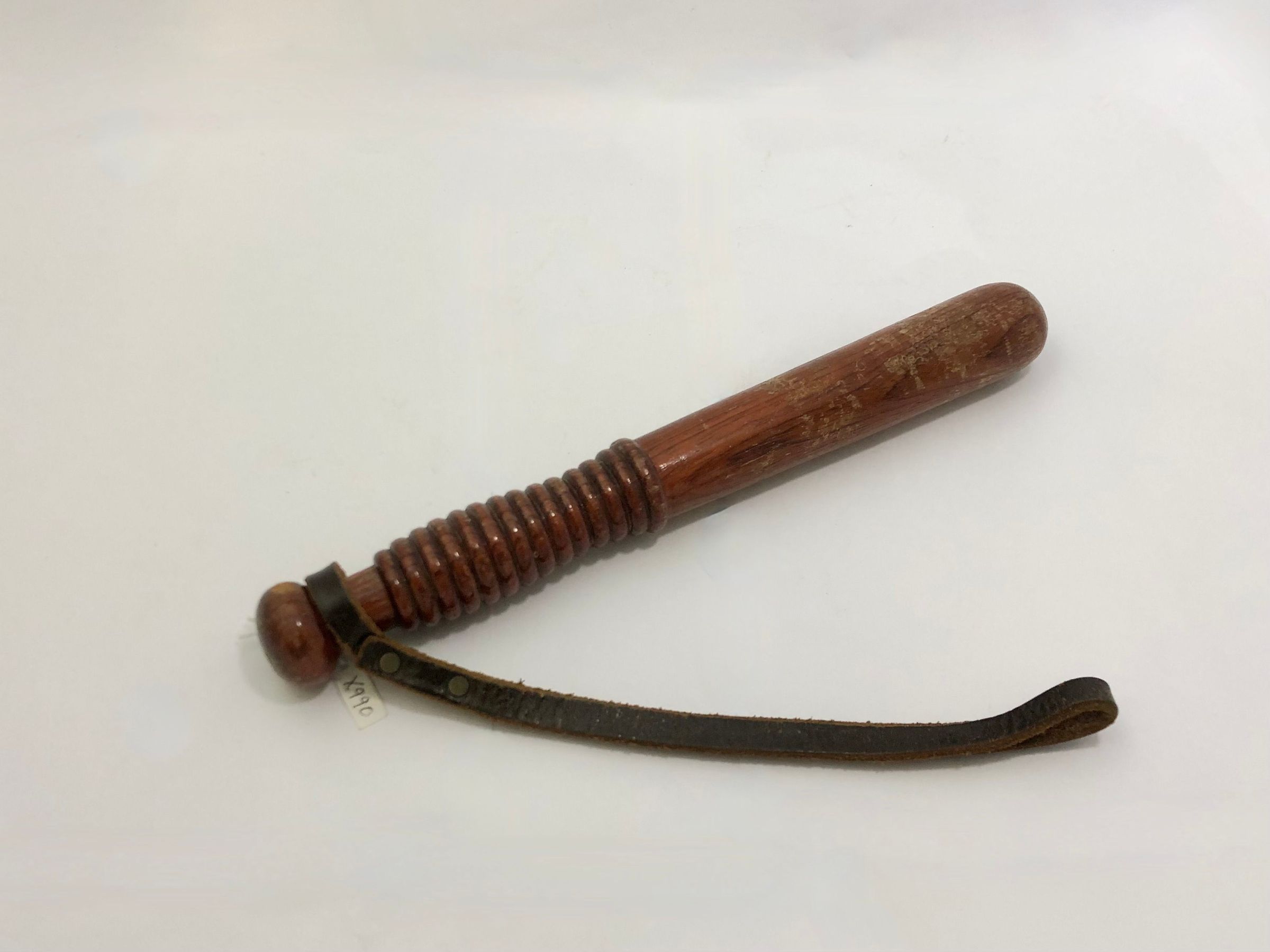
Sussex Police female officer's truncheon 1980sEntry/Object ID
990Description
Short style lightweight plain wooden truncheon, 11 inches (28 cm) long, finished in a reddish stain and varnished, showing wear and signs of use. Multi turned handle grip with leather riveted wrist strap, with marks written in ink "BS" followed by an unreadable 3 figure number. No maker's stamp or mark.Use
For use by a female police officer as protectionContext
Only with the 1974 Equal Opportunities Act and the 1975 Sex Discrimination Act were female police officers finally given the same status as male officers. Until then female officers had not been paid the same as their male colleagues or permitted to carry out the same range of duties or join specialist departments. Not being exposed to as much "front Line" duties and being confined to many women specific roles, they were not normally issued with truncheons.
After 1975 the situation changed and it was recognised that female officers needed to be able to defend themselves now that they were expected to carry out the full range of frontline duties and work night duties. However in some police forces they were not issued with truncheons until the 1980s.
In Sussex Constabulary some women officers were issued with small truncheons as early as 1971, though it is not known how widespread this was and whether the practice extended back to the formation of the force in 1968. Many female officers of the period report not being issued with them at all, and it seems that it was only after the 1975 Act, that they became standard issue for all female officers in the force. The truncheons initially issued were often older short hardwood types initially intended for use by detectives, who by the late 1960s did not routinely carry any truncheons at all in Sussex. Over time lighter weight examples such as the one pictured were issued.
In the 1970s and 1980s female police officers' standard uniform in Sussex Police and elsewhere consisted of a skirt without pockets. In order for them to carry equipment they were (believe it or not) issued with handbags, some of which had special pockets to carry things such as handcuffs and truncheons. Standard size wooden truncheons were too big to fit in these bags so smaller ones such as this were issued.
This particular example probably dates to the 1980s. it is identical to item 612 but has clear signs of wear and warrant number written on the inside of the strap. The earliest female officer warrant numbers for Sussex Constabulary and Sussex Police began with the letters "B", followed by the first letter of the surname and a three digit number. In the late 1980s the "B" was replaced with a "D". It was only in the 1990s were trousers routinely offered to Sussex female constables, allowing them to carry full sized truncheons in pockets. Not long afterwards all officers began to be issued with polycarbonate batons, worn on a belt, and wooden truncheons of all sizes were withdrawn.