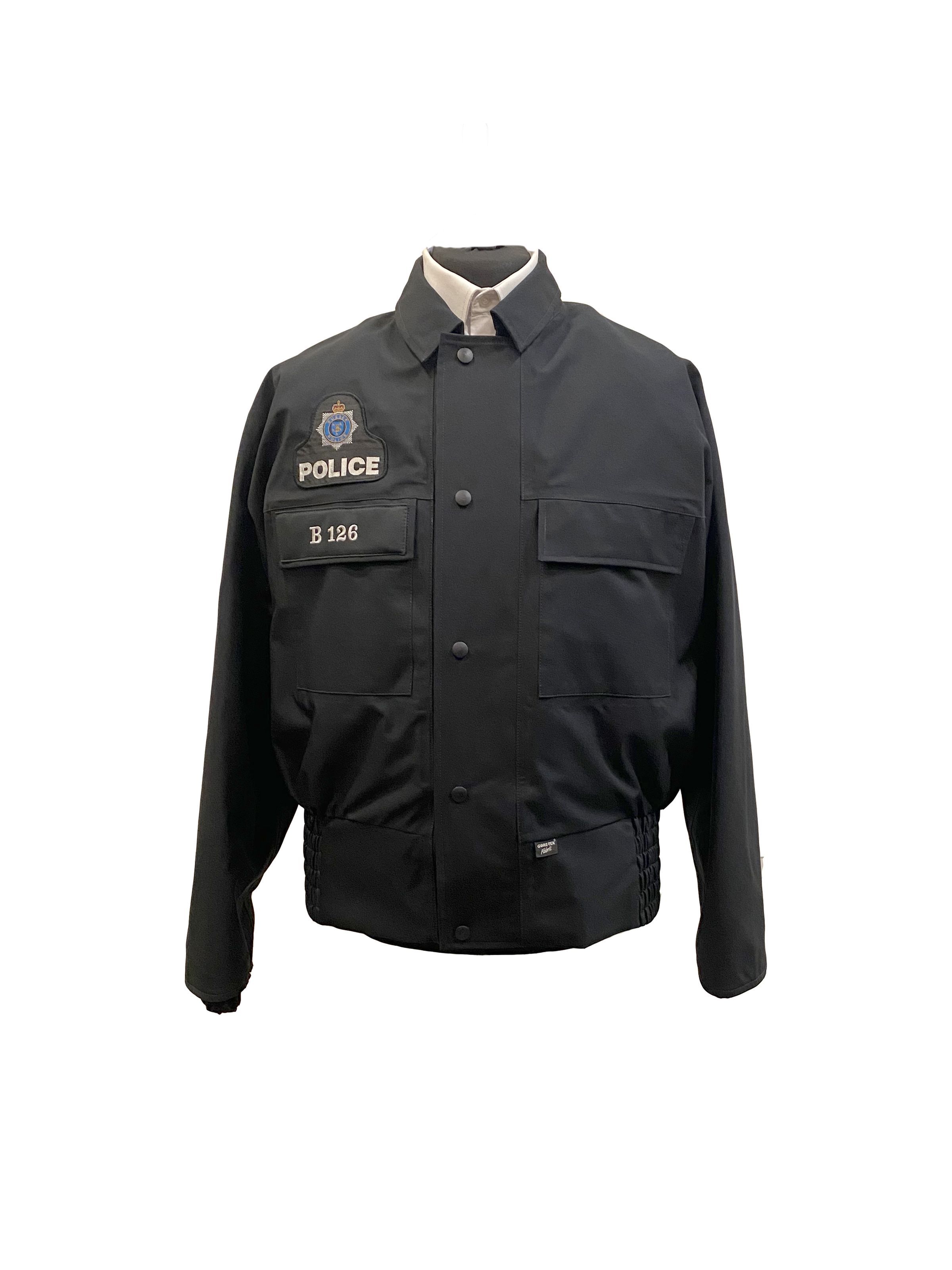
Name/Title
Sussex Police PSU officer's blouson jacket c1995Entry/Object ID
2023Description
Blue nylon and Goretex blouson jacket with 5 popper buttons to the front, an elasticated waist and two breast pockets. Over the right pocket is a bell shaped Sussex Police embroidered badge, depicting a star topped with a crown and a coat of arms centre around which is "Sussex Police", and below this is the word "POLICE". Embroidered into the pocket is "B 126". There is a removable quilted liner and an internal zip fastening to the front. Inside is a fabric label marked "Dewhirst" and a sizing/washing instruction fabric label marked "Dewhirst (Uniforms) Ltd" and "PSUSSUB1 Large Short" followed by care instructions. On the outside waistband is a small label marked "Gore-Tex Fabric"Use
For a Sussex Police PSU (Public Support Unit) officer to wear.Context
In response to the wide scale public disorder and riots that the UK suffered in 1981, the police began to be issued with better protective equipment, including public order helmets, sheilds and arm and leg guards. Some officers were organised into special Public Support Units or PSU's and received additional training in the evolving techniques and tactics to deal with the threat of rioting and other public disorder situations. In Sussex these units were not permanent but made up of specially trained and equipped officers from other departments that would form into pre determined PSU's, as and when required. All other uniformed officers received more basic public support training, but not to the same level and would not be issued with the additional protective equipment.
As both tactics and equipment evolved, so did the uniform issued to officers in PSU's. To begin with they had boiler suits and then two-piece fire retardant suits. Often during the 1980s officers are shown wearing a normal uniform tunic and trousers, with the addition of a PSU helmet and a shield. Indeed this was the normal attire for much of the 1984/85 miner's strike. Generally different types of PSU uniform were and are used, depending on the situation, often with hi visibility vests or jackets over the top.
The type of jacket pictured was introduced in the mid 1990s along with elasticated ankle trousers. The badge dates it from 1995 onwards, when the Sussex Police replaced all of its "EIIR" badges with ones depicting the force coat of arms. Later versions of these jackets have small chest tabs to attach a radio microphone too, suggesting that this particular one is an earlier example. The letter and numbers "B 126" are the officers warrant number and this jacket is thought to have been issued to PC Terrence Barclay, who was a traffic officer based at Brighton. As such he would most likely have been a PSU van driver. In the past these were often traffic officers, as not all other officers were trained to drive the PSU vans at speed using blue lights.
At the time these jackets were introduced for PSU officer's, normal officer outerwear consisted of a three quarter length "car coat" in a similar material, with hip pockets, with a badge and number over a single breast pocket on the left.
The position of the badge and number on the right is interesting, because at the time and since these are normally on the left on most other Sussex Police uniform. It is possible that the right was chosen for PSU officers so that shields, carried on the left did not obstruct the officer's number.