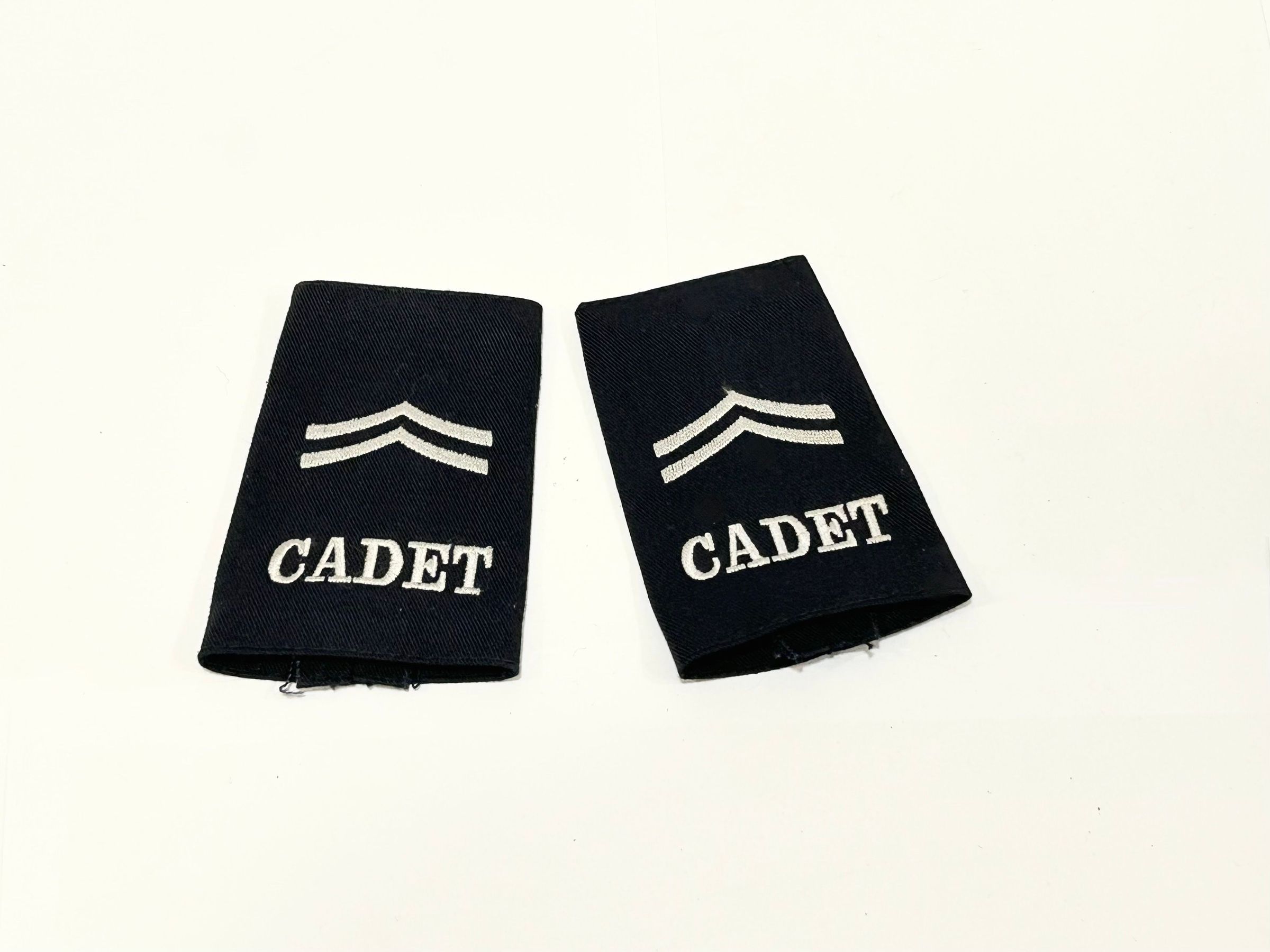
A pair of dark blue coloured cotton sleeve type epaulettes each embroidered in white thread "Cadet" under two embroidered chevrons.
Use
For use on uniform by a Volunteer Police Cadet in Sussex Police
Context
The original police cadet system was first established in 1948 in the Metropolitan Police with youngsters being employed full time from the age of 16 to 19, in a uniform support role and given the option of becoming full time constables when they were old enough. The scheme was introduced in an attempt to increase levels of recruitment to the regular force, by attracting school leavers who were not yet old enough to become constables. Similar schemes operated with some changes in many other police forces until the 1980s when the paid schemes were discontinued.
From the late 1980s the paid police cadet schemes were discontinued. Volunteer schemes were retained or begun for younger children, operating purely as youth organisations on similar lines to those run by the military. These schemes now fall under the national Volunteer Police Cadet programme and are organised on a local territorial police force basis.
Like most youth cadet organisations Police Volunteer Cadets have a rank structure. In Sussex a Senior Cadet is identified by three chevrons or lines, so these epaulettes represent the next rank down. Being of a slider type they are designed for items of clothing that have a fixed epaulette already, to slide over it. These epaulettes appear to be an older style than some others in the museum as they have a more elaborate font. They also have rank chevrons and more unto date versions have straight lines to signify grade.