Name/Title
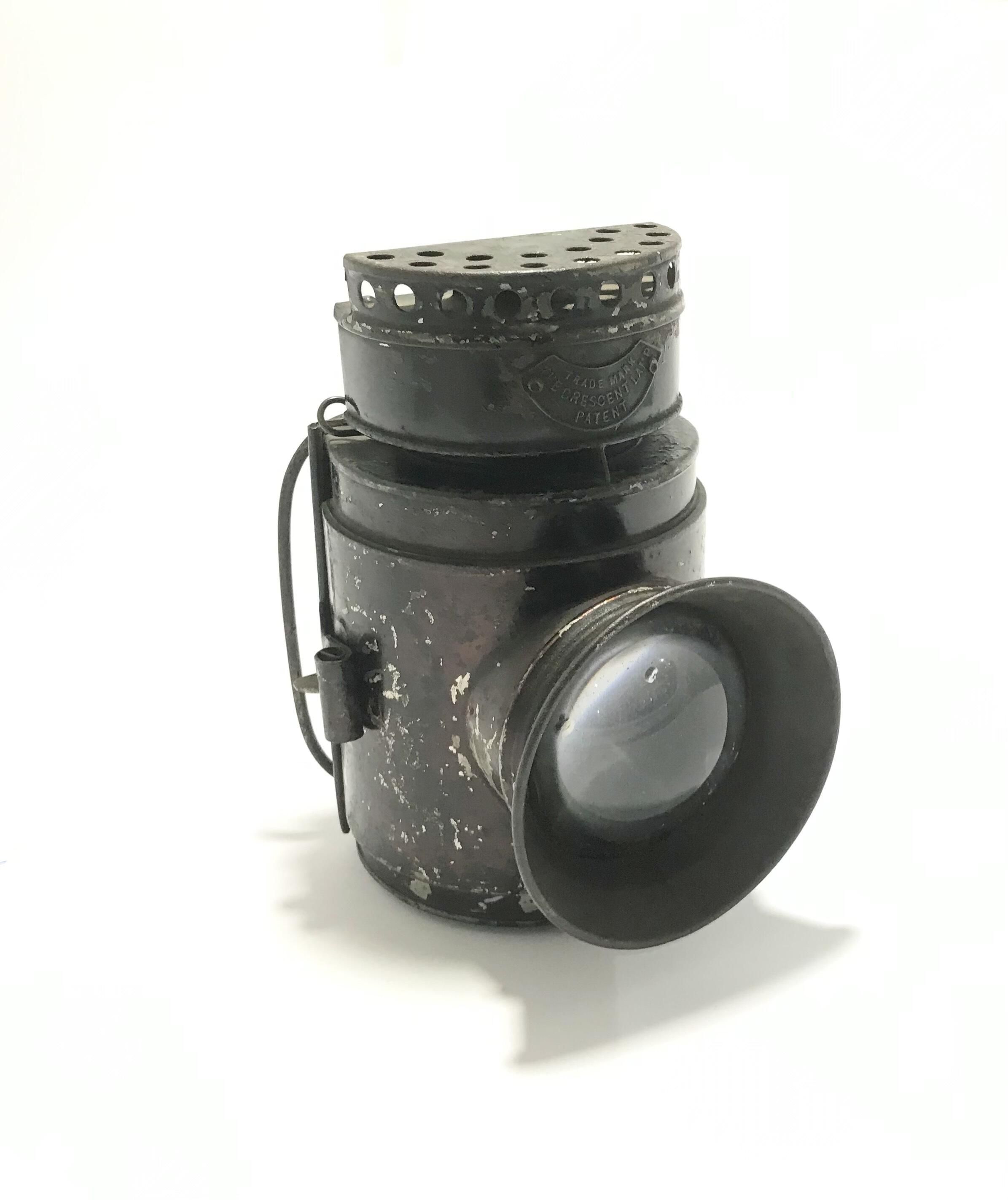
The "Crescent" bulls-eye police lantern c1890Entry/Object ID
462Description
Metal "Bull's eye" type oil lantern, with thick glass lens, flat perforated top, two rear belt hooks, two handles and "Japanned" black/brown finish. Marked on plate at rear "Dolan and Co Vauxhall London" and on at plate at the front "Trade Mark The Crescent Lamp Patent".Use
For use for night time illuminationContext
Throughout the 19th century and into the 20th century British police officers carried oil lanterns at night. The generic name for the type of lantern they used is a "Bull's Eye", so named after the large thick glass lens fitted. The earlier versions had conical shaped chimneys on top. Common features include a hook on the back for attaching to a police officer's belt, folding handles at the rear, and a feature to place a shutter or plate between the lit burner and the lens, so that even if it was burning the shutter would prevent the lantern from emitting any light. This was seen as essential for a patrolling police officer to be able to use at night, meaning he could keep the lamp lit so it could be used immediately, but at the same time not alert wrong doers of his presence. This type of lamp or lantern is, therefore, called a "dark lantern". Because they generated heat they were often a convenient way of keeping warm. Leather rectangular shaped belt guards were used to prevent the lamps, from burning uniforms or staining them with oil.
The use of oil lamps was a significant expense for police forces. Not only did they have to purchase oil to fuel them but the lamps required regular maintenance with wicks needing regular trimming and replacement. Many documents show this expense was a major concern of senior police officers.
A number of different versions of bull's eye lamps were used by the UK police from a number of manufacturers. This particular one is called "The Crescent" and was made by Dolan of Vauxhall in London. The Crescent was adopted as the standard lamp of the Metropolitan Police in 1885.(Fido and Skinner 1999). The design is believed to have been patented by Captain Phillip Bicknell who was the Chief Constable of Lincolnshire Police from 1856-1901. It is subject to a US Patent of 1880(US Patent Office Gazette 7/9/1880) and presumably a British one of the same period. Being designed by a police officer it was clearly intended for police use. This lamp was well made and had a number of features that made it more attractive than earlier models, such as extra ventilation, parts that could easily be removed for maintenance, an elaborate reflector, secure fitting to keep the burner in place, two belt hooks and even a match striker on the burner unit. The shutter is opened and closed by using a lever on the left side. Dolan and Co. were known throughout the 19th century as suppliers of military uniforms.The use of the "Vauxhall " address on this lamp indicates that it was made after 1888, when the company moved to there from another part of London.
Oil lamps like this would have been used by all of the police forces in Sussex until they were replaced by battery powered electric lights, by the 1920's. East Sussex Constabulary were known to have stopped using oil lamps in 1920 (Kyrke 1969).