Name/Title
Ultra 3AH personal radio c1965Entry/Object ID
2337Description
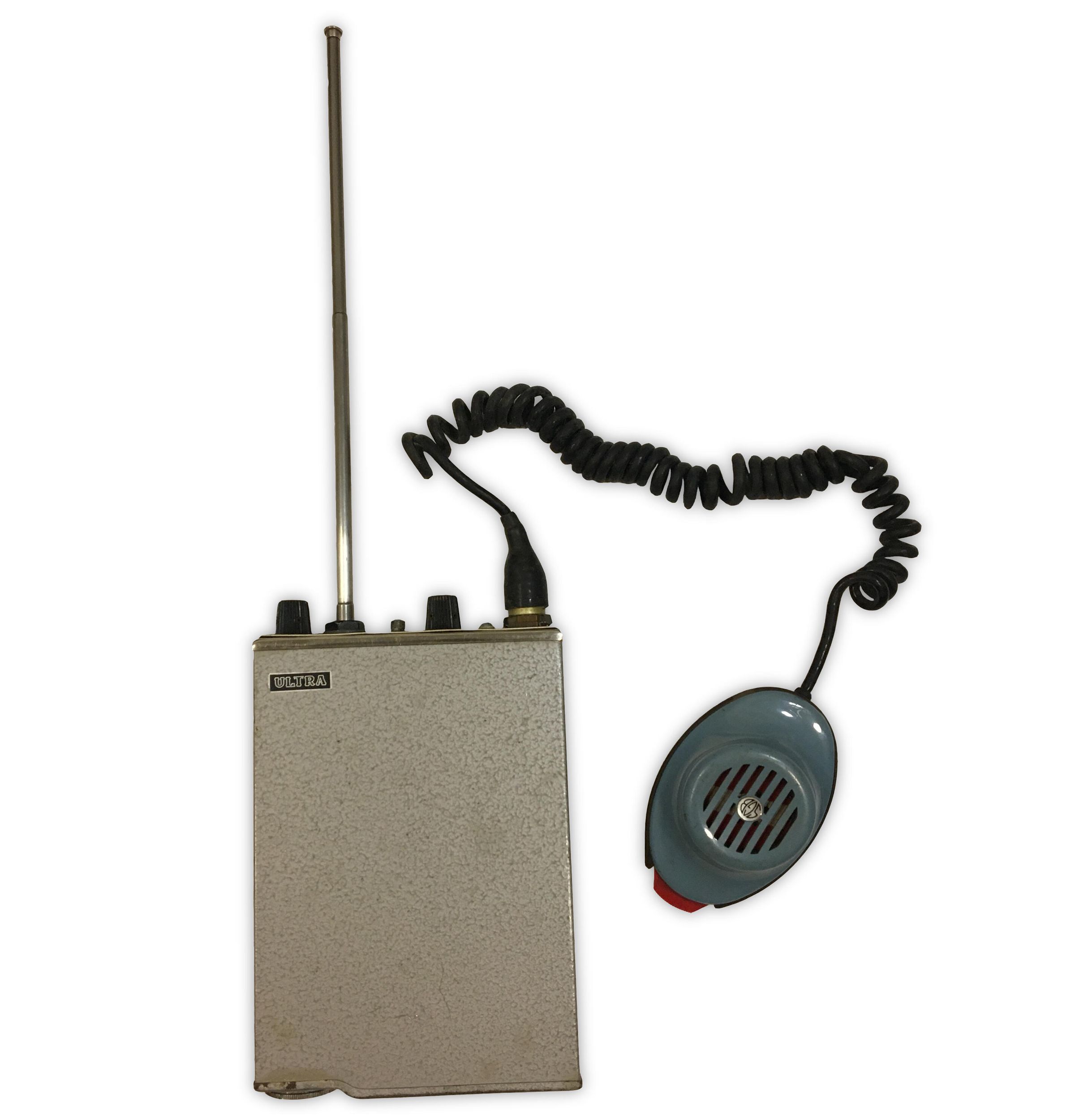
Ultra Electronics 3AH personal radio in grey metal case, with volume and channel knobs, retractable aerial and "SGB" handset microphone attached by curled wire. Marked on front "Ultra" and on plate on side "Transmitter Receiver Type 3A4-AH3 Serial No. 1050 Ultra Electronics Ltd. London W.3."Use
For a police officer to receive and transmit messages from a similar unit.Context
From the late 1920's police forces had been using various forms of radio communications. However due to the size of the equipment required most police radios was confined to vehicles. A few forces, Brighton being the first in 1933, developed workable pocket radios but these were only capable of receiving messages. Brighton stopped using their system in 1939 when its frequency was re-allocated due to preparations for war. Experiments continued nationally after the Second World War but the challenge was to develop a transmitter unit that was small enough for an officer on foot to carry. So until the 1960s officers on the 'beat" had to rely on telephone communications, at police boxes or police pillars.
By the 1960s though some police forces were beginning to use personal radios to some extent as the technology had improved and devices became small enough to be carried by officers on foot. However it was not until the adoption of the Pye Pocketfone by the Home Office as the official standard police personal radio in 1965 that a national programme to introduce personal radios in all police forces began. This process started in some of the Sussex police forces in 1966.
There is some evidence that personal radios were used in Sussex in limited capacities before the adoption of the Pye Pocketfone. The region is thought to have participated in Home Office trials in the early 1960s to decide what type of personal radio communication should be adopted. Also Sussex Constabulary traffic officers are known to have used the Ultra 3AH radio and it is possible that it was used in East Sussex Constabulary as well. There is a rare photograph c1968 of one of the first female traffic officers in the County, Joy Halliday/Christian actually using an Ultra like the one pictured, along with Marconi PETA radar speed detection equipment. It seems that traffic officers would use these in a "back to back" capacity to communicate with each other at such speed traps. One officer would monitor the equipment and when a motorist was over the speed limit, they would use the Ultra to inform another officer further down the road, who had a similar radio, so that they could stop the offending driver and deal with them. It is possible that officers in Sussex may have used these radios in other circumstances, but only to communicate in limited "back to back" capacities. The use of radios by foot patrol officers to contact local stations only began in Sussex with the adoption of the Pye Pocketfone from 1966 onwards.
This particular Ultra 3AH is not from Sussex, but it is identical to the one being used by WPC Halliday/Christian in the photograph mentioned. Because of their size these Ultra 3AH radios were normally carried in a shoulder harness/bag.