Name/Title
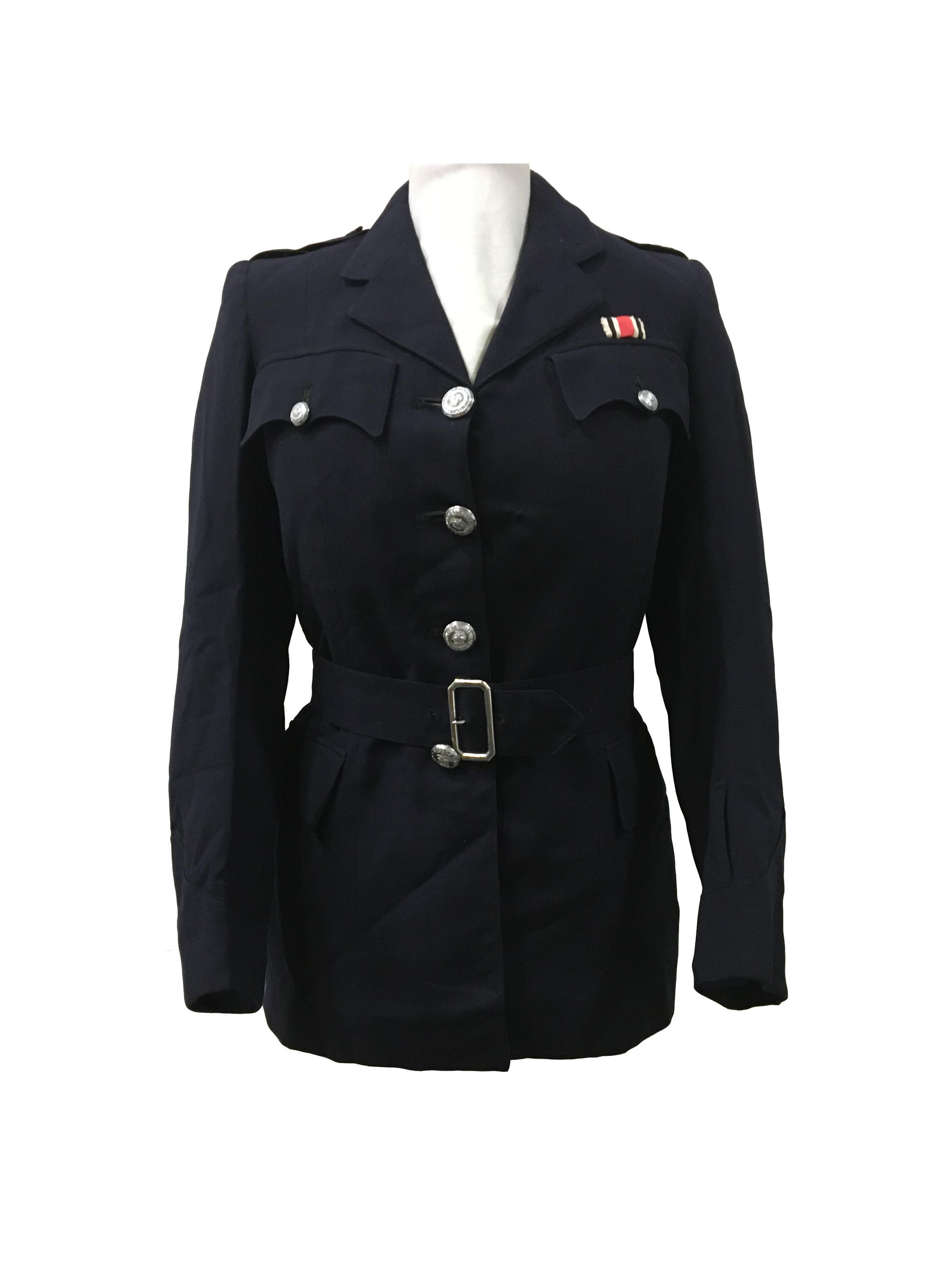
West Sussex Constabulary female special constable's tunic c1950 - 1968Entry/Object ID
2356Description
Navy blue coloured wool female officer's tunic, with white cotton lining, 4 chrome plated buttons to the front, two breast pockets with buttons and two hip pockets without buttons. There are button fastened epaulettes on the shoulders bearing the chrome plated numbers "248" and a woollen belt fasted with a chrome plated buckle". The cuffs to the sleeves have a chevron detail and the left one has the loops for a duty band. Most of the buttons have a King's Crown and are marked "West Sussex Constabulary". One of the epaulette buttons and one of the front buttons have Queen's Crowns and are marked Sussex Constabulary. There is a medal ribbon above the left breast pocket for a Special Constabulary Long Service Medal. No makers marks or label.Use
For use by a West Sussex Constabulary female special constableContext
After the Second World War as police forces began to recruit more female officers, uniform tunics of this type were introduced as standard. In 1946 the Metropolitan Police adopted what became known as "The Bather" uniform, which was based upon the Women's Royal Auxiliary Air Force uniform, used during the war, and variations of that uniform were adopted by other police forces. As with male uniforms of the period, whilst broadly similar, there was no single specific universal design, with individual police forces choosing designs that suited them. However "Bather style" tunics such as this were used widely in the UK until the late 1960s when other more modern styles were brought in.
Whilst Chief Supt. Elizabeth Bather is acknowledged as introducing this type of uniform in the Metropolitan Police in 1946 for full time women constables, replacing earlier designs, it is clear from photographs that variations of it were used during the war for members of the Women's Auxiliary Police Corps. Between 1940 and 1946, women were recruited to the WAPC, in mainly clerical and support roles to bolster falling numbers of male officers. In most cases WAPC officers were not given officer's sworn powers but occasionally they were. Interestingly the wartime combined Sussex Police Force employed a significant number of WAPC officers and was one of only 8 forces that employed over 100 (78 had less than 10).
West Sussex Constabulary recruited its first female sergeant in 1949 and a number of new female constables the same year. This particular tunic probably dates from around that period. The majority of the buttons have a "King's Crown", on them which dates it to pre 1952. However there are also two "Sussex Constabulary' buttons which only date from 1968. The medal ribbon for the Special Constabulary Long Service Medal indicates that at some time the tunic was issued to a member of the Special Constabulary, who would have had to serve at least 9 years to be awarded that medal.
The older buttons suggest that it probably dates from c1950 and if it was initially issued to a special constable it may well have been used throughout the decade. Photographs show that special constables within West Sussex Constabulary retained old uniform for some time, with male specials in particular, using closed neck tunics until the late 1950s. This was common within the special constabulary as a whole, as being part time, they took longer to wear out uniform, but also not being regular officers there was not the same need to issue them with up to date clothing.
The use of the later buttons may indicate this tunic was used as late as 1968 or it has been restored with two later buttons. It certainly has evidence of a few darning repairs. It was definitely last used by a special constable because of the medal ribbon, and special constabulary issue may well explain its extended use, possibly by more than one officer.
The lack of lapel badges or shoulder markings is not unusual for West Sussex female special constables (see Bennett 2008 photo page 241). The presence of duty band loops is a little odd as duty bands were not worn in West Sussex Constabulary at the time this tunic was made. However there was a shortage of uniforms for West Sussex special constables in 1950 (Worthing Herald 17/2/50) and the force may well have had to outsource uniform and this type of tunic may have been all that was available. At the time the Metropolitan Police still wore duty bands on the left sleeve and this tunic may have come from their suppliers.