Name/Title
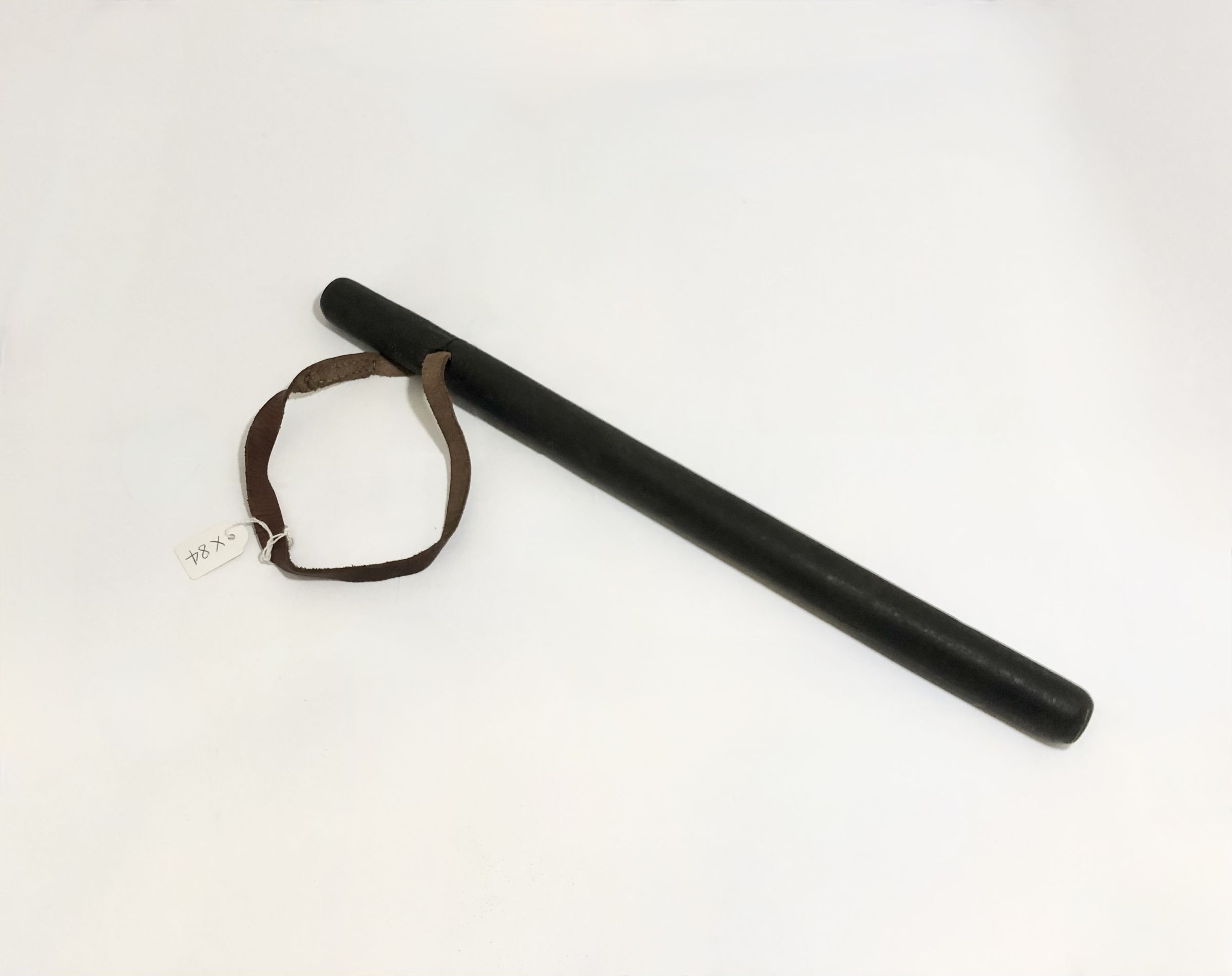
West Sussex Constabulary rubber truncheon 1924-1936Entry/Object ID
84Description
Black rubber parallel sided truncheon, 1 inch (26mm) diameter and 14 inches (36cm) long, with leather stitched wrist strap attached via a hole in the body. Has an impressed or moulded circlet near wrist-strap with "West Sussex Constabulary" and "No 65" therein. No maker's marks.Use
For use by as protection by a West Sussex Constabulary OfficerContext
From the late 1880s until the 1990s most police forces in the UK issued their male officers with wooden truncheons, approximately 15 inches in length with four large groves in the handle as a grip. Though there were often variations in the exact shape, length and type of wood used, for the most part the design was fairly standard for all of this period, with very similar wooden truncheons being the norm in most police forces until they were replaced with polycarbonate and extending metal examples in the 1990s, following concerns about officers' safety against growing knife crime.
The use of rubber truncheons in particular was not common in the UK, though they were often used on the continent.
However, West Sussex Constabulary used rubber truncheons between 1924 and 1936 (Barrett 2008), which makes the force very unusual in the history of British policing. They were introduced under the leadership of Captain Arthur Williams who was the Chief Constable between 1912 and 1936. He came from a military background and was a strict disciplinarian. He made many changes to the force uniform, including the replacement of helmets with caps, and insisted that all officers had a week's training every year devoted to military drill. To this end he also employed a full time drill instructor, Captain Teague who trained the officers in Priory Park , Chichester.
It is thought that rubber truncheons like this were adopted by the West Sussex force as they were less bulky than the standard wooden type and were therefore less likely to interfere with the smart appearance of officers when carried in a trouser truncheon pocket. Given the Chief Constable's insistence on a military style presentation it is highly probable that this is indeed why such truncheons were issued within West Sussex Constabulary.
This particular example retains its original wrist strap and is numbered "65", which is most likely an issue number. Number "57" is known to have been issued in 1925 (see notes), and it appears that most of these rubber truncheons were individually numbered in this way.
A similar truncheon in the collection (item 2326) which is damaged gives an insight into their construction. They are not moulded from a single piece of rubber, but appear to be made of what appears to be a fabric backed rubber sheet material which is then rolled many times around a thin metal core. This rolling is shown in a spiral pattern at each end of these truncheons.
In December 1934 the Chief Constable Arthur Williams retired and was replaced by Captain R.P.S Wilson. In 1936 the new Chief Constable himself introduced a number of uniform changes, including the re-introduction of the helmet. He also replaced the rubber truncheons with standard style wooden ones.