Name/Title
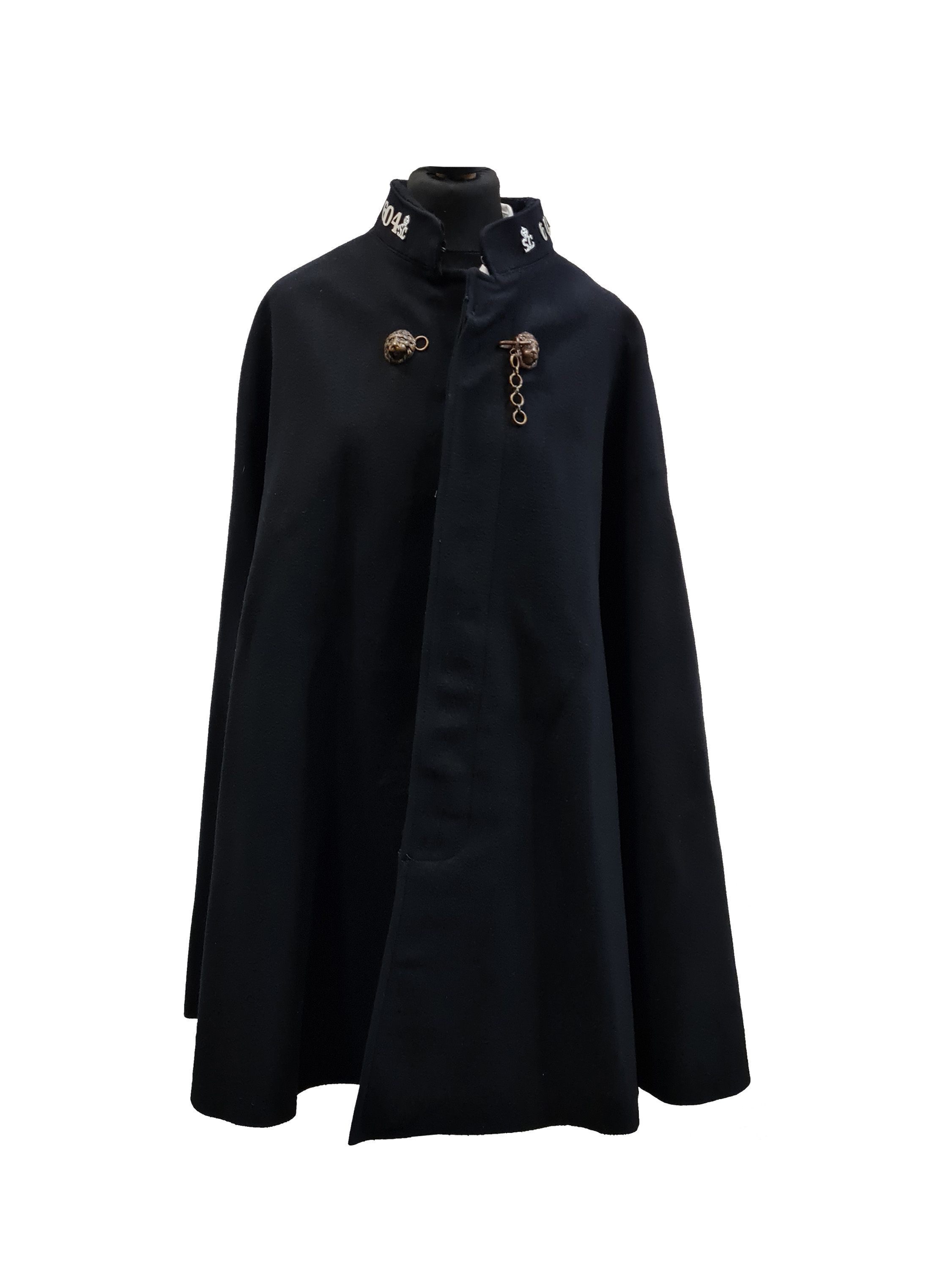
West Sussex Constabulary special constable's cape c1950Entry/Object ID
341Description
Blue wool cape, with three black plastic buttons to the front marked "West Sussex Constabulary" with a King's crown and a black painted brass clasp and chain in the form of two lion's heads, which is heavily worn with a broken chain. Attached to each side of the collar are the chrome metal numbers 604" and badges with "SC" topped by a King's crown. Inside is stencilled "1953".Use
For a special constable to use on night duty or during the winter.Context
Capes were standard police uniform issue for winter and night duty from the Victorian period onwards. In some police forces they were issued to officers as late as the 1970s and 1980s. They are nearly always fitted with a distinctive "Lions Head" clasp as seen here and will often have an officer's number attached to the collar and sometimes additional insignia, as well as buttons marked with the force name. These clasps are usually painted black but chrome plated versions were also used. Lighter weight waterproofed oilskin capes were sometimes used during wet weather and by the 1930s in some police forces, such as the Metropolitan Police, they had replaced wool ones altogether.
It is not known why capes continued to be used for so long but it may be because of the greater freedom of movement they offered. By the time an officer had a woollen overcoat over a woollen tunic, it is likely that arm movement was severely restricted. With the introduction of lighter weight fabrics for outer garments in the 1970s and 1980s, this would no longer have been a problem and the cape would have been obsolete. Capes are known to have been particularly popular when officers still used oil lamps. This was because these were continually lit and being attached to a belt under the cape any heat would be trapped within the cape, thus helping to warm the officer, who presumably had to take care they did not burn the material.
This particular cape has King's crown "West Sussex Constabulary" buttons and King's crown "SC", special constabulary insignia. This shows that it would have been issued to a special constable in the West Sussex force. Normally the use of King's crown insignia would suggest a date of pre 1952, before Queen Elizabeth came to the throne. If the number "1953" stencilled inside, is a year date, then this cape may have been issued later. The use of older insignia, however is not unusual, especially for West Sussex Constabulary. Photographs show that the introduction of Queen's crown insignia was relatively slow in West Sussex, and probably elsewhere, with many longer service officers at the 1957 centenary parade still having King's crown badges on their helmets. The use of old insignia and old style uniform was more common among special constables, who were often issued with obsolete items and who retained uniform for much longer than regular officers, who required replacement uniform far more regularly due to more frequent use.
Special constables had badges or insignia to distinguish them from regular officers, in this case the "SC" badges. The use of the numbers on the collar may also be unique to special constables in West Sussex Constabulary, as the museum has a later regular constable's cape from the force, which has no collar numbers at all (item 2290).