Name/Title
Windham and Ewhurst Hundred High Constable's staff c1801 - 1820Entry/Object ID
1088Description
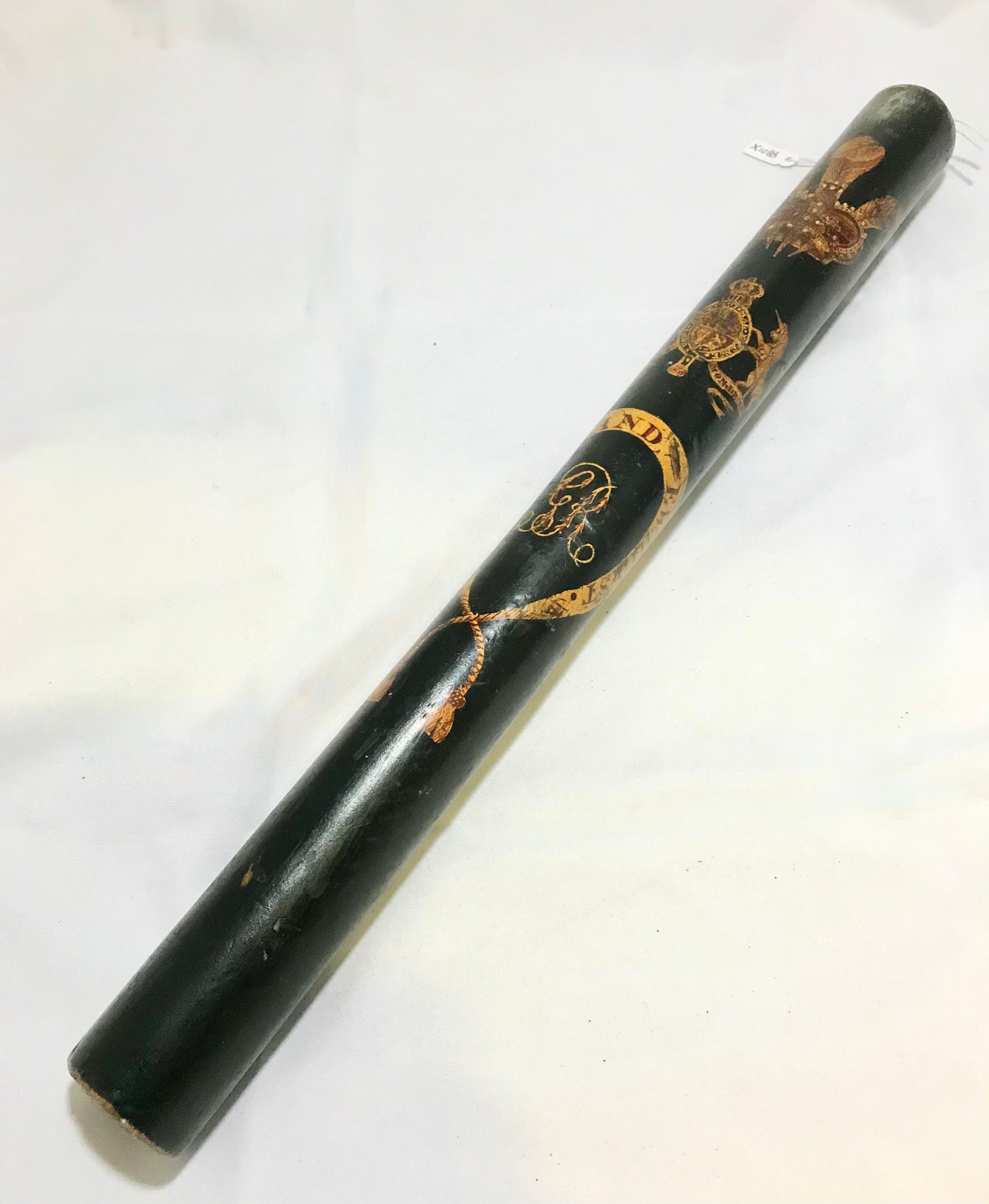
Decorated wooden cylindrical parish constable's staff 16 1/2 inches (41cm) in length, painted black with white gold. Marked with Prince of Wales feathers and coronet, over what appears to be a post 1801 royal coat of arms. Beneath this is a ribbon/garter containing the words "Windham and Ewhurst", within with is a "GR" royal cypher. At some time a hook has been screwed into the top to allow the staff to be hung. It is rough at the bottom end which may indicate that it may have been sawn down. No maker's marks.Use
To be used by a Hundred Constable for both protection and as a symbol of their authorityContext
Before the establishment of regular full time uniformed police forces, responsibility for law and order and keeping the peace, mostly fell upon unpaid parish constables who were usually appointed on an annual basis. Like the later full time uniformed police constables, these parish officers carried decorated truncheons which acted as their authority for carrying out their duties. At the same time these truncheons were also designed to be used for protection and were not ceremonial items.
This staff has the royal cypher "GR" short for "George Rex" representing either King George III, who reigned from 1760 until his death in 1820 or George IV, who reigned from 1820 until 1830. The coat of arms used appears to be that used after 1801 and the presence of the "Prince of Wales" feathers may indicate that it dates from the period when the Prince of Wales acted as Regent from 1811 until 1820 (Dicken 1952). This staff represents the Hundred of Windham and Ewhurst, in West Sussex. A Hundred is an old Anglo Saxon administrative area, based on the amount of land required to sustain one hundred households, and counties or shires were divided into Hundreds. A Hundred was then divided into tythlings or parishes. A tything was enough land to support 10 households, or the equivalent of 10 hides, the hide being the basic unit of land, enough to support one family. In Sussex there was also an administrative area between the county and Hundred, called a Rape.
The Hundred of Windham and Ewhurst is an area in the Rape of Bramber in West Sussex and includes the parishes of Cowhurst and Shermanbury, as well as part of that of Bolney (Wikishire.UK.co). This staff is most likely that of the Hundred Constable of that area, sometimes called the Chief or High Constable. The Hundred Constable took overall charge of the more local parish constables but was also responsible for dealing with riots and disorder, serious crime and for arming local militia to enable him to carry out these duties.
In rural Sussex responsibility for law and order largely fell upon the High and Parish Constables until the establishment of the East and West County police forces.
Sometimes staffs such as this are longer and this one may have been reduced in length.