Elder Interview-Artley Skenandore Sr.
Name/Title
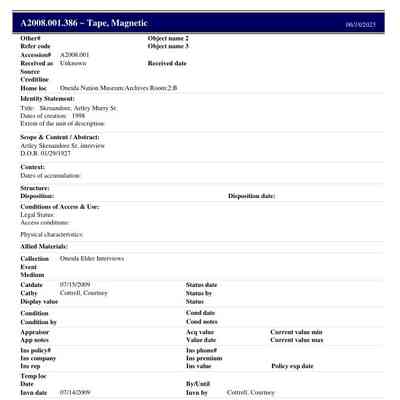
Elder Interview-Artley Skenandore Sr.Entry/Object ID
A.2008.001.386Tags
Needs Accession Sheet, Needs Location, Needs PhotoDescription
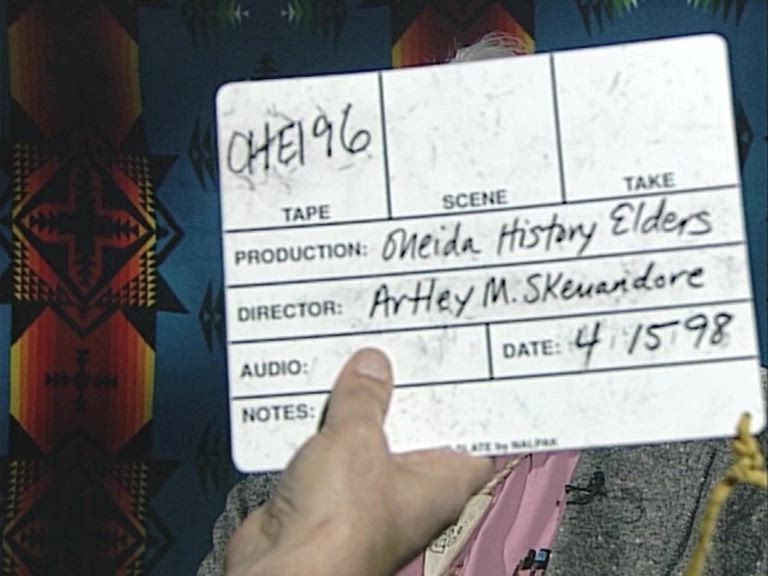
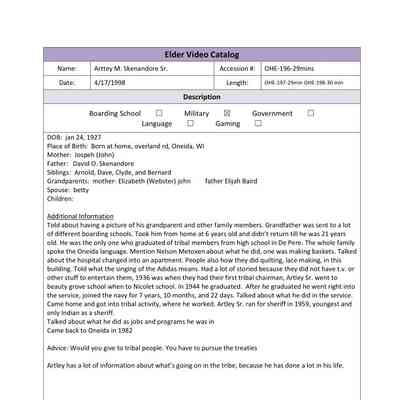
Skenandore, Artley Murry Sr. Born 01/29/1927 Parents: David O. Skenandore and Josephine (John) Maternal Grandmother: Elizabeth Webster John Paternal Grandfather: Elijah Baird He doesn’t remember his grandfather on his mother’s side. His father was a farmer and so was his grandfather. His grandfather went to a government school in Wittenberg and then to Flandreau. He returned back home at age 21 when he finished school. His grandmother was very traditional. She never spoke English and had a well dug close to the house, it was about 35 feet deep. A brother of his fell into the well so his mother and father had it filled in and had a different one built across the road by the barn. His mother went to a public school but he doesn’t know the name of the school. His mother was a stay at home woman and did a lot of canning. He use to haul milk to the cheese factory which was 2 miles down the road. His mother did their wash plus the Nun’s laundry too. She was paid $2.50 for the Nun’s laundry. They would pick up the laundry and bring it back to the Nuns. The hospital is where Dr. Powless practiced his work at. When he passed away it was used for rooming houses and there were a lot of activities going on there too in the basement. They made baskets and lace there also. Oscar Archiquette use to sing the ta deum quite often. The ta deum is a religious solemn prayer like song that was sung on special occasions in Oneida language. There were 2 benches on each side of the altar. That’s where the choir sat and sang. In the 1930’s there was a group that was elected to start a book and alphabet together for the Oneida language. The Oneida hymnals were also started then to. His father had a talent where he made rugs out of cornhusk. He’s braid them and they withheld a lot of durability. His grandmother use to make corn bread for breakfast along with corn soup that she’d make for their lunch or dinner. Hooyah is a greeting. Someone would say Hooyah and they would be wishing a happy new year. His grandparents would treat illnesses at home themselves. They didn’t have doctors come to their house. They used roots and herbs from the woods. There was a lot of storytelling because there was no radio or television back then. Back then you had to be home for all 3 meals also. He was in the military. He went to school at Beauty Grove School through grade 8th. He then went to high school at West DePere High School. Back than it was called Nicolet. He rode his bike to school the first full year then the bus systems that came out. Artley and his brother were both involved in music. Military taught him a lot. He was also in the navy and was in Japan for 14 months. He also was in China for 14 months. This happened after the war was recalled for the Korean thing. He served 2 ½ years as a recall, he had already been in for 8 years. He came home and got into public activities and got involved in housing in 1965. He found an implement on the books that Indians could get housing and had been on the books since 1930’s. He became sheriff for a term of 3 years and was only 26 at that time. He was the only Indian sheriff in the United States.Recording Type
Audio/VisualCollection
Elder InterviewsCataloged By
Gerzetich, Courtney (Cottrell)Category
Digital Media, Military