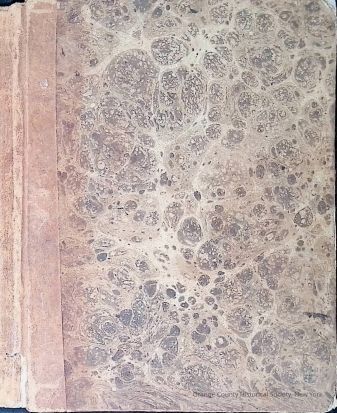
Name/Title
Stockbook of Wm. Horton, 1837-1844Entry/Object ID
2022.1.2Scope and Content
The “Stockbook of Wm. Horton” is a handwritten agricultural ledger and inventory record dating back to the mid-19th century. Based on the OCR text, this document serves as a detailed accounting of livestock and farm assets, providing a window into historical farming practices in the 1830-'40s of William Horton's farm in Blooming Grove, Orange County, New York.
Key Features of the Document:
• Temporal Scope: The text includes a "Counting-House Almanac" for the years 1813 and 1836, though the primary entries for the stock inventory began on May 1, 1834.
• Purpose: It was used to track the "stock left on the farm by Father at his death," suggesting the book functioned as both a probate record and an active farm management tool.
• Livestock Inventory: The ledger contains specific descriptions of animals, including:
• Horses: Detailed entries for several mares and horses, noting their ages (ranging from 7 to 27 years), pedigree (e.g., "Mambrino Colt"), and purchase prices (e.g., $125 or $150).
• Cattle: A count of "Twenty Cows [of] all ages," including notes on calving and breeding (mentions of sending cows "to the Bull" in April 1834).
• Oxen & Young Stock: Records of working oxen ("one fine pair") and seventeen yearlings, including a note about a set of twin heifers.
Historical Significance:
The document is a classic example of a Counting-House Almanac or Waste Book, where a farmer or merchant would record daily transactions, biological cycles of livestock, and asset valuations. The mention of "Mambrino" suggests an interest in specific horse bloodlines, as Mambrino was a famous foundational sire in the 18th and 19th centuries.
This stockbook acts as a vital genealogical and agricultural record, capturing the transition of property between generations and the economic realities of rural life in the early 19th century.
[This summary was generated by Google Gemini from optical character recognition of handwritten script in this ledger, and therefore should not be relied upon to be accurate nor complete.]Collection
William Horton PapersCreate Date
May 20, 2026Update Date
June 10, 2026