Notes
This set of perfume bottles (2023.22.2-3L) and their matching scent case (2023.22.1L) were likely made in France between 1826 and 1851.
According to family tradition, this piece was believed to have been a gift from Gilbert du Motier, Marquis de Lafayette, to Sarah Shelton Aylett Fontaine (1811-1876), a granddaughter of Patrick Henry through Elizabeth Henry Aylett (1769-1842), during his tour of the United States from 1824-1825. However, the connection to Lafayette has since been proven to be incorrect.
It is likely this case was made as a souvenir for gentlemen embarking on a Grand Tour of Europe. Throughout the 18th and 19th centuries, young men of wealth and high social standing in the British North American colonies traditionally traveled across major European countries to gain an education in culture, literature, architecture, and antiquity. Scent cases like this one included miniature portraits of major landmarks the traveler may have encountered on their trip.
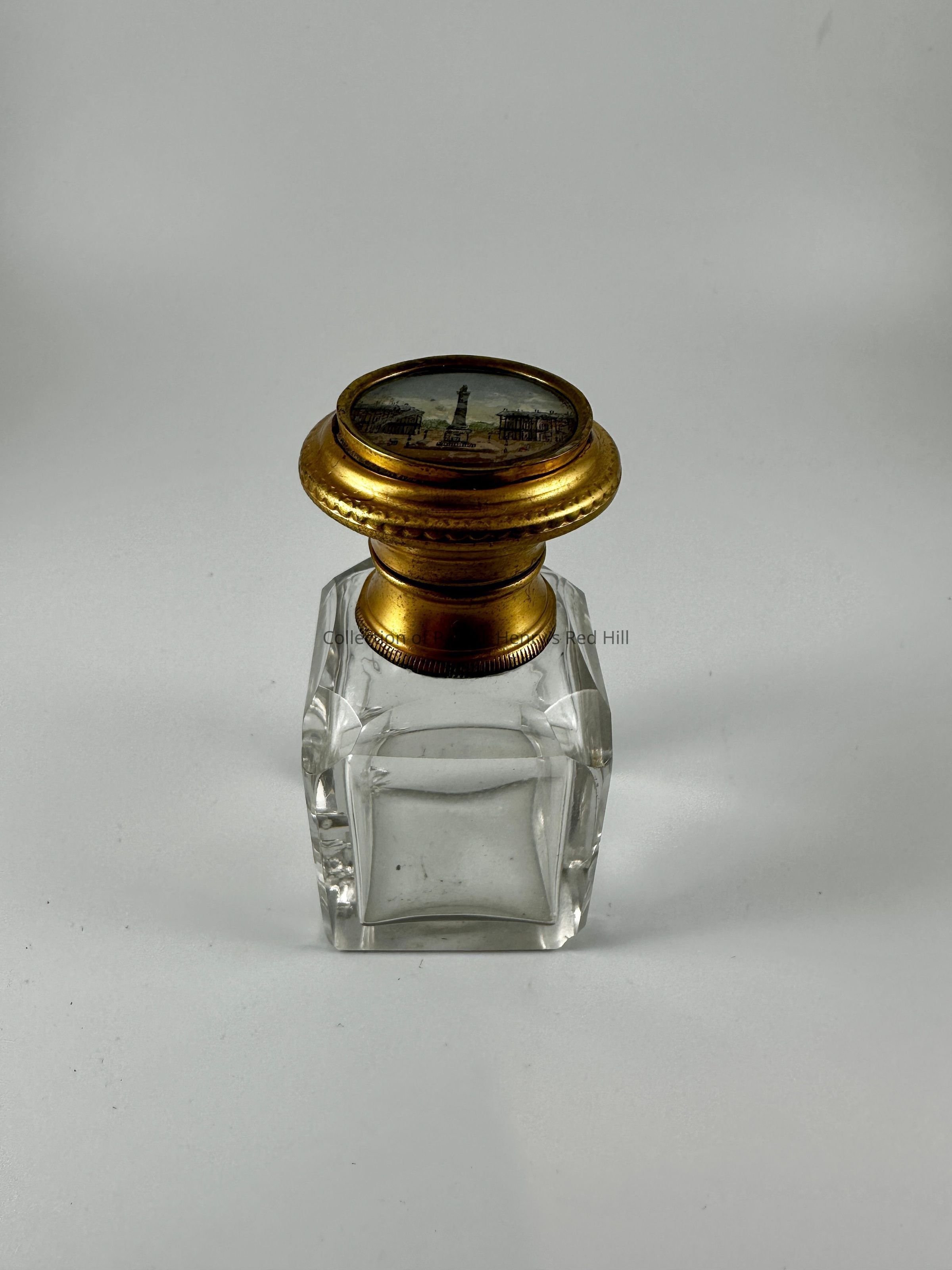
The caps of each bottle are made of gilt-bronze known as ormolu. Ormolu is the gilding technique of applying finely ground, high-carat gold-mercury amalgam to a type of metal. The manufacture of true ormolu employs a process known as mercury-gilding or fire-gilding, in which a solution of mercuric nitrate is applied to a piece of copper, brass, or bronze; followed by the application of an amalgam of gold and mercury. The item is then exposed to extreme heat until the mercury vaporizes and the gold remains, adhering to the metal object. The French refer to this technique as "bronze doré"; in English, it is known as "gilt bronze". This process has generally been supplanted by the electroplating of gold over a nickel substrate, which is more economical and less dangerous.
Within each cap are circular miniature paintings of two Paris landmarks created using a technique known as verre églomisé. This is a French term referring to the process of applying both a design and gilding onto the rear face of glass to produce a mirror finish. The name is derived from the 18th-century French decorator and art-dealer Jean-Baptiste Glomy (1711-1786), who was responsible for its revival. In the gilding process, the silver, gold or other metal leaf is fixed using a gelatin adhesive which, after steaming, results in a mirror-like, reflective finish. The design can be applied by various techniques, often by reverse painting prior to gilding, as is the case on this bottle. When painting a design with depth such as this one, the artist's natural methodology is reversed, with highlights applied first and the background applied last.
This bottle shows the Vendôme Column within the Place Vendôme in Paris, France. The original column was started in 1806 at Napoleon's direction and completed in 1810. It was modeled after Trajan's Column, to celebrate the victory of Austerlitz. In 1871, legislation ordered the column be dismantled; however, it was re-erected just three years later.
Family tradition says Sarah Fontaine passed the scent case to her son Col. William Winston Fontaine (1834-1917), then to his daughter May Aylett Fontaine Borum (1866-1933), then to her daughter Virginia Creighton Borum Hickerson (1891-1948), then to her daughter May Burrows Hickerson Jolly (1918-1994), then to Patrick Henry Jolly (1961-).
The PHMF received the set on loan from the Jolly family on April 10, 2023.