Notes
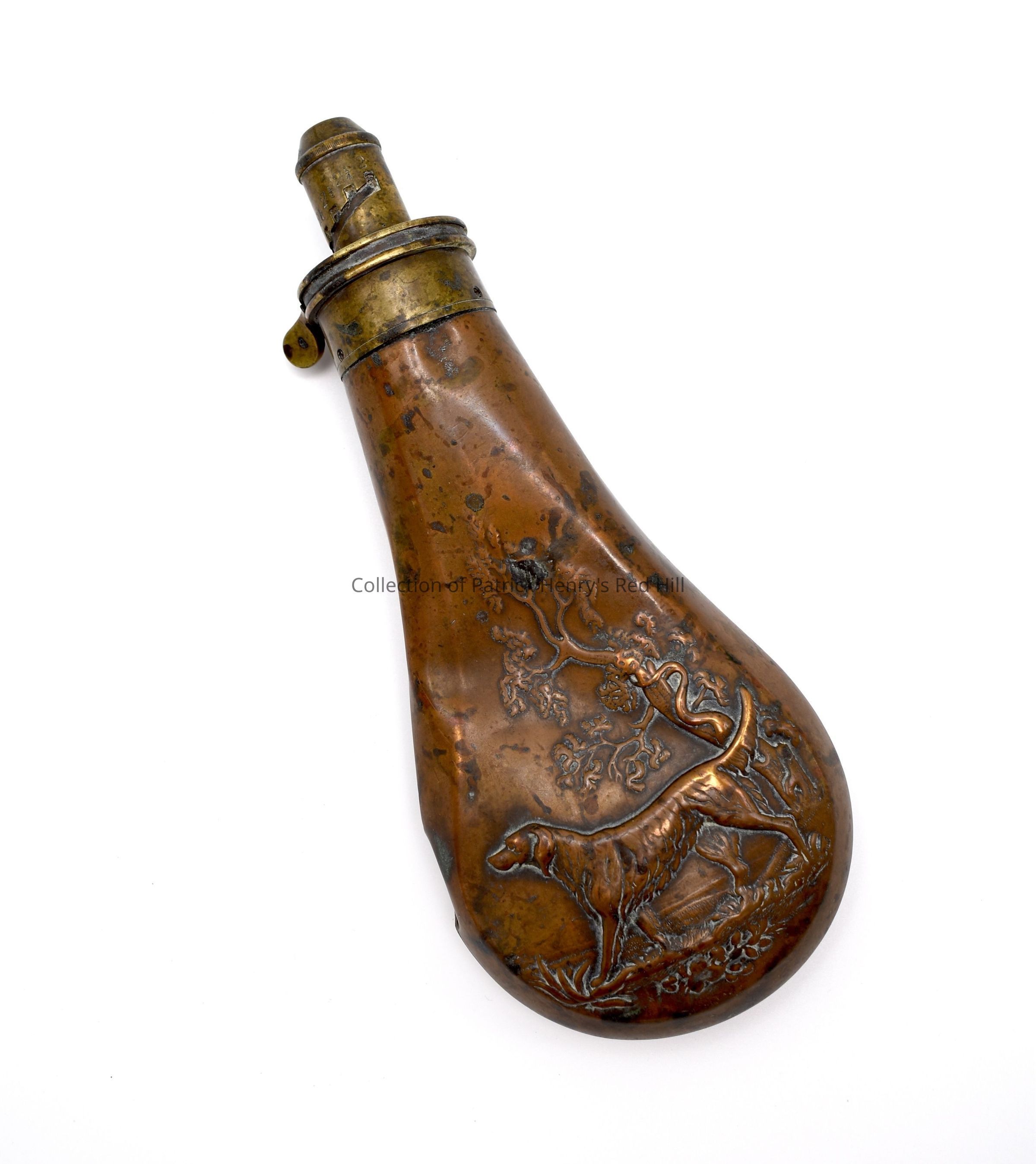
This powder flask belonged to William Wirt Henry Jr. (1860–1941), a great-grandson of Patrick Henry.
William Wirt Henry Jr. gave it to Mary S. Walker McDarment, telling her that it had belonged to Patrick Henry. Ms. McDarment swore that these details were true writing, "I knew William Wirt Henry to have been a man of absolute integrity, and I state without reservation that this is Patrick Henry's own powder horn." However, the maker's mark proves this piece was made sometime between 1835 and 1920, well after Henry died in 1799.
The silver and pewter company, Dixon and Sons, made the flask. James Dixon began a silversmith and metalworking business with Thomas Smith in Sheffield around 1806. After Smith’s withdrawal in 1823, Dixon’s sons joined, and the firm became James Dixon & Sons. Moving to Cornish Place in 1824 allowed major expansion, including the manufacture of silver, plated goods, and later nickel silver (1836) and electroplate (1848). The company built new facilities in the 1850s, won prizes at the Great Exhibition (1851), and produced designs by Christopher Dresser in the 1880s. In the 1920s, they introduced stainless steel flatware branded “Staybrite” (made with Firth Brown steel), as silver production declined. The firm became a limited liability company in 1920 and absorbed William Hutton & Sons Ltd in 1930.
On April 21, 1949, Mary McDarment donated the flask to the Patrick Henry Memorial Foundation.