Notes
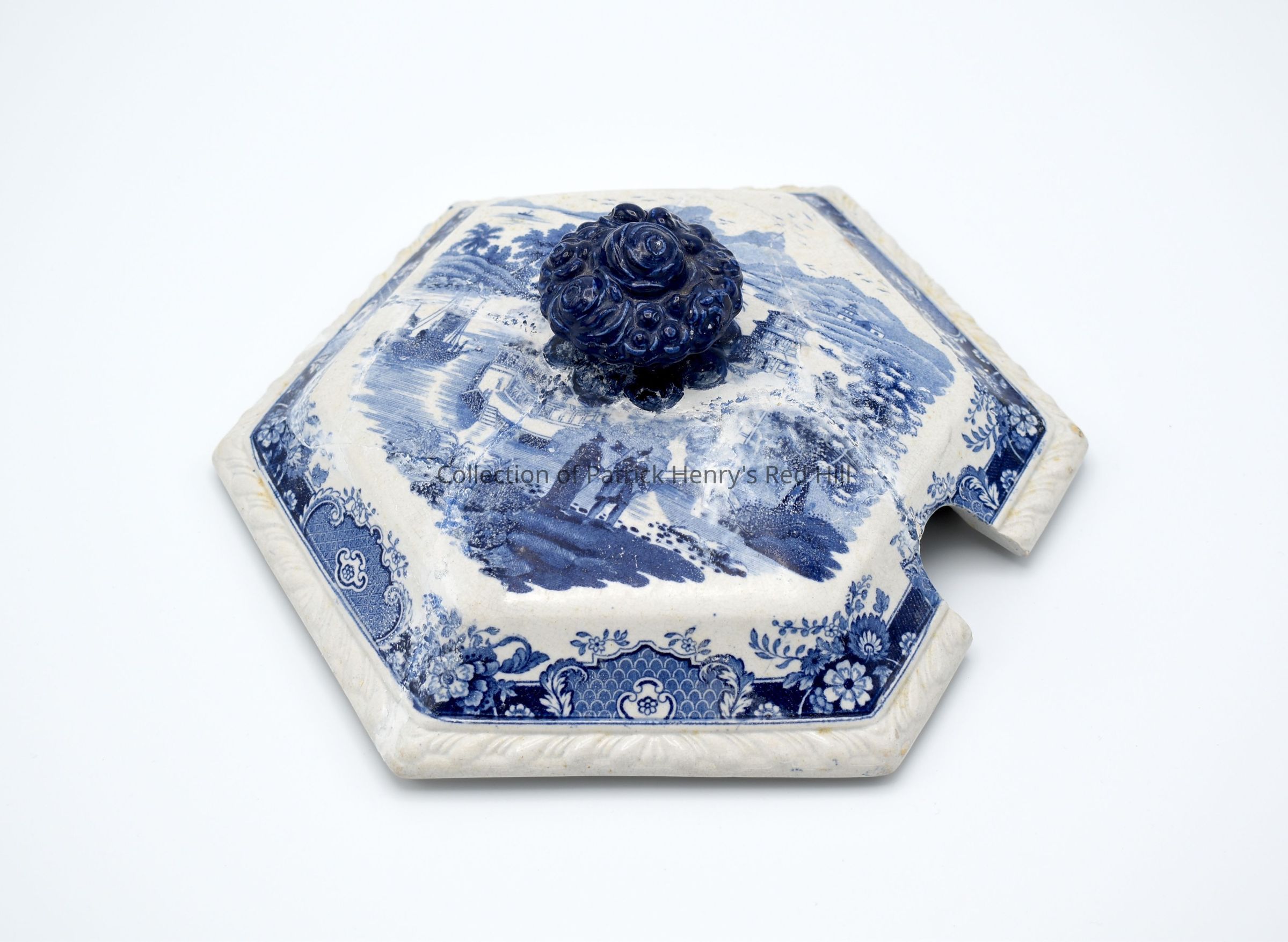
This Staffordshire "India Temple" soup tureen lid belonged originally to Edward Winston Henry Sr. (1794–1872), a son of Patrick Henry. Edward Winston Henry Sr. jointly inherited Red Hill with his brother John Henry (1796–1868). John Henry took over the original plantation, while Edward Winston Henry Sr. took the east side of the property and built a house called Windstone. His descendants lived on this property for many years.
The tureen was made by the potters, John and William Ridgway. The Ridgway brothers operated one of the leading Staffordshire, England, potteries between 1814 and 1830, producing fine earthenware, stone china, and porcelain at their Cauldon Place works in Shelton and the Bell Works in Stoke-upon-Trent. Working under the name "John & William Ridgway", they became known for their high-quality transfer-printed wares, featuring neoclassical and oriental designs often in rich cobalt blue. Much of their output was made for export, especially to the American market, and bore the marks “J.&W.R.” or “J.&W. Ridgway.”
Edward Winston Henry Sr. is said to have used the tureen at his Windstone plantation. In 1938, William Wirt Henry Jr. (1860–1941), Edward Winston Henry Sr.'s grandnephew, testified that the tureen belonged to his great-uncle and had been in the family for 100 years. Edward Winston Henry Sr. then passed the tureen to his son, Edward Winston Henry Jr. (1840–ca. 1904).
The tureen came into the possession of Mary Susannah Walker McDarment (1895–1984). Mary married Walker McDarment, a descendant of Patrick Henry, through Edward Winston Henry Sr. Mary McDarment and William Wirt Henry Jr. were cousins by marriage.
Mary McDarment donated the tureen to the Patrick Henry Memorial Foundation in March 18, 1950.