Notes
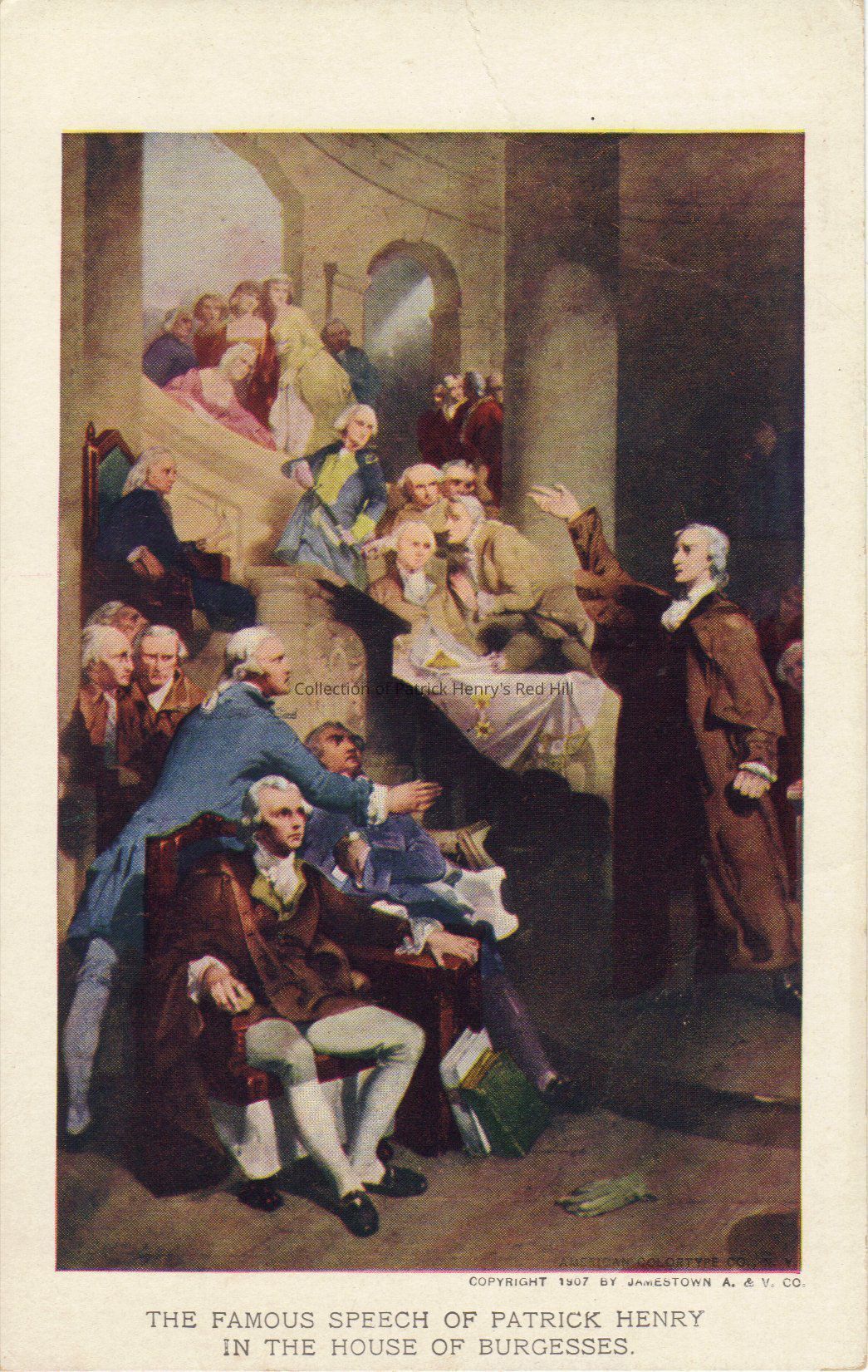
This postcard featuring Peter Rothermel's painting of Patrick Henry was an official souvenir of the Jamestown Exposition. The Jamestown Exposition was held in Norfolk, Virginia, at Sewell's Point from April 26 to November 30, 1907. The exposition was held on the occasion of the 300th anniversary of the founding of Jamestown. Its stated purpose was to "hold a great exposition...in which all our sister States, and, if possible, all the English-speaking people of the earth, shall be invited to participate, and where shall be displayed the products of the peace and the fruits of free institution in all realms." It was one of a series of world fairs popular in America in the early 20th century.
The Jamestown Exposition was initially designed to highlight American and Virginia history, but ended up emphasizing athletics, new technology, and military prowess. Planners of the exposition secured federal, state, and local funds, along with private investments, to build an entire miniature city complete with boulevards, lights, telephones, and even a hospital.
Beautiful permanent buildings were designed representing state governments, American military organizations, and various manufacturers and institutions from all over the world. In addition to the many military and industrial exhibits, the exposition included a "Negro Building" that highlighted the role of African Americans in American history, as well as an Indigenous Powhatan village. The deep harbor fronting the exposition housed American and foreign military cruise ships, private yachts, and hot air balloonists. Almost all prominent members of Congress attended the event at some point. Theodore Roosevelt, Mark Twain, and Booker T. Washington also participated.
The Exposition was not a financial success. The planners hoped for six million visitors, but fewer than three million people actually attended. When the fair closed in November 1907, the Jamestown Exposition Company was $2.5 million in debt, with $900,000 of that owed to the federal government. The permanent improvements to Sewell's Point made it an attractive and cost-efficient location for a new American naval base. In 1917, the empty buildings were converted into the Naval Air Station Hampton Roads.
The Patrick Henry Memorial Foundation purchased this postcard from Gary Konopka on January 25, 2007.