Note
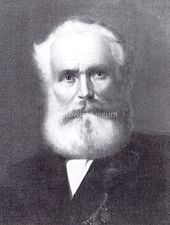
Born in 1796 in Boppard am Rhein, Germany, carpenter and furniture designer Michael Thonet is famed for the invention of bentwood—a revolutionary process that played a key role in the development of the modern design movement.
Thonet opened his eponymous woodworking shop in his hometown in 1819. In the early 1840s, he began experimenting with bending and gluing laminated battens together, which resulted in the Boppard Chair (1841), the first furniture design to use bentwood.
During an exhibition at the Koblenz Fair in Germany in 1841, Chancellor of Vienna Prince Metternich discovered Thonet’s work and convinced him and his family to relocate to Vienna. Between 1843 and 1846, Thonet and his sons made parquet flooring for Carl Leistler and helped to furnish Liechtenstein Palace and Schwarzenberg Palace. In 1853, the company became Gebrüder Thonet (Thonet Brothers), in honor of Thonet’s five sons who would eventually inherit the hugely successful business.
In 1859, Thonet designed his company’s most renowned piece, the classic Chair No. 14, which is internationally known today as the Viennese Coffeehouse Chair. With this design, Thonet had evolved and refined his bentwood process to enabled mass production for the first time in history. Having sold over 50 million models by 1930, the No. 14 is the world’s bestselling chair.
During the 1860s, the Gebrüder Thonet opened subsidiaries across Europe. Other design classics include, Chair No. 04 for Café Daum (1849), Rocking Chair No. 1 (1860), No. 18 (1876), No. 209 (1900’s)—widely used by Le Corbusier in the 1920s—and Otto Wagner’s 247 (1904).
Thonet’s revolutionary designs inspired many designers— including Le Corbusier, Josef Hoffmann, Adolf Loos, Marcel Breuer, Alvar Aalto, Yngve Ekström, Otto Wagner, and Ludwig Mies van der Rohe—and his process allowed for the creation of elegant, lightweight, curvilinear designs that anticipated the minimalist forms associated with modernism.
By the time Thonet passed away in 1871, Gebrüder Thonet had branches in nearly all major European cities. Today the company is known as Thonet GmBh and is headquartered in Frankenberg, Germany.
Thonet—the oldest surviving furniture company in the world—began its long life in 1819, when cabinetmaker Michael Thonet (1796-1871) established a furniture workshop in Boppard, Germany. A proponent of the Biedermeier style, he specialized in chairs, tables, and storage pieces characterized by clean lines, reduced ornamentation, and an emphasis on functionalist principles. By the 1830s, Thonet’s experiments in laminated and steam-bent wood furniture, like his famous Boppard Chair (1836), brought international acclaim. Thonet’s designs achieved a combination of lightness, durability, and comfort unknown in European furniture at the time.
A great fan of his work, Prince Metternich of Austria invited Thonet to present his designs to the Viennese court in 1842. Finding so much support there, Thonet opened a new company in Vienna in 1849. In 1853, he transferred his company to his sons, and Gebrüder Thonet was established.
Through the second half of the 19th century, Gebrüder Thonet designs grew increasingly popular with the cultural vanguard, especially among progressive design thinkers and tastemakers. One design in particular, the No. 14 Café Chair (ca. 1859), led the way to international success: the chair’s innovative bending technique was well suited to industrial production, and its rationalized, easily assembled structure allowed for efficient packing and shipping. In 1850, Anna Daum famously outfitted her fashionable Viennese café with No. 14 Chairs, and by the 1870s, Gebrüder Thonet had sales offices across Europe and the US. To date, more than 50 million No. 14 Chairs have been sold worldwide–not counting the untold pirated copies.
Iconic pieces from the traditional Gebrüder Thonet collection include Rocking Chair No. 1 (1860), No. 14 Café Chair (ca. 1859), Adolf Loos’s Café Museum Chair (1899), No. 209 Armchair (ca. 1900), Otto Wagner’s No. 247 Postal Savings Bank Chair (1904), and Josef Hoffmann’s No. 811 (1925). In the early years of the 20th century, Gebrüder Thonet also began producing designs in bent tubular steel by Bauhaus masters like Marcel Breuer, Ludwig Mies van der Rohe, and Mart Stam.
In the aftermath of World War II, Thonet lost all of its production facilities in Eastern Europe, and the sales office at Vienna’s Stephansplatz had been destroyed. Between 1945 and 1953, Georg Thonet, the great-grandson of company founder Michael Thonet, led the rebuilding. Economic success returned quickly. In the ensuing decades, the company commissioned designs from many outstanding designers, such as Verner Panton, Pierre Paulin, Norman Foster, James Irvine, Piero Lissoni, and Stefan Diez. Classic Thonet pieces can be found in museum collections around the world, including the Museum of Modern Art in New York, the Centre Pompidou and Musée d'Orsay in Paris, the Vitra Design Museum in Weil am Rhein, the Pinakothek der Moderne in Munich, the Austrian Museum of Applied Arts in Vienna, and the British Museum and the Victoria & Albert Museum in London.
In 1976 Thonet was divided into two separate German and Austrian companies, which remain independent of each other. Today, Thonet GmbH is headquartered in Frankenberg, Germany and continues to manufacture the original, bentwood and tubular steel designs alongside new pieces by contemporary, international architects and designers. Originally opened in 1861 by Thonet himself, the furniture factory TON (Továrna Ohýbaného Nábytku), which is located in what is known today as the Czech Republic, continues to manufacture Thonet designs.