Name/Title
Beach Series I - Girl on StumpEntry/Object ID
1850.S06Description
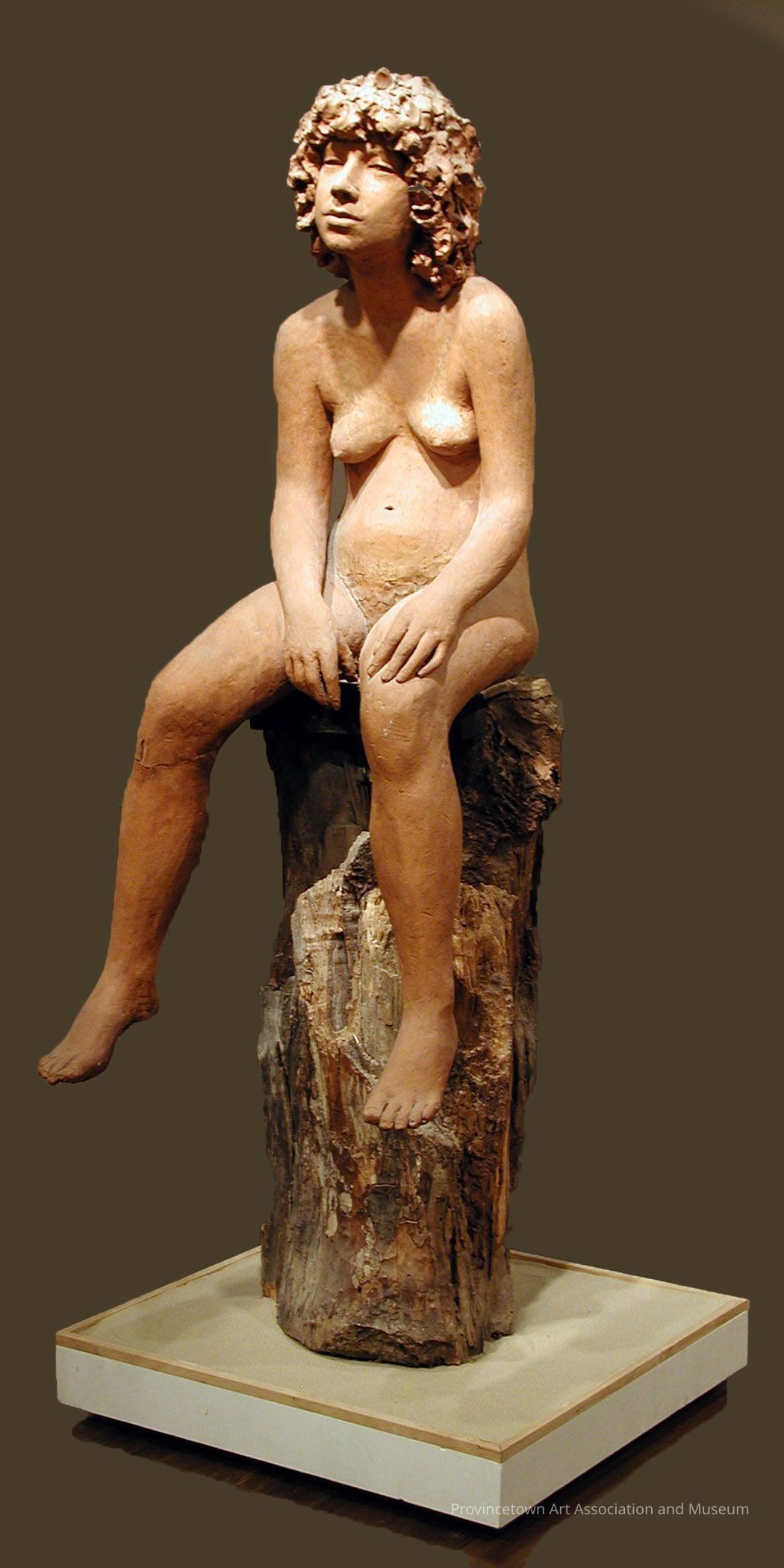
Anchored in sand, a curly haired woman sits nude on top of a tree stump. Pale terracotta forms the tan line of her discarded bikini. Penelope Jencks commemorates the post World War II displays of nudity on Cape Cod beaches. As a child, Jencks recalls her parents and their friends gathering for picnics and bonfires on the beach. These adults, burnt out during the post-war years, found liberty in stripping away their clothes and bathing suits. By itself, this display represents the toll that societal demands take on individuals and communities as a whole. It also identifies the need to escape and momentarily deny the rules of civility.
However, from the perspective of the children standing by, a deeper understanding of authorities' control over identity unfolds. When adults are immersed in their own affairs, there is no one to impose identities onto children. No one is there to scold you, or tell you yes and no, or how to behave. When adults are occupied with their own happenings, children sample a taste of freedom.
Majorities and authority figures play a significant role in determining if masks are worn and if so which ones. In the case of Penelope Jencks' "Nude Beach Series," she reminisces about a time when freedom was won and formalities shed due to the negligence of adult supervision. Jencks and the other children, left to their own devices, no longer felt like children, they became leaders and followers, developing their own ecosystem of adventure on the beach. In this state, a community unto itself arose.
A "Lord of the Flies"-like tale, of a faction of children, lawless without the guides of adult supervision, is not being told. No one is running about the beach fighting over conch shells and chanting for the hunt and slaughter of a pig. Unbound to the imposing standards of conservative authority, a community, who in the confines of isolation, leans closer to one another. In Provincetown, a group of people established an expectation of welcoming. Ultimately, forming a town accustomed to taking care of its own. The freedom felt by Jencks as a child is felt by the inhabitants and visitors of Provincetown. Jencks’ release from her juvenile limbo represents the escape and levity encountered in Provincetown. The typical throngs of authority slip away. Stereotypical labels fall, allowing authenticity to grow. Once one knows themselves, they have the ability to help others remove their masks.Artwork Details
Medium
Terra cotta, tree stump, wooden base, with sandAcquisition
Accession
1850Acquisition Method
GiftCredit Line
Gift of the artist, 2006Dimensions
Height
43 inWidth
31 inDepth
29 in