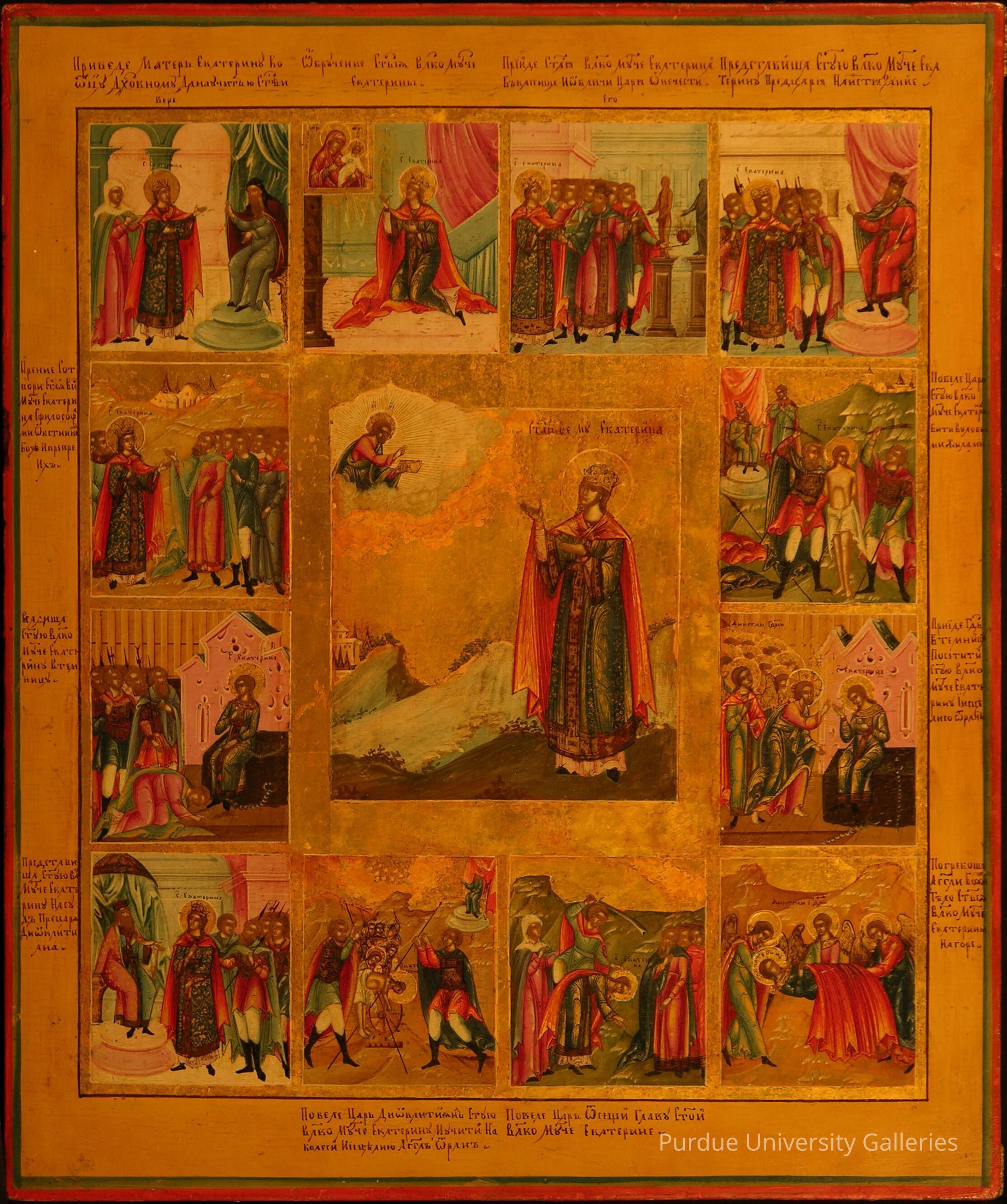
Tempera on curved wood panel with red, blue, and mustard yellow border. Black Cyrillic captions (12 total) are in the mustard yellow border on the outside of the scenes they represent. The middle image features a woman standing on dark rolling hills with small white castle in the back left. She wears a gold rounded crown in red cape, blue tunic with gold embellishments over pale pink gown looking to the left with both arms gesturing that direction. In the upper left corner is Christ in blue and pink robes in the clouds looking back and holding script & three finger blessing gesture towards the woman. Around this image are 12 smaller images depicting different scenes in the woman's (St. Catherine, labelled in each scene in black Cyrillic above her head) life with gold leaf halos.
Type of Painting
Panel
Artwork Details
Medium
Tempera
Collection
Betsy Scheuring Icon Collection
Acquisition
Accession
2005.02
Source or Donor
Betsy Scheuring
Acquisition Method
Gift
Credit Line
Gift of Betsy Scheuring
Made/Created
Date made
1800 - 1850
Place
* Untyped Place
Kostroma, Russia
Lexicon
Nomenclature 4.0
Nomenclature Secondary Object Term
Icon
Nomenclature Primary Object Term
Symbol, Religious
Nomenclature Sub-Class
Religious Objects
Nomenclature Class
Ceremonial Objects
Nomenclature Category
Category 08: Communication Objects
Dimensions
Height
13-1/2 in
Width
11-1/4 in
Depth
1-1/4 in
Exhibition
Spirit Made Tangible: The Scheuring Icon Collection (2006)
Interpretative Labels
Label Type
Cultural/Historical Context
Label
St. Catherine appears dressed as a princess with a crown and royal vestments, her hands lifted in prayer to Jesus, located above her in the clouds. She is standing in a rugged landscape with a building in the distance. The twelve scenes in the border tell the story of her life and martyrdom. According to legend, Catherine was a highly educated princess of Alexandria and a very devout Christian, who in a vision saw herself betrothed to the infant Christ. The emperor Maxentius (reigned 306-312) demanded that she renounce her faith, but she instead defeated his philosophers in argument and converted them to Christianity. Maxentius also tried to have her torn to pieces by two spiked wheels, but the wheels were struck by lightning and destroyed. Finally, Catherine was beheaded, and according to tradition, her remains were brought to the monastery at Mt. Sinai which bears her name. She is often shown with a broken wheel as her principal attribute.