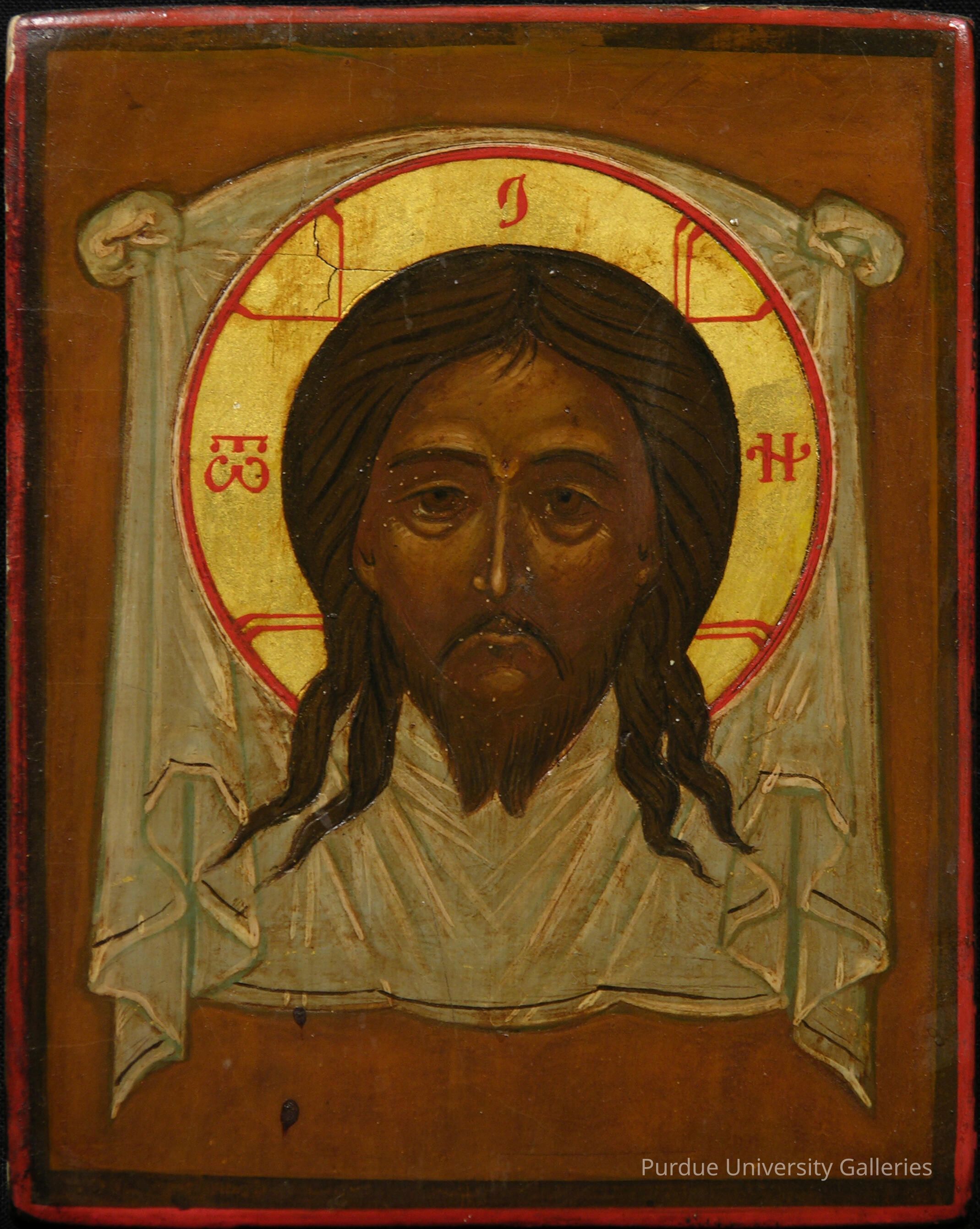
Tempera painting on wood panel with a red and brown border. The central image shows a portrait of Christ's head with long brown hair and beard with a gold leaf halo rimmed in red with Christ's initials in Church Slavonic. The image is shown on a background of white cloth. The reverse side wood is very cracked and chipping.
Type of Painting
Panel
Collection
Betsy Scheuring Icon Collection
Acquisition
Accession
2005.02
Source or Donor
Betsy Scheuring
Acquisition Method
Gift
Credit Line
Gift of Betsy Scheuring
Made/Created
Date made
1917 - 1950
Inscription/Signature/Marks
Type
Sticker
Location
Reverse of icon #48
Lexicon
Nomenclature 4.0
Nomenclature Secondary Object Term
Icon
Nomenclature Primary Object Term
Symbol, Religious
Nomenclature Sub-Class
Religious Objects
Nomenclature Class
Ceremonial Objects
Nomenclature Category
Category 08: Communication Objects
Dimensions
Height
4-3/4 in
Width
3-3/4 in
Exhibition
Spirit Made Tangible: The Scheuring Icon Collection (2006)
Interpretative Labels
Label Type
Cultural/Historical Context
Label
The image “Not Made By Hands” is often confused with the Roman Catholic story of St. Veronica’s veil. However, in the Eastern tradition this miraculous type of image came about when King Abgar of Edessa fell ill and sent a messenger to Jesus Christ, requesting healing. Jesus touched a cloth to his face, imprinting his image upon it and sent it to the King. Abgar was healed by the cloth, but still maintained some of his former illness until Thaddeus (a disciple of Christ) baptized him. This image of the Holy Mandylion was executed in a traditional Byzantine style. Both the head of Christ and the cloth on which it appears are highly formalized with a linear emphasis. In the image, no attempt has been made to suggest significant depth or model the form three-dimensionally. The image of Christ’s face appears against a gold and red halo that bears the abbreviated Greek form of this name. The Image Not Made by Human Hands was a popular subject with the Russian Army.