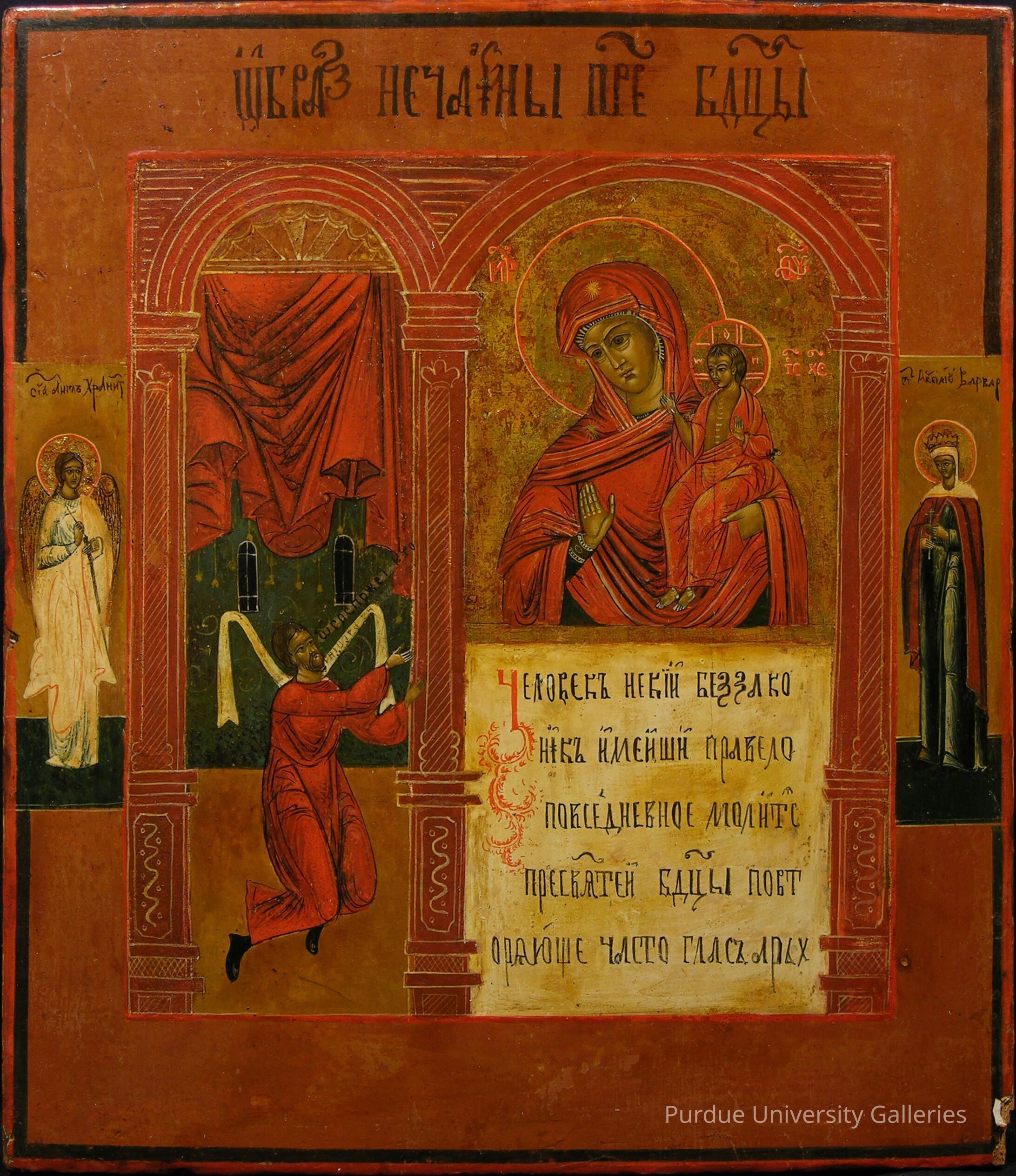
Tempera on curved wooden panel bordered in red and black. A black Church Slavonic caption sits in the top center, and angel clothed in white stands in the left margins, and a woman with a crown stands in the right margin. The central image shows a man in red robes kneeling on a backdrop of green building with red curtains. Opposite of him, the Virgin is shown from the waist up clothes in red robes holding a bare chested Christ child. Both of them face the left, and are on a gold leaf background. The back of this piece is full of little holes.
Type of Painting
Panel
Artwork Details
Medium
Tempera
Collection
Betsy Scheuring Icon Collection
Acquisition
Accession
2005.02
Source or Donor
Betsy Scheuring
Acquisition Method
Gift
Credit Line
Gift of Betsy Scheuring
Made/Created
Date made
circa 1900
Place
* Untyped Place
Central Russia
Lexicon
Nomenclature 4.0
Nomenclature Secondary Object Term
Icon
Nomenclature Primary Object Term
Symbol, Religious
Nomenclature Sub-Class
Religious Objects
Nomenclature Class
Ceremonial Objects
Nomenclature Category
Category 08: Communication Objects
Dimensions
Height
13-5/8 in
Width
11-13/16 in
Depth
1-3/4 in
Exhibition
Spirit Made Tangible: The Scheuring Icon Collection (2006)
Interpretative Labels
Label Type
Cultural/Historical Context
Label
The beginning of the story which this icon type depicts is noted in an inscription below the Virgin: “A certain lawless man had a daily rule to pray to the Most Holy Mother of God with the words of the Archangel’s greeting: Hail, Blessed One…” The scene shows a sinful man falling to his knees before a large painting of the Virgin and Child inside a building. He sees the image in the painting move and the Child bleeding from the wounds of his future Passion. The words “Who has done this?” come out of his mouth. The sinner repents and is forgiven, and there is unexpected joy. This version of the scene includes two family saints: a guardian angel on the left and St. Barbara on the right. One sees columns and arches that frame the scene and represent the interior of the building where the action takes place. There also appears an open window with abundant drapery, through which the windows and façade of another structure are observed.