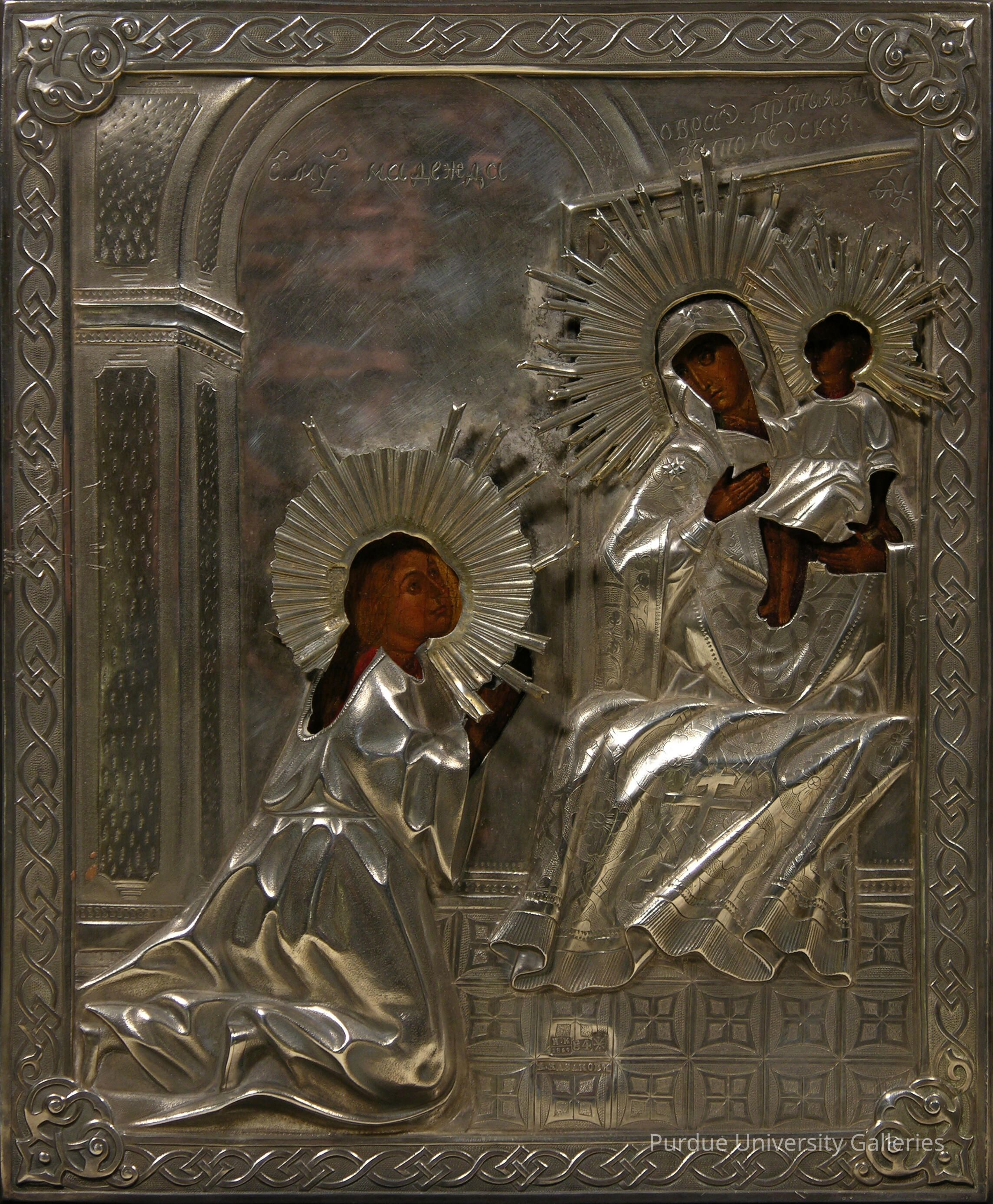
Vision of the Enthroned Mother of God (“Vatopedskaya” type)
Entry/Object ID
2005.02.110
Description
Flat painted wood panel with riza. The riza is iridescent in color and features a diamond and loop motif along the outer edge. There is Cyrillic script captioning in the upper center and right within a onion dome shaped home interior. On the right, Mary sits on a throne with the Christ Child. They both have spiked metal halos with painted faces and hands; Christ's legs are also painted. Mary's riza robe is adorned in floral motifs with the Orthodox cross at the bottom hem. In the center of the image, a female figure kneels with flat hands in prayer, plain robes, and a partially broken metal halo. On the left of both women's halos are several makers marks, and these are repeated in the center of the parquet style floor.
Type of Painting
Panel
Collection
Betsy Scheuring Icon Collection
Acquisition
Accession
2005.02
Source or Donor
Betsy Scheuring
Acquisition Method
Gift
Credit Line
Gift of Betsy Scheuring
Made/Created
Artist
Axazakov
Date made
1850 - 1875
Place
* Untyped Place
St. Petersburg, Russia
Inscription/Signature/Marks
Type
Makers Mark
Location
1. On the left of both women's halos
2. In the bottom center of the parquet floor
Transcription
1. Crossed anchor and grapnel crest symbolizing St. Petersburg, ИК 1869, A.K.
2.ИК 1869, 84, St. Petersburg crest, A. KA(S?)AKOB
Language
Cyrillic
Translation
1. St. Petersburg, I.K. 1869, A.K.
2. I.K. 1869, 84, Axazakov?
Lexicon
Nomenclature 4.0
Nomenclature Secondary Object Term
Icon
Nomenclature Primary Object Term
Symbol, Religious
Nomenclature Sub-Class
Religious Objects
Nomenclature Class
Ceremonial Objects
Nomenclature Category
Category 08: Communication Objects
Dimensions
Height
10-5/8 in
Width
8-3/4 in
Exhibition
Spirit Made Tangible: The Scheuring Icon Collection (2006)
Interpretative Labels
Label Type
Cultural/Historical Context
Label
The scene depicts a vision of the enthroned Mother of God, beheld by a kneeling saint in the left foreground, most likely to be identified as Saint Mary Magdalene This individual, whose halo has the same radiate form as those of the Virgin and Christ child, turns her head in three-quarter view so we may see the gentle expression. The gesturing Virgin is of the “Hodegetria” type, shown full-length. We are struck by the fully “westernized” setting in which the scenes takes place, with clear effects of linear perspective in the arched opening of the background and the diagonal placement of the enthroned Virgin. The riza not only reveals the flesh parts of the figures but also the long hair of the kneeling saint.