Note
73, Oct 1991, p. 50. (R8)
Monitoring Times, Dec 1996, p. 49. (R8A)
Monitoring Times, Dec 1997, p. 3. (R8A)
Highly regarded by amateurs and shortwave listeners, the R8 series was known for its exceptional sensitivity, high dynamic range, and robust build quality.
There were three versions of the R8:
1. Drake R8 (Original)
Production: 1991–1996
– The Blueprint: The initial entry that brought Drake back into the high-end consumer shortwave market. It featured a clean, simplified front panel and 100 memory channels.
– The Quirk: Its interface leaned on a "carousel" style button layout. To change operating modes or bandwidth filters, you had to cycle forward through them one by one. If you accidentally skipped the mode you wanted, you had to press the button multiple times to loop back around.
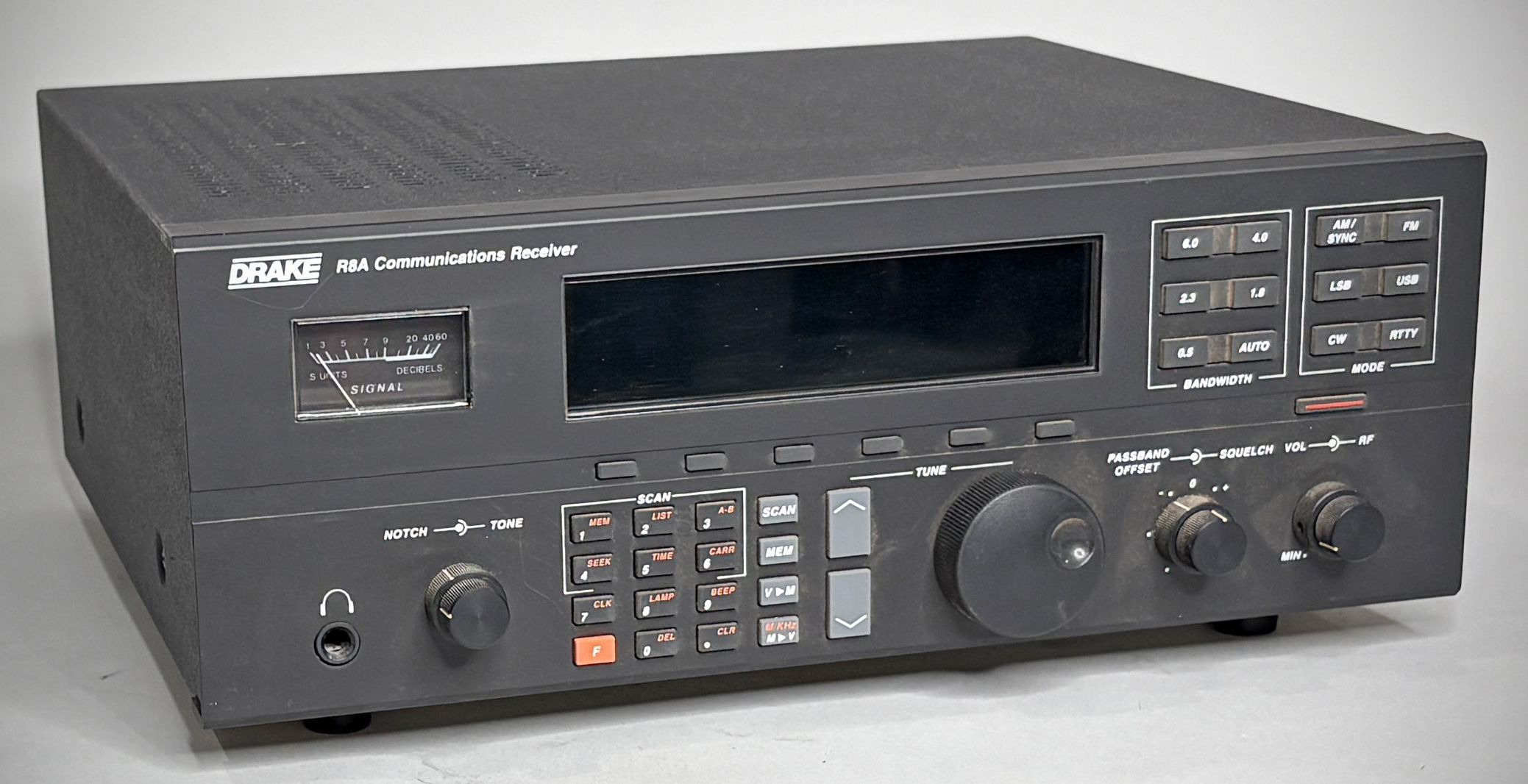
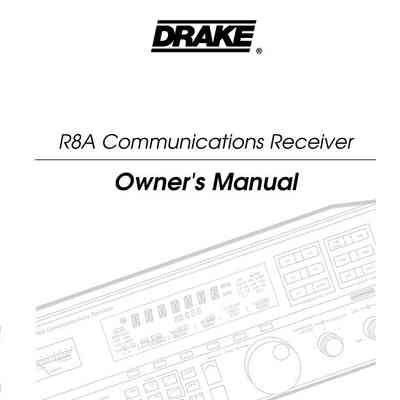
2. Drake R8A
Production: 1996–1997
– Interface Fixes: Drake completely overhauled the front panel ergonomics based on user feedback. The carousel buttons were replaced with six dedicated buttons each for direct, one-press access to all filters and operating modes.
– Memory Boost: Memory storage was dramatically upgraded from 100 slots to 440 alphanumeric channels, allowing users to name their favorite stations.
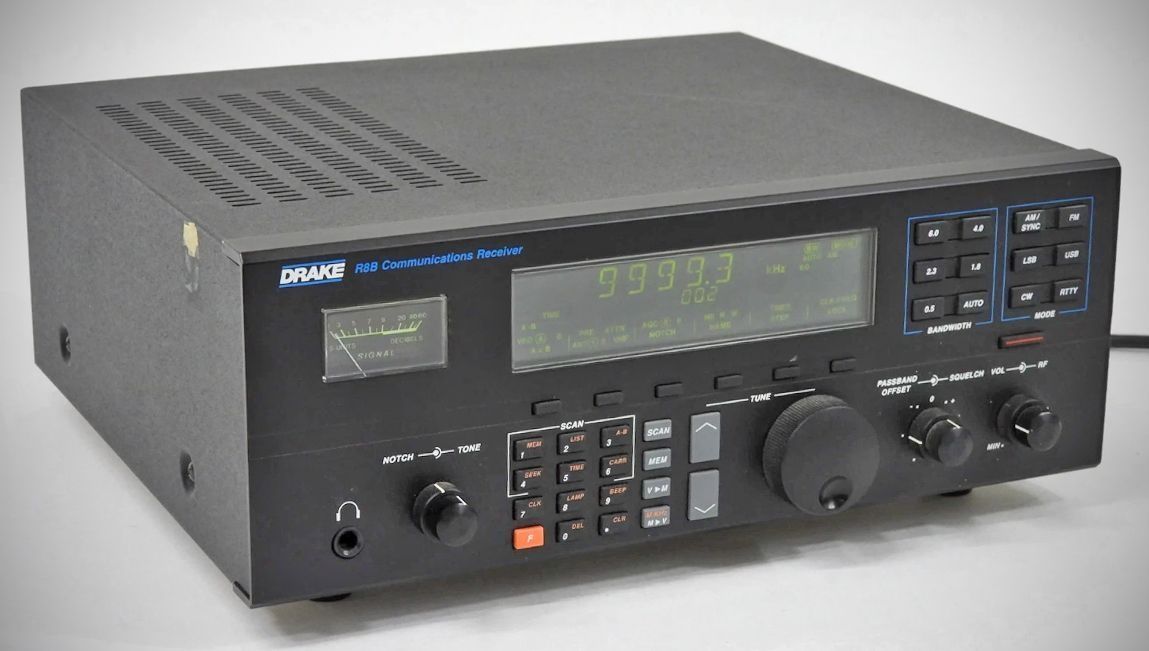
3. Drake R8B
Production: 1997–2005
– The Pinnacle: Widely considered the ultimate version of the radio and a premier DXing machine.
– Dual Sideband Synchronous Detection: The synchronous detector was upgraded to allow independent selection of either the upper or lower sideband, which effectively permitted users to completely slice out interference from a neighboring station on a nearby frequency.
– Maximum Storage: Memory expanded to a massive 1,000 alphanumeric channels.
Features of the R8 Series
Every model in the R8 lineup shared a foundation designed for demanding world-band listening:
– Frequency Range: 100 kHz to 30 MHz (covering longwave, mediumwave/AM, and shortwave bands), with an optional internal VHF converter expanding coverage to 35–55 MHz and 108–174 MHz.
– Multi-Mode Reception: Native support for AM, FM (narrowband), USB, LSB, CW, and RTTY.
– Advanced Signal Processing: Equipped with a Passband Offset control to slide interference out of the listening window, a Notch filter to kill annoying background tones, and a selectable synchronous detector to clean up fading AM signals.
– Optional VHF converter covers 35–55 MHz and 108–174 MHz.
Specifications
Note: These specifications apply to the R8A
– Frequency Range: 100–30,000 kHz
– Modes: AM, LSB, USB, CW, RTTY, FM
– Frequency Stability: 5ppm, $-10^\circ$ to $+50^\circ$ Celsius
– Frequency Accuracy: Better than $\pm$100 Hz, $-10^\circ$ to $+50^\circ$ Celsius
Ultimate Selectivity: Greater than 95 dB
Image Rejection: Greater than 80 dB, 100–30,000 kHz
IF Rejection: Greater than 80 dB at 45 MHz (1st IF)
Greater than 100 dB at 50 kHz (2nd IF)
Intermediate Frequencies (IF): 1st IF: 45 MHz
2nd IF: 50 kHz
Dynamic Range: 97 dB, 100–30,000 kHz @ 100 kHz spacing
IP (Intercept Point): (with preamplifier off)
+20 dBm @ 100 kHz spacing
$-20$ dBm @ 5 kHz spacing
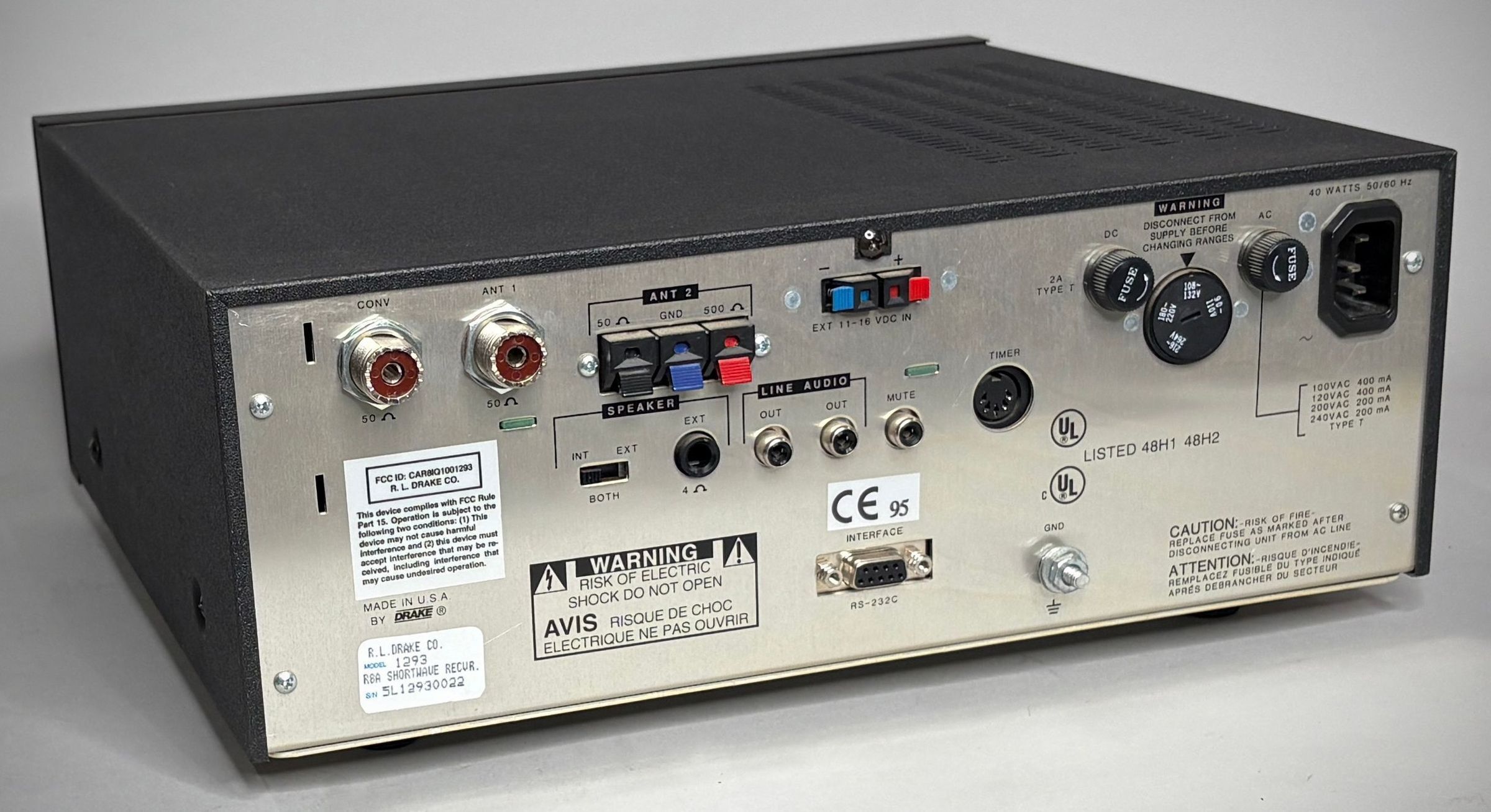
Antenna Inputs:
Ant 1, Converter: 50 Ohms unbalanced
Ant 2: 50 or 500 Ohms unbalanced
Notch Filter Attenuation: AF type, 40 dB minimum depth (500–5000 Hz)
Operating Temperature: $-10^\circ$ to $+50^\circ$ Celsius
### Sensitivity Specs (100–30,000 kHz)
SSB, CW (10 dB S+N/N): 0.5 $\mu$V nominal (preamplifier off)
Less than 0.25 $\mu$V (preamplifier on)
AM (10 dB S+N/N, 1000 Hz, 30% modulation): 1.5 $\mu$V nominal (preamplifier off)
Less than 1.0 $\mu$V (preamplifier on)
FM (12 dB SINAD): Less than 0.5 $\mu$V
### Selectivity (Bandwidth Settings)
6.0 kHz: @ $-6$ dB, less than 12 kHz @ $-60$ dB
4.0 kHz: @ $-6$ dB, less than 8 kHz @ $-60$ dB
2.3 kHz: @ $-6$ dB, less than 4.5 kHz @ $-60$ dB
1.8 kHz: @ $-6$ dB, less than 3.6 kHz @ $-60$ dB
500 Hz: @ $-6$ dB, less than 1.5 kHz @ $-60$ dB
12 kHz (FM Only): @ $-6$ dB, less than 25 kHz @ $-60$ dB
### AGC Characteristics
Threshold: 0.8 $\mu$V
Attack Time: 1 mS
Release Time: SLOW: 2 Seconds
FAST: 300 mSec
Audio Output Stability: Nominal 6 dB change in audio output for a 100 dB input change above the AGC threshold
### Audio & Power Requirements
External Speaker Output: 2.5 Watts into 4 Ohms @ less than 5% distortion
Line Outputs: 300 mV into 4.7K Ohms
AC Power Requirements: 100/120/200/240 VAC, $\pm$10%, 50 or 60 Hz, 40 Watts nominal
DC Power Requirements: 11–16 VDC @ 2A
### Physical Dimensions
Weight: 13 lbs. (5.9 Kg)
Size: Width: $13\ \frac{1}{8}$ inches (33.4 cm)
Height: $5\ \frac{1}{4}$ inches (13.4 cm) including feet
Depth: 13 inches (33 cm) including front knobs and rear connectors
Options
If a buyer wanted to add the optional internal VHF converter board (which opened up coverage for 35–55 MHz and 108–174 MHz), it typically tacked another $250+ onto the final receipt.
Review. 73, Oct 1991, p. 50. (R8)